
303907 Evaluation of Surface Modified Thin Film Composite Membranes of Varying Permselectivites for Pressure Retarded Osmosis
Pressure retarded osmosis (PRO) is an renewable energy technology to harness latent energy of concentration gradients, operating from the constant pressure volumetric increase of a concentrated draw solution under a hydraulic pressure less than its osmotic pressure. By relieving this pressure through a hydroturbine it becomes possible to convert the volume change of the draw solution into mechanical or electrical energy[1, 2]. There have long been attempts to develop higher performance membranes for use in PRO.
Thin film composite membranes offer a breadth of permselectivities readily available from commercial vendors. These membranes are based off a three tiered structure consisting of a selective layer, a phase inverted porous polymer mid-layer, and a non-woven fabric support layer. The selective layer is typically formed on a hydrophobic polymer such as polysulfone (PSu) or polyethersulfone. Early studies using conventional TFC membranes observed poor water flux in osmotic flow. This was later determined to be a result of the characteristic hydrophobicity of the PSu mid-layer. The hydrophobicity of this layer reduces flux in osmotic flow because of a lack of wetting throughout the pore structure[3]. Since the pore structure does not completely wet, the effective porosity of the support is reduced and internal concentration polarization is enhanced through reduced solute transport through the PSu .
A previous study by Arena revealed that dramatic improvement in osmotic flux performance in conventional reverse osmosis membranes is achievable through a chemical modification of the support layer with polydopamine (PDA)[4]. PDA is a hydrophilic polymer with similar characteristics to the adhesive secretions of mussels. It self-polymerizes from dopamine in an oxygenated solution, typically between pH 8.5-9.0, on surfaces exposed to the polymerizing aqueous bath. A thin film of PDA forms on the internal structure of the membrane, increasing its hydrophobicity and overall wettability of the membrane's support structure. The polydopamine modification coating presents a stable and permanent chemical modification, increasing the hydrophilicity of the porous polymer support layer without altering conventional TFC membrane fabrication process or selectivity.
A number of PDA modified membranes were tested in zero pressure differential pressure retarded and reverse osmosis to examine the role of PDA deposition on permselectivity and osmotic flux performance. Contact angle was used to characterize changes in hydrophilicity before and after PDA modification. The modified membranes exhibit 5-10 fold increases in osmotic water flux relative to the native membranes while retaining the high selectivity that is expected of these membranes. A rigorous model was used to determine structural parameters for these membranes and to correct for small differences within the internal structure of these membranes.
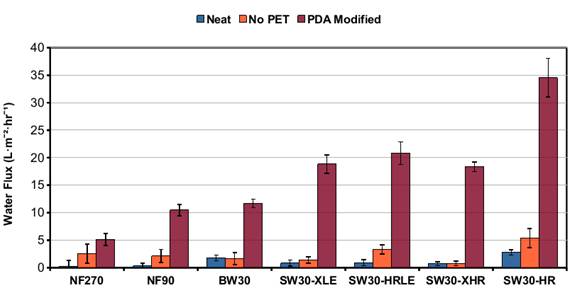
Figure 1: Water flux for various NF and RO membranes with a 1.0 M NaCl draw solution
Works Cited
[1] Cath TY, Childress AE & Elimelech M. Forward osmosis: principles, applications, and recent developments. Journal of Membrane Science (2006) 281: pp. 70-87.
[2] Achilli A, Cath TY & Childress AE. Power generation with pressure retarded osmosis: an experimental and theoretical investigation. Journal of Membrane Science (2009) 343: pp. 42-52.
[3] McCutcheon JR & Elimelech M. Influence of membrane support layer hydrophobicity on water flux in osmotically driven membrane processes. Journal of Membrane Science (2008) 318: pp. 458-466.
[4] Arena JT, McCloskey BD, Freeman BD & McCutcheon JR. Surface modification of thin film composite membrane support layers with polydopamine: enabling use of reverse osmosis membranes in pressure retarded osmosis. Journal of Membrane Science (2011) 375: pp. 55-62.
See more of this Group/Topical: Poster Submissions