
307463 Functional Reconstitution and Characterization Artificial WATER Channels For Desalination
Functional reconstitution and characterization artificial water channels for desalination
Yue-xiao Shen1, Erol Licsandru2, Mihail Barboiu2, Manish Kumar*1
1Department of Chemical Engineering, Pennsylvania State Univerity, University Park, PA, 16802, USA
2Institut Europeen des Membranes, ENSCM-UMII-UMR CNRS 5635, Place Eugene Bataillon CC047, Montpellier, 34095, France
*Corresponding author: 155 Fenske Laboratory, Pennsylvania State Univerity, University Park, PA, 16802, USA, (814) 865-7519, manish.kumar@psu.edu
 Artificial
water channels mimicking water-channel proteins known as aquaporins present in
biological membranes could be basic
materials robust as well as efficient desalination membranes. Aquaporins
have high water permeability but may be challenging to stabilize in synthetic
systems used for applications. Imidazole
compounds with urea ribbons can self-assemble into tubular architectures,
mutually stabilized by strong hydrogen bonding with inner water in the solid
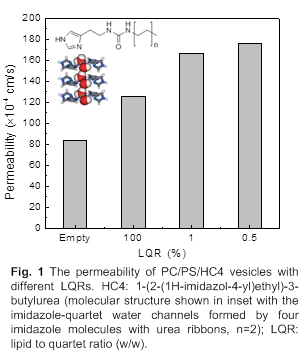
state (Fig. 1 inset).1 These
compounds also self assemble in lipid bilayers and behave like natural water
channels, which indicates that imidazole quartet may have potential to be an
applicable water channel for sensors or separation. We are conducting a
comprehensive evaluation of the water transport properties of these imidazole-quartet
channels using stopped-flow light scattering.2 Fig. 1 shows permeability data of lipid (PC/PS)
and lipid-quartet channel (PC/PS/HC4) vesicles at different lipid-to-quartet
ratios (LQR, w/w). When the imidazole compound ratio increased, the permeability
of vesicles increased indicating the activity of the water channel.
In addition, we are reconstituting these channnels into block copolymer membranes at high packing
density, as ideal materials for desalination membranes.2
References
1 Le Duc, Y. et al. Angew. Chem. Int. Ed. 50, 11366-11372 (2011).
2 Kumar, M. et al. J. Amer. Chem. Soc. 134, 18631-18637 (2012).
Emails: Yuexiao Shen (yxs174@psu.edu), Erol Licsandru (erol.licsandru@gmail.com), Mihai Barboiu (Mihail-Dumitru.Barboiu@univ-montp2.fr), Manish Kumar (manish.kumar@psu.edu).
See more of this Group/Topical: Poster Submissions