

Effect of potassium on highly dispersed iron nanoparticles support on carbon for CO hydrogenation
1Department
of Chemical engineering, Norwegian University of Science and Technology, NO-7491,
Trondheim, Norway 1. Introduction In this work we employ
an iron-carbon based catalyst (Fe-C) derived from pyrolysis of iron-containing
polymers, with a narrow size distribution of iron particles. The effect of
potassium promotion on CO hydrogenation is investigated
using Steady-State Isotopic Transient Kinetic Analysis (SSITKA). 2. Experimental The supported Fe
nanoparticles were investigated by powder X-ray diffraction (XRD) (Bruker D8
Advance Da Vinci, Cu Kα, 20-80 2θ, V6 slit) and
Transmission Electron Microscopy (200k eV, Tecnai).
The apparent surface areas of the catalysts were measured by N2-physisorption
(Tristar-3020) applying the BET-equation, while Fe and K loadings were
determined by ICP-MS (ELEMENT 2). SSITKA experiments were carried out in a fixed-bed quartz reactor (44 mm i.d.). 150 mg of the catalyst (90-253 μm) was mixed with 150 mg of
inert silicon carbide of the same fraction, to improve heat transfer in the
reactor. The catalyst was reduced in H2/Ar (10/10 mL/min) with a
ramping rate of 3º min-1 to 350°C. After 2
hours of reduction, the temperature was reduced to
340°C, and syngas H2/CO/Ar (15/3/7 mL/min) was introduced along with
a pressure increase to 1.85 bar. The reactants and products were recorded with
an online gas chromatograph (GC) equipped with a TCD and FID. After 12 hours on
stream, an isotopic switch from H2/12CO/Ar to H2/13CO/Kr
was performed, and the isotopic transient response was
recorded with a Balmer QMG-422 quadrupole mass
spectrometer (MS). A 16-loop storage was also used during
isotopic switching, and subsequently analyzed with a GC-MS. The isotopic
distribution of C2-C4 hydrocarbons was
calculated by linear combination of the fragmentation patterns of the
corresponding isotopic products. [3] 3. Results and
discussion Sample Iron phase Fe particle size Surface area Fe loading K loading Fe-C_0.0 Fe3O4 + Fe 3.05 353 30.0 0.0 Fe-C_0.2 Fe3O4 + Fe - 350 31.5 0.2 The CO hydrogenation
results show a relatively low selectivity towards methane given a H2:CO ratio of 5.0 and 1.85 bar pressure, and also
good selectivity towards lower olefins (25-27% of total carbon, 45-51% of total
hydrocarbons) (Table 2.). The potassium promotion leads to slightly higher
olefin selectivity, but also lowers overall activity. The CO2 selectivity is also higher for the promoted sample,
indicating higher WGS rates. Table 2. Selectivity at 340ºC, H2/CO
ratio of 5 after reaching steady state (16 h), averaged over 8
analysis.
XCO CH4 C2-4p C2-4o C5+ CO2 C2 o/p C3 o/p C4 o/p Fe-C_0.0 7.4 16.0 7.9 24.9 8.8 44.5 1.9 5.7 6.5 Fe-C_0.2 6.2 15.7 7.5 26.9 5.2 47.1 2.2 6.4 6.5 The SSITKA technique is able to measure site coverage
and residence time of the intermediates, and therefore it is very powerful technique
to distinguish the contribution of the two on the overall reaction rate. The
residence time and site coverages of CO, CHx,
C2H4, C3H6 and C4H8
intermediates are shown in Table 3. Table 3. Residence times and site coverages of unlabeled
species when switching from 12CO to 13CO. CH4
and CO measurements were performed 4 times with MS,
while C2-C4 results are from one GC-MS loop analysis. All
residence times are corrected for the chromatographic
effect of Ar, and hydrocarbons are corrected by ½τCO. A
dispersion of 10% was assumed for both samples when
calculating surface coverages. Standard errors for the last digit are listed in parenthesis where applicable.
τCO τCHx τC2o τC3o τC4o θCO θCHx θC2o θC3o θC4o Fe-C_0.0 1.5(3) 12.5(5) 87.0 77.3 90.7 0.040(7) 0.0043(2) 0.019 0.015 0.008 Fe-C_0.2 2.2(3) 11.8(3) 74.7 67.1 81.1 0.058(9) 0.0032(1) 0.014 0.011 0.006 The effect of potassium promotion has
been debated; it has been suggested to act as an electronic promotor through
donation of negative charge, or to cause blocking of active sites. The effect could be differentiated by comparing the effect of potassium
on residence times and site coverages. The difference between the two samples
show a greater relative difference in CHx
and olefin site coverage than residence time. These results suggest that
electronic changes relating to surface adsorption are small, while the sites
coverages are more severely reduced. The dispersion is
important in the calculation of site coverage, and here we have assumed it to be equal for both catalyst. If the additional pyrolysis
step performed on the promoted sample influences particle size, the comparison
of site coverages falls short. When performing a
switch from 12CO to 13CO, the iron carbides will
gradually increase the amount of interstitial 13C over time. The
process of exchanging one isotope of interstitial carbon with another is a much
slower process than exchanging surface species. With a Mars-van Krevelen like
mechanism, one would expect a lingering effect on the isotopic product
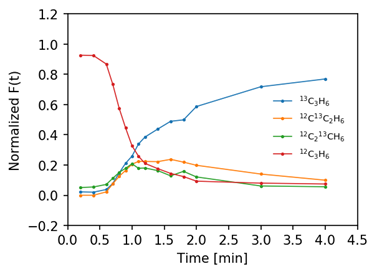
distribution. Here we observe a slow depletion of isotopic products, as seen on
the left in Figure 1 with C3-olefins for the unpromoted catalyst,
where particularly 12C13C2H6
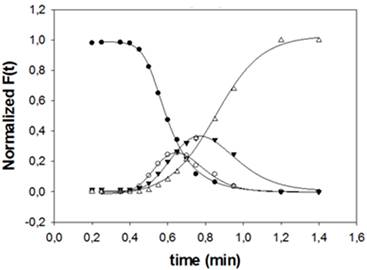
still have a relatively significant contribution until 4 minutes. In cobalt
where the active phase is mainly metallic, one would expect the depletion to be
much quicker. This is illustrated in Figure 1 with the Fe-C_0.0 to the left,
and 20 wt.%Co 0.5 wt.%Re/ γ-Al2O3 from Ledesma et al.
on the right. [3] From these results it would appear
that a Mars-van Krevelen-like mechanism is present, but it isn’t apparent to
what degree it contributes to the overall activity. At CO hydrogenation
conditions, the effect of 0.2 wt. % potassium promotion
is not very significant. To confirm the observed effect, higher loadings
(0.6 wt. %, 1.0 wt. %) of potassium will be tested to
observe greater differences on the effect of promotion. In addition, we plan to
investigate the effect of the pyrolysis treatment with operando XRD and
EXAFS to investigate the nature of the iron particles. Figure 1. Isotopic distribution of C3-olefin products
for the Fe-C_0.0 and a 20 wt.%Co
0.5 wt.%Re/ γ-Al2O3
catalyst. [3] 4. Conclusion 5. References [1] Ordomsky
V.V, Legras B, Cheng K, Paul S, Khodakov
A.Y. Role of carbon atoms of supported iron carbides in Fischer-Tropsch
Synthesis. Catal. Sci. Technol., 2015; 5,
1433-1437.
2SINTEF Materials and Chemistry, N-7463 Trondheim, Norway
* Corresponding author: jia.yang@ntnu.no
Fischer-Tropsch synthesis is a versatile process in terms of hydrocarbon
production. Cobalt and iron are the most commonly employed catalysts in
industry, where the former is used for long-chain
paraffin production and the latter for wax formation as well as olefin
production, depending on operation temperature. Iron also has the added benefit
of water-gas shift (WGS) activity, utilizing the H2O by-product to
form additional H2, thus enabling the use of H2/CO lower
than the stoichiometric number of the reaction. The role of the different iron phases
present during reaction remains controversial, but the presence of iron
carbides are clearly linked with high FTS activity.
The bulk carbon from iron carbides might participate in a Mars-van
Krevelen-like reaction, as suggested by both experimental work and DFT. [1,2]
The unpromoted catalyst was prepared by pyrolysis of
iron-containing polymers, resulting in iron nanoparticles with a narrow size
distribution in a carbon matrix. Potassium promotion was
introduced by subsequent incipient wetness impregnation of unpromoted
catalyst with an aqueous solution of KHCO3. The sample was dried, then pyrolyzed in N2 at
500°C, with a ramp rate of 2°/min and dwell for 4 hours.
The loading of the base catalyst (Fe-C_0.0) was 30 wt. %,
with iron nanoparticles (Fe3O4 + Fe) well dispersed
(average size of 3 nm) in a porous carbon matrix (350 m2g-1).
The ICP-MS results confirmed that the desired potassium loading was achieved. These results are summarized
in Table 1.
Table 1. Physical characterization
[nm]
[m2g-1]
[wt. %]
[wt. %]
[%]
[%]
[%]
[%]
[%]
[%]
[s]
[s]
[s]
[s]
[s]
The addition of
potassium lowers methane selectivity and enhances olefin selectivity slightly,
which is reflected in the residence times and surface coverages, with the
largest observed impact on the surface coverages. The slow decay of 12C
in the product distribution seem to indicate that a Mars-van Krevelen-like
mechanism is present.
[2] Gracia J.M, Prinsloo
F.F., Niemantsverdriet J.W. Mars-van Krevelen-like
Mechanism of CO Hydrogenation on an Iron Carbide Surface. Catal.
Lett. 2009; 133, 257-261
[3] Ledesma C, Yang J, Blekkan E.A, Holmen A, Chen D.
Carbon Number Dependence of Reaction Mechanism and Kinetics in CO Hydrogenation
on a Co-Based Catalyst. ACS Catalysis. 2016;
6(10):6674-6686.
See more of this Group/Topical: General Submissions