

State-of-the-art catalyst SAPO-34 was tested for the reaction of Methanol-to-Hydrocarbons. In order to capture the rapidly changing product spectrum during deactivation, suitable test methods were developed at commercially relevant conditions. In order to follow the rapid deactivation of SAPO-34 in high time resolution, a fast spectroscopic method was used and evaluated by chemometrics.
1. Introduction
In this article we will focus on the Methanol-to-Hydrocarbons (MTH) reaction that has been thoroughly investigated with current state-of-the-art catalyst SAPO-34. This process represents a challenging application for parallel testing of catalysts which was met by appropriate test protocols and an advanced analytical setup to detect complex multi-component products in connection with a fully automated data evaluation.
2. Experimental
All experiments were carried out in 16-fold parallel fixed bed reactor systems. The unique process control guarantees constant pressure, flow, feed concentration and temperature (up to 570‹C) and allows sequential start-up of the reactors and product analysis. This means that catalysts with different deactivation time-scales can be compared at constant time-on-stream.
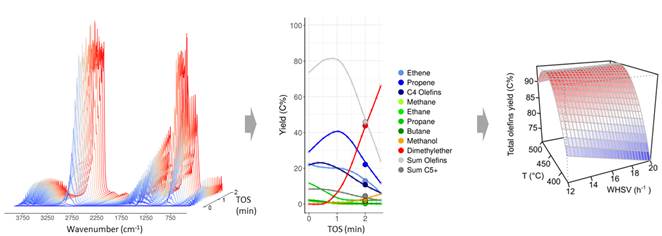
Figure 1. Data evaluation workflow from FTIR spectra (left) to chemometrical interpretation (middle) to regression of design of experiments DoE (right)
3. Results and discussion
The evolution and distribution of products on SAPO-34 was studied in a fixed-bed reactor at different severities ranging from 0.2-20 h−1. Thereby, the timescale of deactivation at low severities smaller 1 h−1 is slow enough for online GC to give detailed information on changes of the product distribution and the reaction network. However, at higher and commercially relevant severities > 1 h−1 the timescale of deactivation becomes too fast to be adequately followed by online GC. In order to follow the rapidly changing reaction products, FTIR spectroscopy in the gas-phase was applied in measurement intervals down to 5 s. Multivariate analysis of the FTIR spectra and correlation to the online product analysis by GC was used for in-situ training of chemometrical models for all major products between C1-C5 . These models were used for the prediction of product selectivities from the FTIR spectra in high time resolution giving insights into the product formation during incubation, selectivation and deactivation period of the catalyst.
Partially burning-off the coke-on-catalyst indicated that the remaining coke-on-catalyst is linked to the product distribution and that a certain selectivation by coke is required to yield the maximum olefin selectivity. Finally, the temperature and WHSV were varied in a small design of experiments (DoE) showing the influence of these parameters on selectivity and conversion capacity.
4. Conclusions
Testing of catalysts with fast decay can be done in parallel fixed-beds by starting up reactors sequentially and comparing conversion and yields during TOS. More recently, catalysts can be tested at short contact times under high severity conditions using a fast analytical setup.
References
1. C. D. Chang, Catal. Rev.-Sci. Eng. 1983, 25, 1.
2. U. Olsbye, , S. Svelle, M. Bjørgen, P. Beato, T. V. W. Janssens, F. Joensen, S. Bordiga, K. P. Lillerud, Angew. Chem. Int. Ed. 2012, 51, 5810.