

Selective oxidation of methane to methanol on Cu/SBA-15 via a stepwise manner
Ha V. Le1,2, Samira Parishan3, Anton Sagaltchik4, Hamideh Ahi4,5, Annette Trunschke5, Reinhard Schomäcker3, Arne Thomas1
1Institute of Chemistry-Functional Materials, Technische Universitat Berlin, BA2, Hardenbergstraße 40, 10623 Berlin, Germany
2Faculty of Chemical Engineering, Ho Chi Minh City University of Technology (VNU–HCM), Building B2, Ly Thuong Kiet Street 268, District 10, 700910 Ho Chi Minh City, Vietnam
3Institute of Chemistry-Technical Chemistry, Technische Universitat Berlin, TC8, Straße des 17. Juni 124, 10623 Berlin, Germany
4BasCat-UniCat BASF Joint Lab, Technische Universitat Berlin, EW K 01, Hardenbergstraße 36, 10623 Berlin, Germany
5Department of Inorganic Chemistry, Fritz Haber Institute of the Max Planck Society, Faradayweg 4-6, 14195 Berlin, Germany
Abundant and cheap resources containing methane such as natural gas, methane hydrates, and biogas have been considered as promising alternatives to decline the dependence of chemical and energy industries on crude oil. However, unsafe and costly transportation and storage, and high chemical inertness of methane cause an underutilization of these resources at present.[1, 2, 3] The direct conversion of methane to more energy-dense liquid derivatives such as methanol is an economically efficient protocol to promote the application of methane. Although great interest and numerous efforts have been devoted to the hydroxylation of methane, unfortunately, the development of a commercially viable catalytic process with a high yield of methanol remains unsolved.[4]
Inspired by prototype natural machines, namely, Fe- and Cu-dependent methane monooxygenase enzymes (MMOs) in methanotrophic bacteria, in the last decades, several Cu- and Fe-exchanged zeolites have been applied as heterogeneous catalysts for the methane-to-methanol conversion due to their ability to activate methane at low temperatures and reveal high selectivity to methanol. This is typically achieved in a stepwise process, in which the catalyst is first oxidized in O2 or N2O at high temperatures (> 200 °C), and then reacts with methane at lower temperatures (≤ 200 °C). The final transformation of the formed intermediate bound on the catalyst surface to methanol should be performed via a treatment with water.[5-9] As the so far most active catalysts, Cu/zeolites have been intensively studied to identify possible structures of active Cu sites and the catalytic mechanisms, finally obtaining improved performances.[10, 11]
|
|
Figure 1. Mass spectral (MS) signals of products after interaction of Cu/SBA-15 with methane at 200 oC, followed by online extraction in a water-saturated He flow. | Figure 2. MS signals of DME extracted from Cu/SBA-15 in the online stage at room temperature using different solvents. |
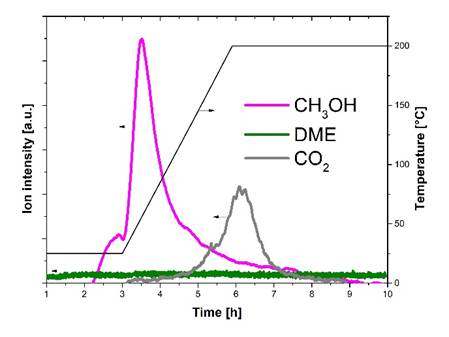
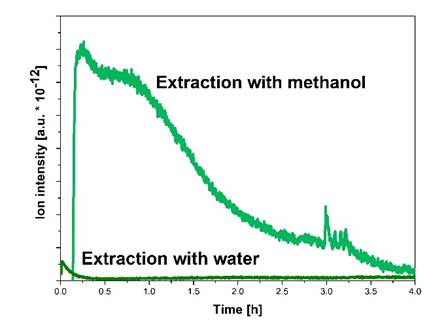
To expand the Cu-containing catalytic material class for the O2-mediated hydroxylation of methane, instead of zeolite, a highly ordered mesoporous silica type, i.e. SBA-15, was used as a support for Cu-based species. Our study proves that highly dispersed CuO species on SBA-15 are able to react with methane and subsequently produce methanol with high selectivity (> 84%) via water-assisted extraction (Figure 1). Furthermore, it is confirmed that the main intermediate formed after interaction of the catalyst with methane is indeed a methoxy species, which can be further converted to methanol or dimethyl ether (DME) upon extraction with water or methanol, respectively (Figure 2).[12]
|
|
|
Figure 3. In situ UV-vis spectra of CuO/SBA-15 after activation in O2 at 550 °C and subsequent reaction with methane at 200 °C. |
| Figure 4. TEM image of Cu/SBA-15.
|
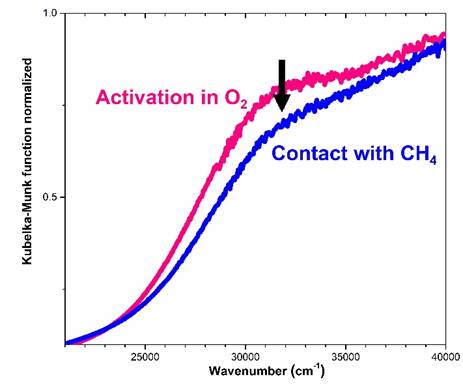
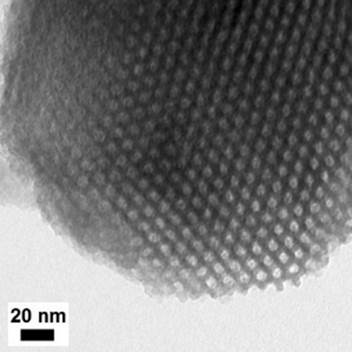
The reactivity of the Cu-based species on SBA-15 with methane was further demonstrated by in situ UV-vis spectroscopic measurements, in which intensity of the band centered at 32 000 cm-1 increased by activation in O2 at 550 °C and significantly decreased upon contact with methane (Figure 3) at 200 °C. Unlike the Cu-oxo complexes in Cu/zeolites previously proposed as the active sites for activation of methane, the catalytic activity of Cu/SBA-15 is attributed to small CuO nanoclusters that are highly dispersed throughout the SBA-15 framework (Figure 4). Based on this demonstration, it might be worthwhile to further test various porous silica forms or other materials as supports for Cu-base species for the challenging direct conversion of methane to methanol.[12]
References
[1] C. Hammond, S. Conrad, and I. Hermans, ChemSusChem 2012, 5, 1668.
[2] P. Schwach, X. Pan, and X. Bao, Chem. Rev. 2017, 117, 8497.
[3] P. Tomkins, M. Ranocchiari, and J. A. van Bokhoven, Acc. Chem. Res. 2017, 50, 418.
[4] V. L. Sushkevich, D. Palagin, M. Ranocchiari, and J. A. van Bokhoven, Science 2017, 356, 523.
[5] J. M. Bollinger Jr, Nature 2010, 465, 40.
[7] R. Banerjee, Y. Proshlyakov, J. D. Lipscomb, and D. A. Proshlyakov, Nature 2015, 518, 431.
[8] M. H. Groothaert, P. J. Smeets, B. F. Sels, P. A. Jacobs, and R. A. Schoonheydt, J. Am. Chem. Soc. 2005, 127, 1394.
[8] E. V. Starokon, M. V. Parfenov, L. V. Pirutko, S. I. Abornev, and G. I. Panov, J. Phys. Chem. C 2011, 115, 2155.
[9] N. V. Beznis, A. N. C. van Laak, B. M. Weckhuysen, and J. H. Bitter, Microporous Mesoporous Mater. 2011, 138, 176.
[10] M. Ravi, M. Ranocchiari, and J.A. van Bokhoven, Angew. Chem., Int. Ed. 2017, 56, 16464.
[11] H. V. Le, S. Parishan, A. Sagaltchik, C. Göbel, C. Schlesiger, W. Malzer, A. Trunschke, R. Schomäcker, and A. Thomas, ACS Catal. 2017, 7, 1403.
[12] H. V. Le, S. Parishan, A. Sagaltchik, H. Ahi, A. Trunschke, R. Schomäcker, and A. Thomas, Chem. Eur. J. 2018, 24, 12592.
See more of this Group/Topical: General Submissions