

Methanol is an extremely important chemical component, with a worldwide production capacity exceeding 100 Mtpa. It can be produced in a highly selective manner from synthesis gas, which in turn is available from a large variety of carbonaceous feedstocks. Methanol has a large range of applications. It is a starting material in the production of formaldehyde, acetic acid, dimethyl ether, or hydrocarbons via several MTX processes. It can also be used as a fuel or fuel additive and can also serve as an energy carrier in fuel cells. With these properties, methanol can play a pivotal role in an energy and chemical economy.
The industrial production of methanol from synthesis gas is a well-established process. Nevertheless, there is an ongoing need for process related research to test established or new catalyst formulations for the suitability with new feedstocks, and to find regions in the process parameter space with improved productivity or stability.
In this contribution, we present a study of a commercial methanol catalyst that was carried out under industrially relevant conditions (CO2 ranging from 0 – 6 vol.-%, GHSV 3150 – 13000 h-1, temperature 200 – 250 °C, pressure 40 bar) in a bench scale test system. The catalyst was tested both in once through mode and in recycle mode. In the latter case, a variable fraction of the reactor effluent was fed back to the reactor inlet and, together with fresh feed gas, passed over the catalyst bed again.
In once through mode, the CO2 concentration, the space velocity, and the reaction temperature were varied. In the kinetically controlled regime (210-230 °C), the methanol formation rate was mainly determined by the reaction temperature. At higher temperatures (around 250 °C), the methanol formation rate final reached a broad maximum and then started to decrease, indicating operation at thermodynamic control. The formation rates of byproducts (methane, DME, higher alcohols) started to increase. However, the selectivity towards methanol remained on a high level (> 99%)
A special emphasis will be out on the results obtained in recycle mode. Operation in recycle mode dramatically increases the atom efficiency and the productivity of the process. Due to the back feeding of the condenser effluent to the reactor inlet, only a small fraction of the fed synthesis gas leaves the reactor system unconverted. On the other hand, the recycle operation increases the complexity of controlling the process parameters and keeping the entire reactor system in a productivity-maximized steady state. Overall, stable steady state operation was achieved both in once-through and recycle mode, with a maximum productivity of 1 g(MeOH)/(g(Cat)/h observed in recycle mode.
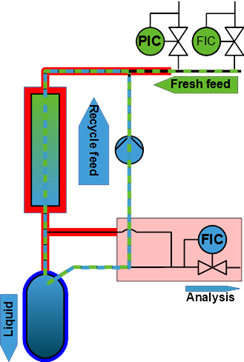
Figure 1. Once Through Mode
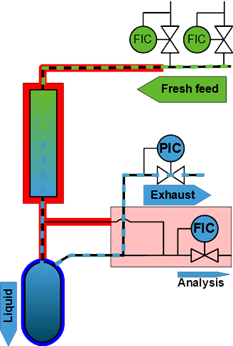
Figure 2. Recycle Mode
See more of this Group/Topical: General Submissions