

One-pass tunable formation of chemicals or super-clean fuels via syngas conversion: precise design of multiple functional catalysts
Noritatsu Tsubaki
Department of Applied Chemistry, School of Engineering, University of Toyama, Gofuku 3190, Toyama 930-8555, Japan
Corresponding authors: tsubaki@eng.u-toyama.ac.jp
The ongoing depletion of finite petroleum resources and emphasis on sustainable development compels humanity to seek new routes to energy supplement. In various transformation processes, catalytic conversion of syngas to chemicals or super-clean fuels is a promising and powerful approach. Thereinto, the formation of syngas produced from nonpetroleum sources such as natural gas, coal and biomass, can be viewed as a green process. Hence, directly converting syngas to ideal target products has become the focus of research, especially achieving directional transformation. Given the product distribution from syngas conversion occurring on Fischer-Tropsch catalysts (i.e. iron or/and cobalt, etc.), is limited by the Anderson-Schulz-Flory (ASF) distribution, precise control of chain propagation process or regulation of chain length is a huge challenge. Single-type active site does not well meet the requirements for catalytic performance, and then multifunctional catalysts (oxide-zeolite) containing several types of active sites are developed to overcome these problems. Using the synergistic catalysis between multiple active sites to achieve an excellent performance, can preferably meet product diversity and selectivity.
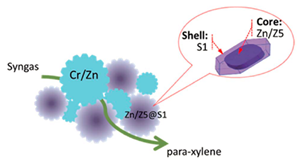
Figure 1 Illustration of the one-pass selective conversion of syngas to para-xylene over the designed hybrid catalyst Cr/ZnOx¨CZn/Z5@S1.
Part I: Based on the above considerations, we fabricate a promising multifunctional catalyst, named Cr/ZnOx-Zn/Z5@S1, to effectively realize the one-pass conversion of syngas to para-xylene, as shown in Figure 1. This hybrid catalyst exhibited enhanced activity on syngas conversion (CO conversion of 55.0%), good stability of catalyst lifetime and considerable selectivity of para-xylene (27.6% in the total products and 77.3% in xylene). The characterization and catalytic performance evaluation revealed that the well-designed Zn/Z5@S1 zeolite capsule catalyst, as a vital part of this Cr/Zn-Zn/Z5@S1 hybrid catalyst, substantially contributed to its extreme performance for the para-xylene one-pass precise synthesis from syngas. The concerted combination of two components in this hybrid catalyst can effectively depress the formation of unwanted by-products and facilitate the oriented synthesis of para-xylene from syngas with unprecedented efficiency at the same time (1).
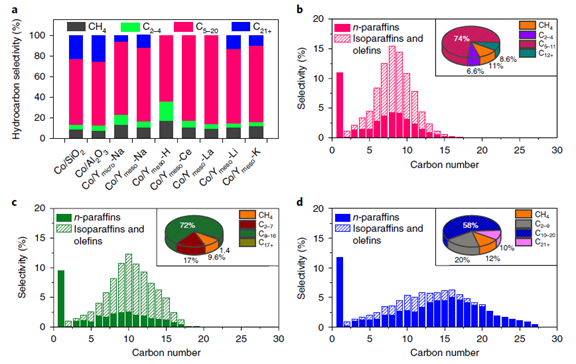
Figure 2 a) Fischer-Tropsch performance over the catalysts with conventional supports or Ymeso zeolites. (b-d) Detailed product distribution of Ymeso catalysts: Co/Ymeso-Ce (b), Co/Ymeso-La (c) and Co/Ymeso-K (d).
Part II: In general, liquid hydrocarbon fuels possess higher energy content compared with other fuels such as dimethyl ether, hydrogen, and so on. Moreover, super-clean Fischer-Tropsch-based fuels with a very low content of sulfur and aromatic compounds are more environmentally friendly than petroleum-based fuels. However, to control the products of Fischer-Tropsch synthesis distributing in a specified range (such as gasoline C5-11, jet fuel C8-16 or diesel fuel C10-20) is highly challenging. In order to break the limitation of ASF distribution, we present an integrated catalytic process for the direct conversion of syngas (CO/H2) into different types of liquid fuels without subsequent hydrorefining post-treatments of Fischer-Tropsch hydrocarbons. As for this integrated catalytic process, outstanding selectivities for gasoline, jet fuel and diesel fuel as high as 74, 72 and 58% are achieved, respectively, by only using mesoporous Y-type zeolites in combination with cobalt nanoparticles (Figure 2). The porous and acidic properties of Ymeso zeolites play two key roles in tuning the product distribution, thus the types of liquid fuels can be readily tuned by controlling the porosity and acid properties of the zeolites (2). A new Fischer-Tropsch products distribution model is also proposed to replace the classic ASF model.
References
(1) P. Zhang, L. Tan, G. Yang, N. Tsubaki, Chemical Science, Vol.8, 7941-7946, 2017
(2) J. Li, Y. He, L. Tan, P. Zhang, X. Peng, A. Oruganti, G. Yang, H. Abe, Y. Wang, N. Tsubaki, Nature Catalysis, Vol.1, 787-793, 2018
See more of this Group/Topical: General Submissions