

Halogen-Dependent Surface Confinement Governs Selective Alkane Functionalization to Olefins
Guido Zichittella,a Matthias Scharfe,a Begoña Puértolas,a Vladimir Paunović,a Patrick Hemberger,b Andras Bodi,b László Szentmiklósi,c Núria López,d and Javier Pérez-Ramíreza,*
a Institute for Chemical and Bioengineering, ETH Zurich, Switzerland
b Laboratory of Femtochemistry and Synchrotron Radiation, Paul Scherrer Institute, Switzerland
c Nuclear Analysis and Radiography Department, Hungarian Academy of Sciences, Hungary
d Institute of Chemical Research of Catalonia, The Barcelona Institute of Science and Technology, Spain
|
|
 The
large availability of natural gas, enhanced by recent discoveries of new
unconventional gas reservoirs, provides a strong incentive to consider this
resource as a key feedstock for energy and chemicals in the transition from the
oil to the renewables era.[1] A necessary cornerstone to meet this
great challenge is the in‑depth understanding of complex reaction
mechanisms over dynamic surfaces, allowing to elucidate catalyst design
criteria for selective alkane functionalization processes. A
prominent example is the oxyhalogenation of ethane over iron phosphate (FePO4)
in which a switch from HCl to
HBr results in distinct product distribution, ranging from virtually only
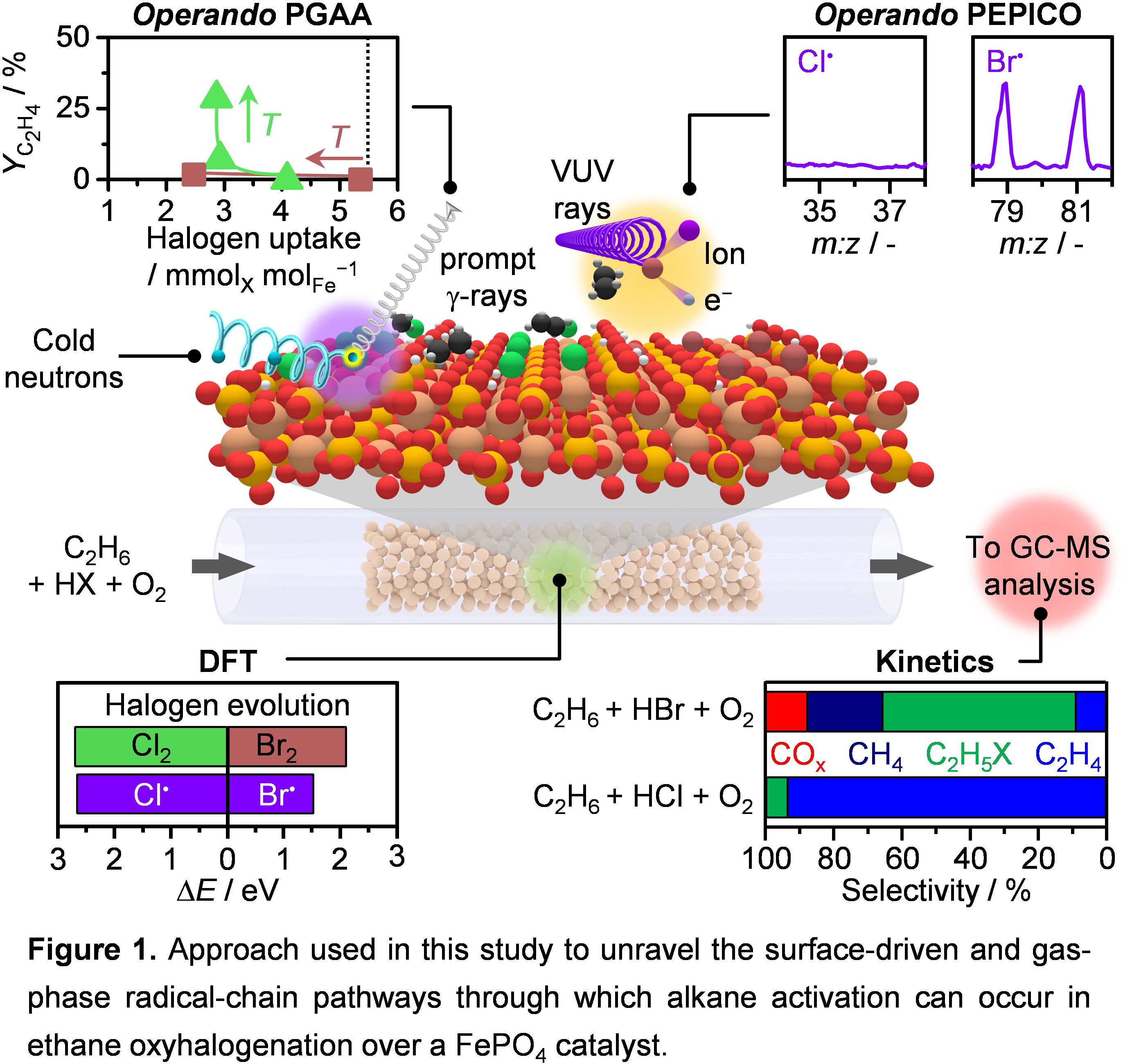
olefins to a mixture of alkyl bromide, cracking and combustion products (Figure 1, bottom left). The
quest for the mechanistic origin of these different selectivity patterns
remains unanswered due to the inability of most characterization techniques to accurately describe the complex dynamics of catalysts
under reaction conditions and to assess potential pathways that can occur in a
multi‑phase reaction environment, where surface‑catalyzed reactions
may coexist with gas-phase contributions.
We have resolved this “selectivity puzzle” by a multi-technique approach, combining evidence from steady-state kinetics, operando prompt-gamma activation analysis (PGAA) and photoelectron photoion coincidence (PEPICO) spectroscopies, ultimately rationalized by theoretical calculations (Figure 1). The sharp selectivity control in oxychlorination is achieved via a purely surface-driven functionalization of ethane into ethyl chloride, which is further dehydrochlorinated to ethylene over a Cl-Fe center, which account for ≥ 55% of the iron sites under reaction conditions (Figure 1, top right). In contrast, alkane activation to ethyl bromide in oxybromination mainly occurs in the gas-phase with bromine and bromine radical species that can evolve form the catalyst, as determined by PEPICO and rationalized by DFT (Figure 1, top left and bottom right, respectively), thus leaving a halogen-free surface that is more prone to additional cracking and combustion pathways. Our results provide a strategy to rationalize the mechanism of selective alkane functionalization, which can be extrapolated to other reactions where gas-phase contributions are of concern.
References
[1] R. Lin, A. P. Amrute, J. Pérez-Ramírez, Chem. Rev. 2017, 117, 4182‑4247.
Corresponding author email: jpr@chem.ethz.ch
See more of this Group/Topical: General Submissions