Wednesday, 26 April 2006 - 8:00 AM
166a
Simulation of Vibration-Induced Segregation of Equal-Sized Bronze and Glass Spheres
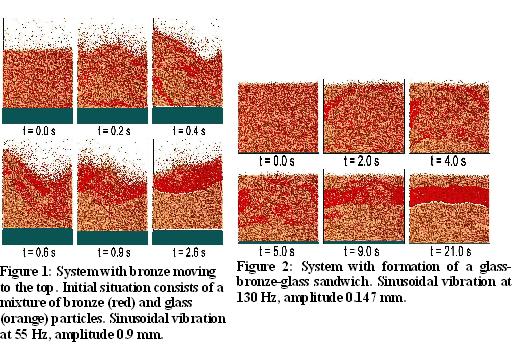
We report on extensive simulations of this system, using a hybrid model, where a molecular dynamics type method is used to account for the motion of the spheres (30 000 in total), and a computational fluid dynamics model is used to account for the flow of air in the system. There is a full two-way coupling between the solid and the gas phase. In general, we observe the same phenomena as in the experiments. Furthermore we find that the particle interaction parameters, such as the level of dissipation and surface friction in particle-particle collisions, have a clear influence on the segregation phenomena. In particular, for some shaking parameters (frequency and amplitude) we found that without friction, the bronze phase would move to the bottom, whereas with friction present a sandwich formation is formed with a bronze phase layer in the middle.
See more of #166 - Mixing and Segregation - II (TWD05)
See more of Topical W: Fifth World Congress on Particle Technology
See more of The 2006 Spring National Meeting