Wednesday, 26 April 2006 - 8:00 AM
163a
Drying of Crystals at Particle-Scale: Modelling and Tomographic Visualisation
Simultaneously, the development of the moisture content profiles during contact drying has been calculated. Liquid evaporation and capillary flow are determined by solving material and energy balances combined with the Volume-of-Fluid (VOF) method, which describes free interface (liquid menisci) propagation in a porous medium controlled by the requirements on the contact angle and the mean interface curvature. Output from the simulations is detailed distribution of the liquid phase within the porous medium as a function of time.
The temporally resolved 3D moisture distribution profiles obtained experimentally by XCMT for two different crystal particle assemblies under different drying regimes have then been directly compared with moisture distribution profiles generated by computer simulation in a computer-reconstructed porous medium having the same microstructure as the physical one. These studies can be used for the investigation of the effect of porous microstructure on drying kinetics.
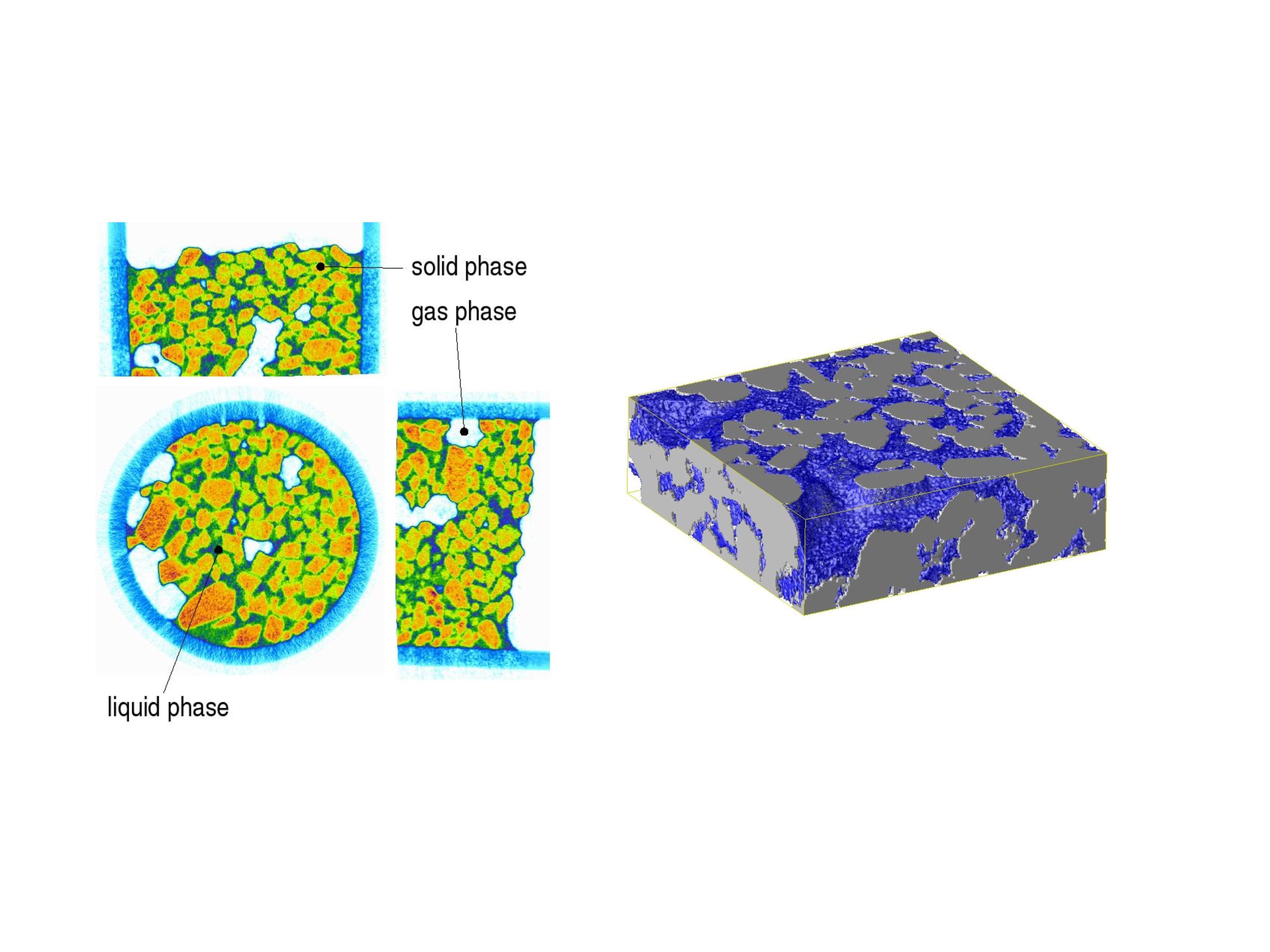
Figure 1: Illustration of tomography visualization technique of packed bed of crystals partially wetted by solvent: the cross-sections of the attenuation distribution obtained by XCMT (left) and 3D reconstruction (right).
See more of #163 - Dewatering and Drying (TWC15)
See more of Topical W: Fifth World Congress on Particle Technology
See more of The 2006 Spring National Meeting