Thursday, 27 April 2006 - 8:20 AM
251b
Permeation of Packed Beds Excited by Electric and Hydraulic Gradients
- In macroscale systems the only particle-particle interaction is the contact force resulting from the compression. In nanoscale packed beds, the particles interact via electrostatic repulsion, van-der-Waals attraction and Born's repulsion, as described by the DLVO theory. These forces determine the structure of nanoscale packed beds formed by filtration of particulate suspensions. Highly charged particles strongly repulse each other. This prevents agglomeration and leads to a packed bed with a dense structure and a homogenous pore size distribution. At low particle charge the particles agglomerate. They form a loosely packed bed with large pores between the agglomerates, which are responsible for the major part of the fluid transport.
- The fluid flow interacts with the particles via drag forces. On the nanoscale, the flow generates a streaming potential because the diffuse double layer is deformed and the particle charge is dislocated from the particle center. The streaming potential induces an electroosmotic backflow, which retards the permeation. This apparent rise of the fluid viscosity is called electroviscous effect.
- Field gradients acting on packed beds are gravitational and centrifugal fields, but the high flow resistance of nanoscale packed beds limits the permeation. However, the permeation can be assisted by the application of electric fields acting on the moveable ions in the diffuse part of the electrochemical double layer. When the ions are moved, the water starts to flow due to drag forces. This electroosmotic effect can also be used to pump liquids.
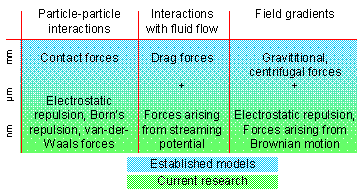
Figure 1: Overview of forces acting on particles and fluid in packed beds consisting of particles in different size ranges.
The combination of these phenomena can be described by the following equations [modified from Yeung & Mitchell 1993):
 (1)
 (2)
The volume flow rate  and the electric current I in a packed bed are linear functions of the pressure difference
 and the electric field strength E. The coefficients L11 to L22 are mainly influenced by the particle size and material, the compression of the packed bed,the pH value and the ionic strength of the liquid in the pores. L11 is the hydraulic permeability established by Darcy. L12 characterizes the electroosmotic flow. L21 is the coefficient for the conductive ion transport, which evokes the streaming potential. L22 is the electrical conductance of the packed bed comprising the surface conductance of the particles. Figure 2 shows the current and mass flow rate depending on voltage and pressure difference for a packed bed consisting of alumina with a primary particle size of 47 nm (NanoTek, Nanostructured & Amorphous Materials, Inc., Houston). The linearity and parallelism of the graphs shows the applicability of the abovementioned model at least in the range of low voltage.
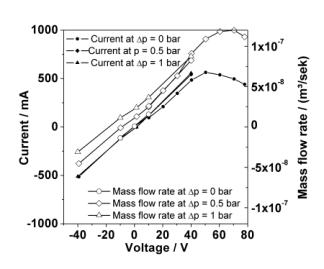
Figure 2: Current and mass flow rate depending on voltage and pressure difference for a packed bed consisting of alumina with a primary particle size of 47 nm (NanoTek, Nanostructured & Amorphous Materials, Inc., Houston)
References
Yeung A.T., Mitchell J.K., Coupled fluid, electrical and chemical flows in soil, Geotechnique 43 (1993) 121-134
See more of #251 - Solid/Liquid Separation - II (TWD16)
See more of Topical W: Fifth World Congress on Particle Technology
See more of The 2006 Spring National Meeting