
 Google
 Yelp
 Facebook
 Twitter
 ChEnected
211997 Insight Into the Application of Advanced Oxidative Method for Biosorbent Modification In Water Treatment Application
INSIGHT INTO THE APPLICATION OF ADVANCED OXIDATIVE METHOD FOR BIOSORBENT MODIFICATION IN WATER TREATMENT APPLICATION
Ofomaja, A.E., Naidoo E.B., and DLADLA, T.V.
Department of Chemistry, Vaal University of Technology, X021, VanderbiljPark, 1900 South Africa.
INTRODUCTION
Adsorption using waste/dead plant materials as adsorbent is receiving much attention in recent times due to its low value, natural abundance in nature, ability to remove pollutants at low concentrations e.t.c. Numerous research have been conducted to ascertain the potentials and applicability of water and wastewater treatment to eliminate pollutants such as heavy metals, colored compounds such as dyes, and organic pollutants. The results have indicated the promising ability for these materials to be applied as filters to replace or compliment several other expensive and advanced technologies.
Plant materials are usually made up cellulose, hemi-cellulose, lignin extractives, lipids, water, proteins, simple sugars, hydrocarbons, and starch along with other organic components (Ofomaja 2009). In their use as adsorbents, some plants materials are found to cause discoloration of the treated wastewater leading to increased chemical oxygen demand (COD), biological oxygen demand (BOD) and total organic carbon (TOC) levels (Gaballah et al., 1997). Several methods have been applied in the activation of these biomaterials to prevent leaching of colored organic pigments, some of which are treatment with base solutions (sodium hydroxide, calcium hydroxide, sodium carbonate) mineral and organic acid solutions (hydrochloric acid, nitric acid, sulfuric acid), have been reported in literature.
Oxidative methods have been
applied in the removal of organic pollutants from aqueous solution and soils
with success, these methods include; Wet oxidation and Catalytic wet oxidation
(Deepak et al., 2002), Ozone based oxidation (Bila et
al., 2005), Electrochemical oxidation (Deng and Englehardt, 2007) and Fenton's
oxidation (San
Sebastian et al., 2003). These advanced
oxidative method as there are called are effective due to the role of a highly
reactive radical intermediate such as hydroxyl radical (•OH) as an oxidant. With
an oxidation potential (E0
 ) of 2.80 mV, the •OH radical can
rapidly degrade recalcitrant organics such as aromatic, chlorinated, and
phenolic compounds (Parsons and Williams, 2004). Once a reaction of the free radical is initiated by ozone or H2O2,
a series of oxidation reactions occurs in the solution and the radicals rapidly
react with most of the target compounds.
In this report the Fenton oxidation is applied as a method for extracting organic colored components from Pine cone powder in its application as adsorbent for lead(II) from water.
METHODS:
Pine cone was collected from local plantation in South Africa, washed crushed and sieved to size below 90 μm. Fenton reagent was prepared at different ratios of Fe2+/H2O2 at room temperature and initial pH of 2.5. The effect of time and solid/liquid ratio was also determined at optimum Fe2+/H2O2.
The reaction steps involved as well as the optimum conditions for extraction with Fenton's reagent were monitored by the oxidation/reduction potential (ORP) of the mixture, the consumption of hydrogen ions (Δ pH) during reaction, acid value, surface charge, and surface functional groups.
RESULTS:
The results for the varying of Fe2+/H2O2 were conducted in two separate experiments. In the first experiment, Fe2+ concentration was fixed at 500 mg/L, while H2O2 concentration varied between 1000 to 140,000 mg/L. While in the second experiment, H2O2 concentration was fixed at 100,000 mg/L and Fe2+ concentration varied between 50 and 5000 mg/L. Figure 1 shows the results of both experiments.
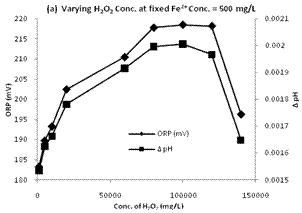
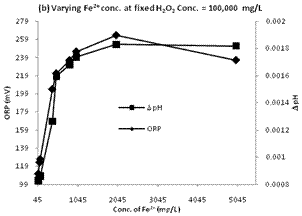
Fig. 1: Effect of varying (a) H2O2 on a fixed amount of Fe2+and (b)Fe2+ at fixed H2O2.
The results reveal that both Change in hydrogen ion consumption and ORP values changed as the Fe2+/H2O2 ratio changes reaching a maximum at similar point in the plots. This point was found to correspond with acid number determined the maximum value for surface charge and bulk density. The Fourier transform infrared (FTIR) spectra of the samples at different Fe2+/H2O2 ratios revealed that the no new chemical groups were formed, but an increase along with a slight shift in peaks at 3342.65 and 1607.57 cm-1 were observed. These observations along with the Scanning electron microscope (SEM) analysis suggest that the structural integrity of the samples were maintained after treatment. The reduction in bulk density of the activated samples and the sharp drop in COD of the treated water as compared to the raw pine cone indicates that extraction of large amounts of the organics causing discoloration have been achieved. Finally, higher lead(II) removal was achieved with the activated pine cone as compared with the raw sample.
DISCUSSION & CONCLUSIONS:
Argun et al. (2008) showed that the ORP values of were consistent with activation of pine cone. This study has also shown that both the ORP values and the consumption of hydrogen ions during the formation of the hydroxyl radical followed that same trend and can used to follow the activation process.

According to Argun et al. (2008), increase in porosity of the activated pine cones lead to increase in adsorption capacity. But in our study, it is suggested that Fenton activation did not only destroy the organic and increasing porosity, but oxidized the material producing additional acidic functional groups as was observed from the increasing values of acid number and the functional group determination. Varying the Fe2+/H2O2 increased these parameters to a maximum values at Fe2+/H2O2 = 0.01, and after this value these parameters were found to decrease. Therefore, maximum lead(II) removal was due to increased acid functional groups on the pine cone surface rather than increased porosity.
REFERENCES:
Argun, M.E., Dursun, S., Karatas, M., Gürü, M. Activation of pine cone using Fenton oxidation for Cd(II) and Pb(II) removal. Bioresource Technology, 99(2008) 8691-8698.
Bila, D.M., Montalvao, A.F., Silva, A.C., Dezotti, M. Ozonation of a landfill leachate: evaluation of toxicity removal and biodegradability improvement, Journal of Hazardous Materials 117(2005) 235–242.
Deepak, B.A., Suresh K.B., Irfan S., Jaidev P. Catalytic wet oxidation: an environmental solution for organic pollutant removal from paper and pulp industrial waste liquor . Applied Catalysis A: 236(2002) 255-262.
Deng, Y., Englehardt, J.D., Electrochemical oxidation for landfill leachate treatment. Waste Management, 27(2007) 380–388.
Gaballah, I., Goy, D., Allain, E., Kilbertus, G., Thauront, J. Recovery of copper through decontamination of synthetic solutions using modified barks, Met. Metall. Trans. B 28 (1997) 13–23.
Ofomaja A.E. Removal of transition metals from industrial wastewater using natural biosorbents. Doctoral Thesis submitted to Vaal University of Technology (2009).
Parsons S.A., Williams, M. Introduction: in Advanced Oxidation Processes for Water and Wastewater Treatment, S. A. Parsons, Ed., pp. 1–6, IWA Publishing, London, UK, 2004.
San Sebastian, N., Fernandez, J.F., Segura, X.F., Ferrer, A.S., Pre-oxidation of an extremely polluted industrial wastewater by the Fenton's reagent. Journal of Hazardous Materials 101(2003) 315–322.
See more of this Group/Topical: Environmental Division