
 Google
 Yelp
 Facebook
 Twitter
 ChEnected
212078 Nano-Structured Sorbents for Desulfurization of Biomass-Derived Syngas
Thermochemical conversion of biomass residue to syngas has recently gained considerable attention worldwide. Gasification of biomass, a thermochemical conversion, is particularly attractive as it can operate with a wide range in the quality and consistency of the feedstock, thus increasing the available feedstock, and reducing overall costs. Moreover, by achieving almost complete depolymerization of the source biomass to useful gaseous products like syngas, gasification is the only established technology that can make the most of the energy stored in the raw biomass.
However, on gasification, along with the syngas, gaseous impurities like sulfur containing species (H2S, COS), ammonia, alkali oxides, halides etc are also generated due to the volatile contaminants present in the biomass residue. Many downstream processes, like Fischer Tropsch synthesis, Solid Oxide Fuel Cells and methanol production, use catalysts that have little tolerance with gaseous contaminants. Transition metal / metal oxide catalysts, typically employed for such value-addition processes, are especially vulnerable to sulfur containing gaseous species like hydrogen sulfide. Therefore, before this raw syngas can be used for different downstream applications, it needs to be cleaned. Among the different processes used for H2S removal, wet amine scrubbing has been the most popular. However, such wet processes require comparatively low operating temperatures (35 - 55⁰C). The cleaned syngas has to be subsequently reheated for the downstream processes (300 - 800⁰C). Such consecutive cooling and heating can cause considerable thermal losses.
To avoid such energy losses, it is important to desulfurize the gas stream at suitably high temperatures. A solid-phase sulfur-sorbent material that has a high reactivity, good structural stability, and easy regenerability at such high temperatures can provide such an alternative. In past work, different bulk sorbents with different chemical and structural properties have been tried for high temperature desulfurization. However, in spite of numerous efforts to modify chemical and compositional properties, only a limited success has been achieved. It is due to sorbent's failure in meeting one or more of the aforementioned criteria. For instance, in the past, it has been demonstrated that due to mass transfer limitations, if a bulk sorbent gets completely sulfided, it is almost impossible to achieve complete regeneration afterwards, regardless of process's favorable thermodynamics and chemical kinetics. This incomplete regeneration, partly due to mass transfer limitation and subsequent loss of sorbent's surface area, leads to underutilization of the sorbent material, which is typically a transition or rare earth metal oxide. To overcome these limitations, it seems necessary that one needs to go beyond doing modifications in sorbent chemical composition.
One option that has been little explored involves integration of tailored design and morphology of the sorbent with the process's favorable kinetics. We will attempt to describe how the nanostructuring of sorbent can help in achieving improved sorbent performance for a process involving cyclic regeneration. Since the reaction time has been shown to be comparatively short, the approach here is to come up with a sorbent design that facilitates short contact time so that deep sulfidation of sorbent can be avoided without affecting the sulfur removal capacity. As this would require high gas velocity along with sorbent's high specific surface area, the use of conventional bulk sorbent will lead to incomplete regeneration and significant pressure drop. Sorbents with tailored designs and sizes, however, can help in overcoming such limitations. The criteria for such designs should be to maximize available specific surface area along with short diffusion lengths. Nanosizing of sorbent seems as a good alternative. However, sorbent in the form of nanopowders tend to aggregate and cause mass transfer limitations similar to bulk sorbents. On the other hand, nanostructures having high aspect ratio, like nanofibers, can remain isolated; thus, potentially providing a more suitable framework for carrying out frequent cyclic sulfidation-regeneration operation. These high aspect ratio nanoscale structures can not only retain the properties from their bulk form such as favorable thermodynamics, chemical affinity etc., but they also tend to develop useful properties due to highly anisotropic geometry and confined grain size. Because of the confinement of the grain size and short contacting time, nanofibers will tend to limit the large volume changes and accompanying grain boundary collisions which are typical during repeated sulfidation/regeneration. Thus, it is expected that the use of nanostructured sorbent will not only lead to high specific surface area and improved mass transfer, it can also lead to an improved mechanical behavior during high temperature cyclic operation.
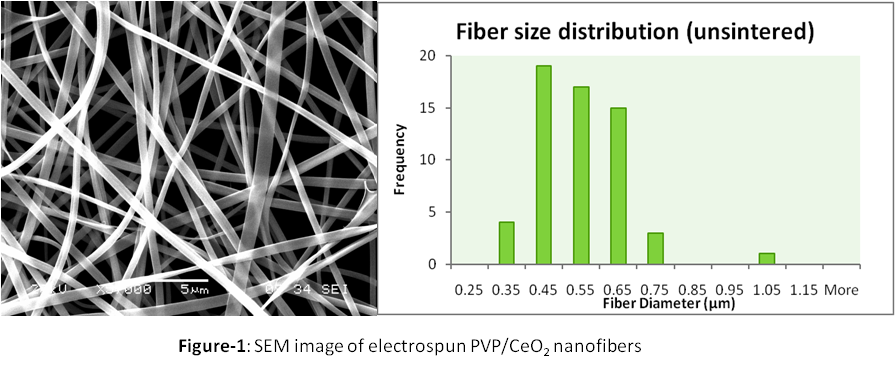
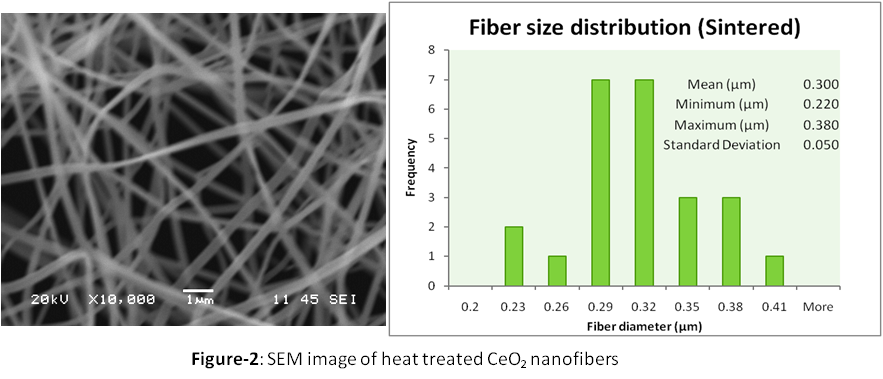
This work will present the results from the investigation of such high-aspect ratio nanofibers that were synthesized from rare-earth and transition metal oxides, namely, La2O3 CeO2, and Zn2TiO4 using the process of electrospinning. Salt solutions of the respective metals with PVP (Mw ~ 1300000) as the binding polymer were used to prepare the corresponding sol-gels, which were then used as the precursor solutions for electrospinning of the fibers. For PVP/CeO2 sol, the fibrous mats having an average fiber diameter of 497 nm were obtained (Fig-1). These fibers were then sintered at 600⁰C for 4.5 hrs to obtain metal oxide fibers, free from the polymeric binder. The average diameter for sintered fibers reduced to 300 nm (Fig-2). Fibers were subsequently tested for their reactivity, micro-structural changes, regenerability and high temperature durability during cyclic sulfidation-regeneration operation. After each cycle, the difference in the performance was characterized by measurements of specific surface area (BET), changes in surface morphology (SEM, TEM), sulfidation kinetics (TGA), crystal structure changes (XAFS, XRD) and variations in surface composition (XPS). The results from these tests can help in estimating the extent to which nanostructuring of sorbents can facilitate increase in sorbent life.
See more of this Group/Topical: Topical 5: University Research for Industry