
 Google
 Yelp
 Facebook
 Twitter
 ChEnected
212295 A Comprehensive Heat Transfer Model for the Fischer-Tropsch Tubular Fixed Bed Reactor
INTRODUCTION: The chemistry of the Fischer-Tropsch synthesis can be described as the polymerization of single carbon units on a catalytic site. The FTS reaction is highly exothermic and has an adiabatic temperature rise of up to 1750K. Efficient heat removal is of crucial importance because too high temperatures may lead to a loss in selectivity, possible thermal runaways and rapid deactivation of the catalyst. The investigation of the heat transfer and accurate heat transfer model are crucial when a tubular fixed bed reactor needs to be designed for this synthesis. The current heat transfer models are for classical packed bed reactors. When a fixed bed reactor is used for FTS, there may be liquid involved. A study from a colleague (Xiaojun Lu et al 2010) showed that water might be both in liquid and vapor phases under FT reaction conditions. The interaction between reaction, heat transfer, VLE, condensation, and boiling is very complex and is not covered in the current models. Thus, it would not be appropriate to apply these models in this situation. What we are attempting to do in this paper is to set up a heat transfer model, considering the heat transfer by the conduction mechanism and the condensation and evaporation of the material, to offer a better simulation for FT reactors.
METHODS: In this study, a tubular reactor with an inner diameter of 23 mm is used to investigate the radial heat transfer in a fixed bed FTS reactor with TiO2 supported cobalt catalyst (10% Co/90% TiO2, BET area 28.6 m2/g, average pore diameter 35.8 nm). Thermo-wells were built into the reactor at different radial positions as indicated in Figure 1. Thermocouples could be moved up and down to measure the temperature at different axial positions. Multiple heating jackets offered a flat axial temperature profile (<0.5C) under no flow conditions. FTS reaction was performed at typical low temperature FTS conditions. Different control temperatures and flow rates were chosen
The model being developed currently regards the heat transferred in the bed as a combination of the conduction mechanism and the heat flux due to the radial flow of the materials in the reactor as a consequence of condensation and evaporation that is governed by vapour liquid equilibrium.
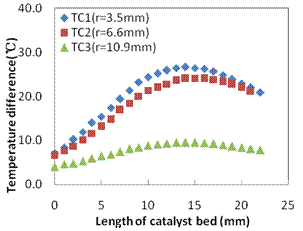
Fig.1: A temperature profile of the catalytic bed when the FT reaction took place (Twall=200oC, P=20bar, SV=2.25 NL/(h-gcat))
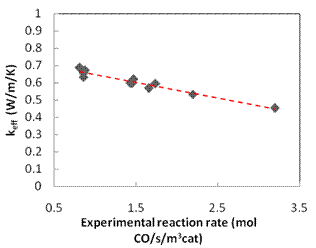
Fig. 2 The keff of the catalyst bed at different FT reaction rates
RESULTS: A two dimensional temperature profile of the catalyst bed is presented in Figure 1. When wall control temperature was at 200oC, the maximum temperature rise in the bed was as high as 27oC with a SV of 2.25 NL/(h-gcat). In Figure 2, calculated effective thermal conductivity coefficients (keff) of the catalyst bed are plotted in respect of the reaction rates that were derived at different reaction conditions. A higher reaction rate results in a lower keff.
DISCUSSION & CONCLUSIONS: The measured temperature profiles of the bed show that the temperature rise in the catalyst bed is very sensitive to the wall control temperature, and a small increment (from 200oC to 205oC) of Twall could make the maximum temperature rise increase from 27oC to 45oC. An obvious conclusion from the keff values derived for the different temperatures suggests that an assumption of constant heat transfer characteristics for the whole bed is not sufficient and even incorrect The complexity of the vapour liquid equilibrium and the condensation and evaporation of the products in different parts of the bed limits the application of the classic heat transfer model from the literature. The preliminary simulation shows promising results when using the model taking both the conduction and the heat flux carried by the side flow of the stream with condensation and evaporation into consideration.
References:
Xiaojun Lu, Diane Hildebrandt, and David Glasser
Study of Fischer-Tropsch Synthesis (FTS) in a Batch Reactor with TiO2 supported Co catalyst Abstract AIChE Spring Meeting 2010
See more of this Group/Topical: Topical 6: 11th Topical Conference on Gas Utilization