
Approved Alternative Control Device: VOC Biotreatment Technology
(As Required by NESHAPs [BWON, HON, MON, MACT]
and Other Regulations)
Dr. Carl E. Adams, Jr., PE, Senior Author/Presenter
Global Practice Area Leader: Industrial Wastewater Management,
ENVIRON International Corporation
Lial F. Tischler, Partner, Tischler/Kocurek, and
Andrew W. Edwards, PE, Principal, ENVIRON International Corporation
Need for Investigation
The USEPA National Emission Standards for Hazardous Air Pollutants (NESHAP) compliance regulations require 95 percent or greater removal of regulated Hazardous Air Pollutants (HAPs) in off-gas from storage vessels, process vents, and wastewater equipment. The BWON (Benzene Waste Operations NESHAP) regulations for refineries require 98 percent benzene removal or 95 percent total VOC removal. Previous to the effort discussed herein, the only Control Technologies, typically acceptable to the USEPA, were Vapor Phase Adsorption and Thermal Incineration, including Flares. Both control devices are capital and operationally expensive and generate high carbon footprints.
However, the rule allows implementation of an Alternative Control Device, subject to 98 percent benzene (95 percent VOC) removal and specified operating and monitoring conditions. This paper describes innovative protocols, developed by the authors and Marathon Petroleum Company (MPC) in Garyville, Louisiana, to certify that the activated sludge system was an Alternative Control Device that is cost-effective and has a minimal carbon footprint (Table 1).
Significance and Objectives of the Investigation
The major objective of the investigation was to develop bench-scale BOX Test and Core Column Simulation full-scale confirmation protocols and parameters, which delineate more realistic and reliable benzene biodegradation rates (fbio) than the typical EPA methodology and default rates. This effort has required modifying the recommended protocols and approach by the USEPA and obtaining their approval of data collection, testing methodology, and appropriate modeling techniques. Modification of typical, conventional protocols for both the BOX Test and the full-scale confirmation negated the required use of VOC biodegradation rate default values.
This benzene-biodegradation system was approved in writing by the State of Louisiana and accepted by the USEPA - Research Triangle, North Carolina. It is premised that any properly designed and operated activated sludge system can be qualified as an Alternative Control Device when developed with the protocols herein. The new Alternative Control Device at MPC will be fully operational in February 2011.
Modeling Techniques
The development of site-specific predictive models for wastewater processes involves a choice of two models, i.e., USEPA's WATER 9 or Toxchem+™. Toxchem+ is approved in 40 CFR Part 63 Appendix C and is preferred in the case of biodegradable VOC gaseous emissions for several reasons:
µ The Toxchem+ model allows introduction of target pollutants in gas streams as well as in aqueous wastewaters.
µ Toxchem+ assumes non-equilibrium conditions for vapor phase-liquid phase transfer.
µ Benzene biodegradation rate is the most important element of model.
µ Toxchem+ is very sensitive to modelers' expertise.
Findings of Investigation
The information provided herein summarizes the BOX Test and Full-Scale Confirmation testing objectives and achievement of benzene removal goals under maximum stress conditions. The following information confirms compliance with 40 CFR µ 61.340:
- ENVIRON has developed bench-scale BOX Test batch and Core Column Simulation full-scale confirmation protocols and parameters, which delineate more realistic and reliable benzene biodegradation rates (fbio) than the EPA default rates (Figures 1, 2, 3 & 4).
- The biorates, thus determined, are more representative of full-scale conditions than the typical USEPA approach.
- This effort has required modifying the typically recommended protocols and approach by the USEPA and obtaining their approval of data collection, testing methodology, and appropriate modeling techniques.
- The approach, presented herein, is an environmental-friendly, sustainable VOC Control Device
– Negligible additional energy usage
– Minimal carbon footprint
- The site-specific benzene biodegradation rate is 29.3 L / g VSS-hr @ 26 oC (22.6 L/gm-hr, @ 20 oC). See Figure 4 for modeling results using developed fbio.
- The activated sludge system configured herein provides excellent configuration and flexibility to achieve benzene removals >99+% even under benzene loadings >16 times projected operating design loadings(Table 2).
Table 1. Comparative Costs for Major VOC Control Devices at MPC-Garyville Refinery
| ||
Process Technology
| Cost-Effective Impact
| |
Capital cost ($)
| Annual Operating Cost ($)
| |
Thermal Oxidizer | $800,000 | $300,000 |
Granular Activated Carbon (6 carbon canisters on each of two API separators,22 change-outs/yr per API) | $240,000 | $500,000 |
Biological (piping, fans and connection to blowers) | $400,000 | Minimal |
Figure 1. Recommended Box Test Apparatus (57-L Volume)
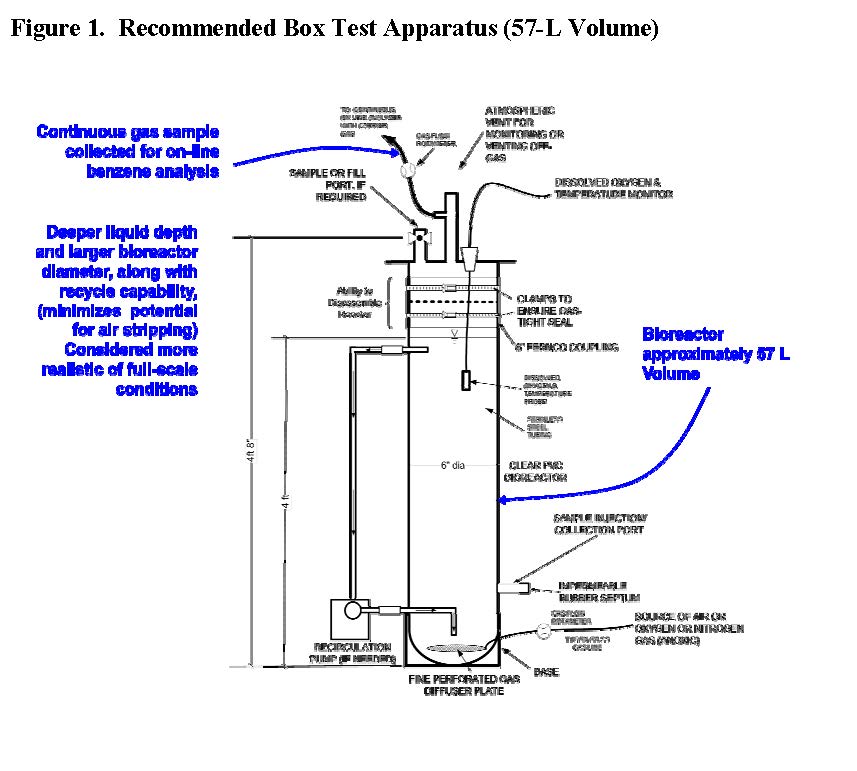
Figure 2. Combined Stripping and
Biodegradation Benzene Emissions
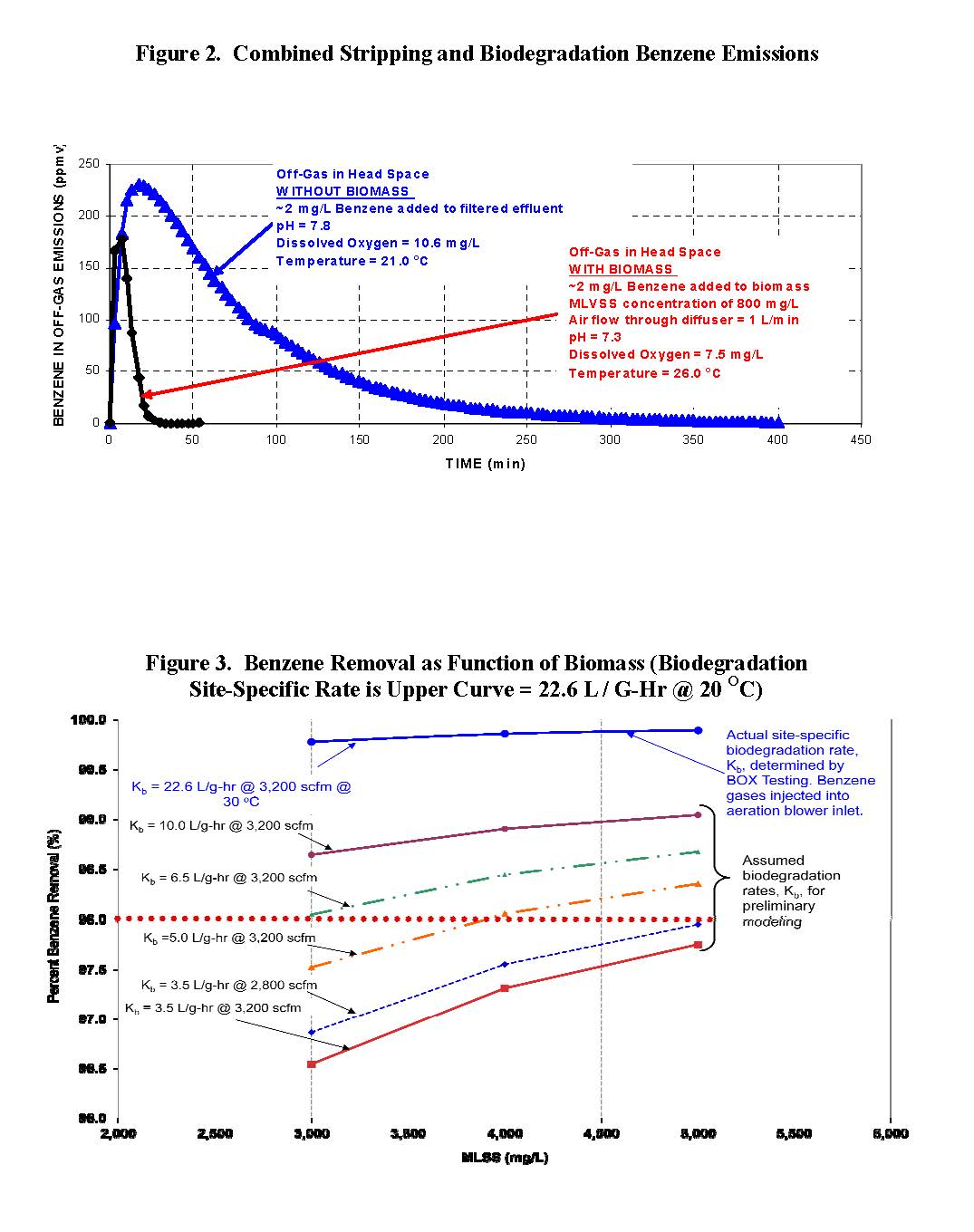
Figure 3. Benzene Removal as Function of Biomass (Biodegradation
Site-Specific Rate is Upper Curve = 22.6 L / G-Hr @ 20 OC)
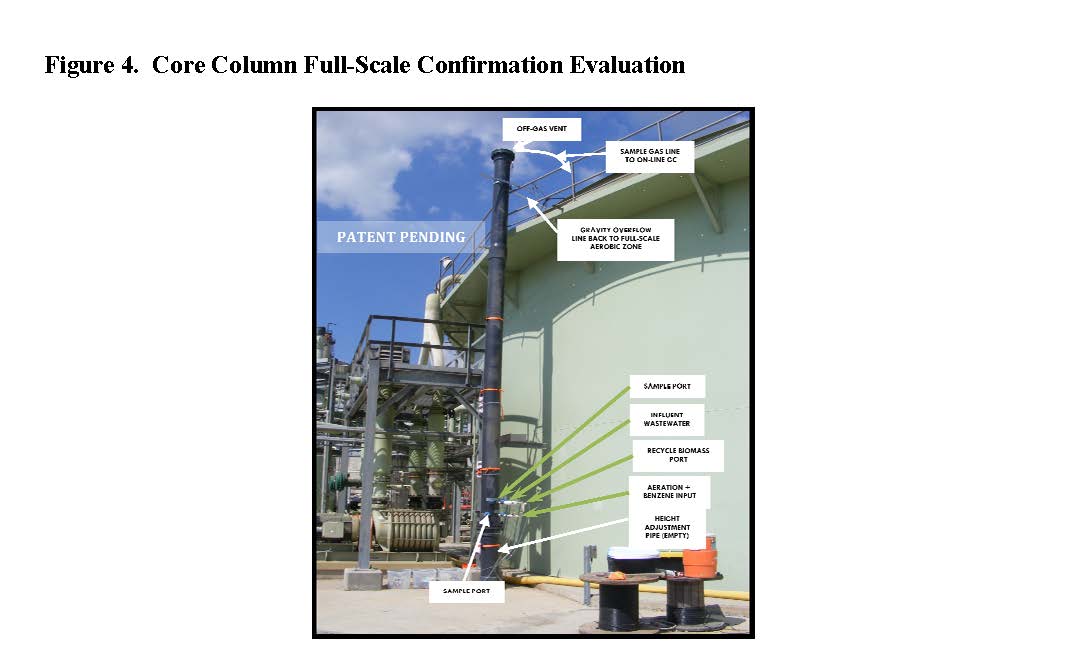
Figure 4. Core Column Full-Scale Confirmation Evaluation

Table 2. Benzene Analytical Results Of Full-Scale Confirmation
| |||||||||
Parameter
| Units
| Run 1
| Run 3
| Run 4
| Run 5
| ||||
A
| B
| A
| B
| A
| B
| ||||
Inlet Benzene Gas Concentration (Design = 14 ppbv) | ppbv
| 21
| 121
| 153
| 153
| 482
| 182
| 226
| |
Outlet Off-Gas Benzene Concentration
| ppbv
| <2
| <2
| <2
| <2
| 13.3
| <2
| <2
| |
Percent Gaseous Benzene Removal
| %
| NA
| >98.35
| >98.69
| >98.72
| 97.24
| >98.80
| >99.11
| |
| |||||||||
Influent Aqueous Benzene
| μg/L
| 109
| 129
| 129
| 137
| 137
| 245
| 245
| |
Effluent Aqueous Benzene
| μg/L
| <1
| <1
| <1
| <1
| <1
| <1
| <1
| |
Percent Aqueous Benzene Removal
| %
| >99.09
| >99.22
| >99.22
| >99.27
| >99.27
| >99.59
| >99.59
| |
| |||||||||
Inlet Raw Wastewater Flow
| gpm
| 0.21
| 0.21
| 0.21
| 0.21
| 0.21
| 0.35
| 0.35
| |
Biomass Recycle from Clarifier
| gpm
| 0.35
| 0.35
| 0.35
| 0.35
| 0.35
| 0.35
| 0.35
| |
Internal Anoxic Recycle
| gpm
| 0
| 0
| 0
| 1.1
| 1.1
| 1.1
| 1.1
| |
See more of this Group/Topical: Environmental Division