
ABSTRACT
The present work studied the behavior of ejectors which are widely used in industry as substitutes for mechanical compressors or even for vacuum producers in distillation towers. They drag a secondary fluid through the difference of pressure generated by the entrance of a high pressure motive fluid on the main nozzle which has a combination of converging/diverging ducts. A preliminary study using Computational Fluid Dynamics (CFD) was validated against experimental data. Then the effects of operating conditions and geometries on ejector performance were investigated at different pressure and temperature conditions. The CFD model was capable to predict well the experimental data (Figure 1). For adequate phenomenon representation, a density based solver was used with a steady-state approach for time prediction, ideal gas treatment for the working fluid and a two-dimensional (2D) approximation. High velocities were achieved after the primary nozzle entrance and a supersonic flow took place. For better use of computational resources, an independency test for the flow pattern was carried out by varying mesh refinement. As a second part of this study, an optimization analysis was developed. In this step, the goal was to achieve the best geometric configuration for an ejector by varying three different geometrical parameters simultaneously with a fixed operating condition and maximizing efficiency of the device. The parameters varied were: primary nozzle inlet diameter where the high pressure motive fluid enters, the length throat which is responsible for flow stabilization and finally the inlet diameter of the mixture chamber which is the entrance of the secondary fluid. The device efficiency was evaluated by the entrainment ratio which is the rate between the entrance of secondary fluid and of motive fluid. In order to create an initial population for the problem, the Uniform Latin Hypercube model was used as a design of experiments. Moreover for the optimization itself the Non-dominated Sorting Genetic Algorithm II (NSGA-II) was employed. The results for the optimization cases show a direct effect on the ejector performance of all geometrical parameters tested. Increases on the selected parameters provide larger entrainment ratios under the same operating condition. The same analysis also shows that highest sensibility on the device efficiency was achieved by variations on the primary nozzle diameter. Small increases on this diameter generated a much higher drag of secondary fluid.
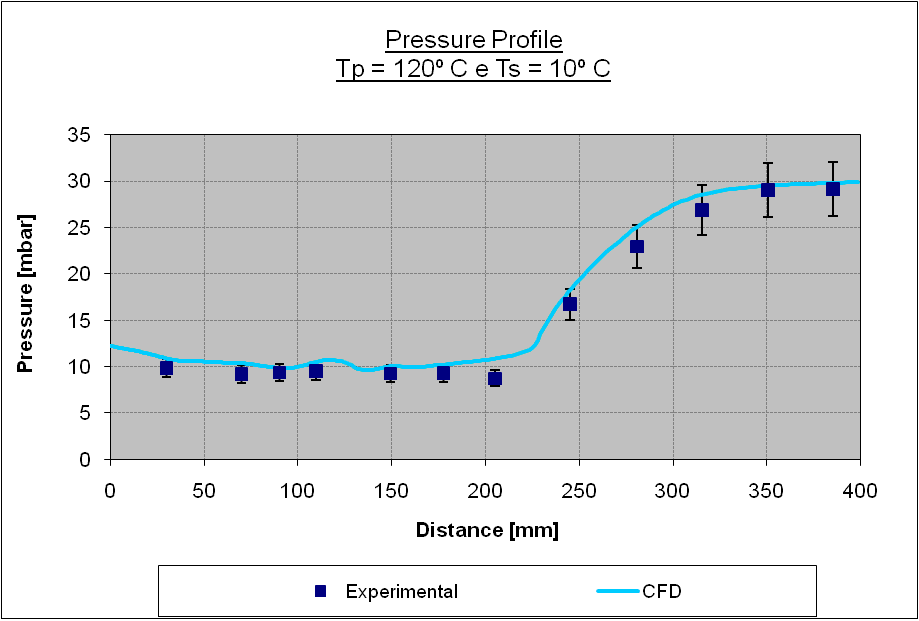
Figure 1. Pressure profile along the wall of the ejector.
See more of this Group/Topical: Separations Division