
Control of Kaibel Distillation Column by Estimated Compositions from temperature measurements
Maryam Ghadrdan1, Ivar Halvorsen2, Sigurd Skogestad1, Deeptanshu Dwivedi1
1 Department of Chemical Engineering, Norwegian University of Science and Technology, N-7491 Trondheim, Norway, Email: ghadrdan@nt.ntnu.no, skoge@nt.ntnu.no, dwivedi@nt.ntnu.no
2 SINTEF ICT, Applied Cybernetics, N-7465 Trondheim, Norway, Email: ivar.j.halvorsen@sintef.no
Reliable and accurate measurement of product compositions is one of the important issues in distillation column control. However, direct composition measurements are expensive, not so reliable and there is also a significant delay. Temperature measurements are robust, fast and cheap and represents proven technology in the process industry.
We have used a soft-sensor to estimate the compositions from temperature measurements. Our estimation method (we call it Loss method) is a reformulation of the well-developed Self-optimizing method proposed by Skogestad (2000) to make it adequate for the purpose of estimation (Ghadrdan et al. 2011). We have formulated the Loss method for open-loop and closed-loop estimator. With the term “open-loop” estimator, it is implied that the predicted variables are not used for control purposes. In "closed-loop" the estimates are used as feedback in control loops, and the performance of the closed loop control will depend on the estimator performance. Since the estimator is based on steady-state information, it is important that the behavior in a dynamic system does not degrade the control.
In this work, we are demonstrating our estimation method for a Kaibel distillation arrangement which is a complex case-study. Kaibel distillation arrangement (Figure 1) separates a four-component mixture into pure products and thus replaces a sequence of three conventional distillation columns. There is a potential for significant energy savings, but this requires that the column is operated optimally. The extra operational degrees of freedom in the column are used for the purpose of optimization and to operate the column as close as possible to the minimum energy. The tight integration in Kaibel column makes it challenging to control, compared to the conventional sequence of simple columns. The control performance using the estimated compositions to be controlled in face of various process disturbances will be demonstrated by dynamic simulations.
|
|
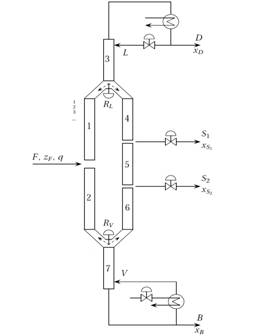
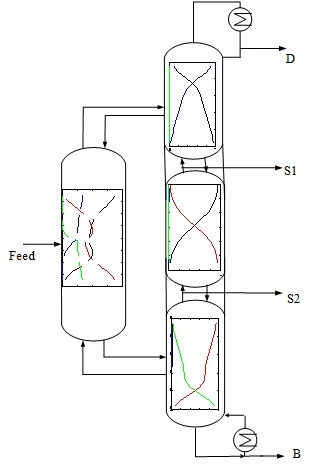
Figure 1. Schematic of Kaibel Distillation Column
References
Skogestad, S. (2000). “Plantwide control: the search for the selfoptimizing control structure.” J. Proc. Control 10:487-507
Ghadrdan, M. ,Grimholt, C., Skogestad, S., Halvorsen, I.J., “Loss method: A static estimator applied for product composition estimation from distillation column temperature profile.” AIChE Annual Meeting, (2011), Minneapolis, USA
See more of this Group/Topical: Separations Division