
 Google
 Yelp
 Facebook
 Twitter
 ChEnected
293956 Development of Stable Multiphase Ni-Mgx-Aly-O Catalysts for CO2 Reforming of Methane
Development of stable multiphase Ni-MgxAlyO catalysts for CO2 reforming of methane
J. Zhanga, Q. J. Chena, B. R. Pana, W. B. Kong a, Q. W. Jina, T.J. Zhao*a, Y. H. Sun*a,b
a: Low Carbon Energy Conversion Center, Shanghai Advanced Research Institute, Chinese Academy of Sciences, Shanghai 201203, China
b: State Key Laboratory of Coal Conversion, Institute of Coal Chemistry, Chinese Academy of Sciences, Taiyuan 030001, Shanxi, China
_______________________________________________________________________________
Abstraction:
CO2 reforming of methane to produce synthesis gas is becoming more research attractive due to the increasing interest in reduction of carbon dioxide emissions and more efficient utilization of natural gas. From an industrial standpoint, Ni-based catalysts have drawn significant research attention for their high activity and wide availability. However, metal sintering, oxidation, and especially significant carbon formation result in the severe deactivation of the Ni catalysts. Some catalysts such as NiO/MgO solid solution, Ni/Al2O3, NiAl2O4 spinel, etc. were reported to have excellent performance for CO2 reforming of methane. However, those kinds of catalysts still have their own disadvantages, for example, hydrophobia of NiO/MgO, low active site dispersion for Ni/ Al2O3, difficult reduction for NiAl2O4 spinel, etc.
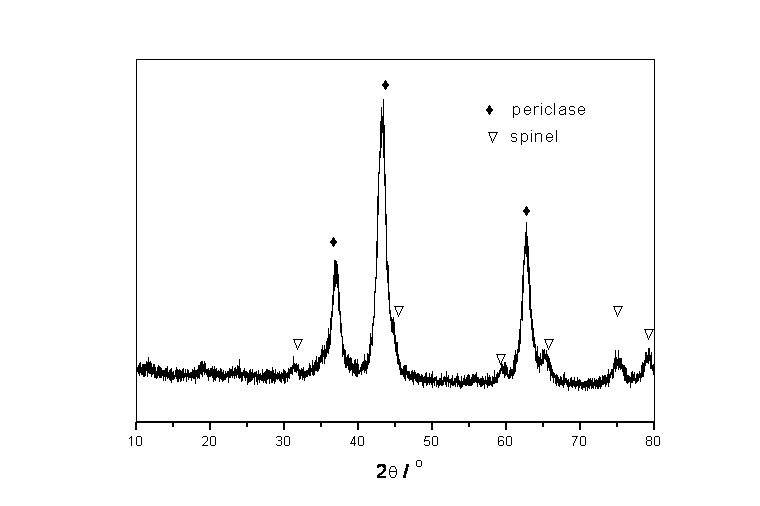
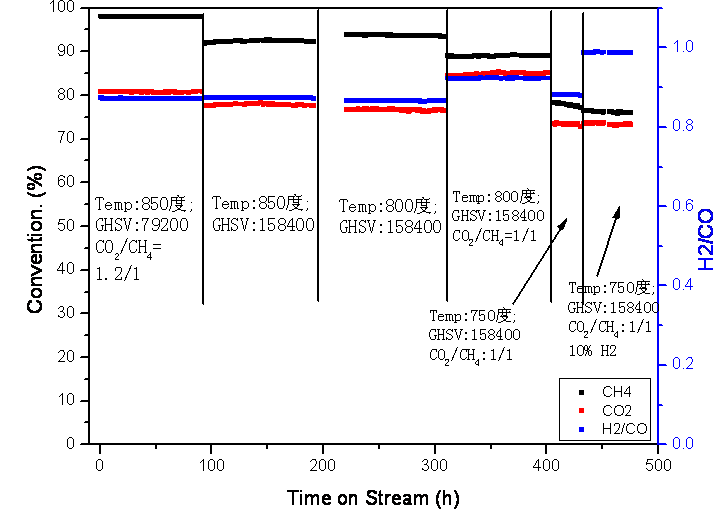
Fig .1 XRD for Ni-MgxAlyO catalysts Fig .2 Stability of Ni-MgxAlyO for CO2 reforming of methane
In this work, a high stable multiphase Ni-MgxAlyO catalyst for CO2 reforming of methane was developed by HT precursors. For comparison, NiO/MgO solid solution, Ni/Al2O3, and NiAl2O4 spinel catalysts were also prepared and tested. The Catalysts were characterized using ICP-MS, BET, XRD, H2-TPR, TEM, and TG. Catalysts screening for the carbon dioxide reforming of methane showed that Ni-MgxAlyO catalysts with multiphase (periclase-spinel) obtained by hydrotalcite-type (HT-type) precursors exhibited superior performance to other Ni–Mg–Al–O catalysts with different phases. This special multiphase catalyst exhibits very high and stable activity over 1000 h without deactivation at a GHSV of 79, 000 ml/(hg) at 850 oC. Both commercial Ni/Al2O3 catalyst and the NiO/MgO solid solution with single periclase phase deactivated quickly after the ignition of reaction, and the NiAl2O4 spinel show less activity for their low reductively. BET, XRD and H2-TPR results indicated that the activity of the catalysts were strongly depended on the structures, the sizes of the nanoparticles, surface area and active site dispersion. In fact, those characteristics are strongly depended on the types of the phases in the catalyst, and the interaction between them. It was believed that the synergy between periclase and spinel could also significantly improve catalyst performance and reduce carbon formation. A high metal dispersion or small ensemble size can be obtained by NiO/MgO solid solution. The excellent stability of metal was enhanced by spinel phase exist in the NiO/MgO solid solution, which further promoted the metal dispersion and resistance of metal sintering. The synergistic effects between crystal phases and phase cooperation, the phenomena responsible for the variation of activity in the methane reforming as a function of the degree of spinel substitution in periclase were deeply discussed.
Keywords : Natural gas; CO2 Methane reforming; Ni-MgxAlyO multiphase catalysts; phase cooperation