
 Google
 Yelp
 Facebook
 Twitter
 ChEnected
479650 Computational Fluid Dynamics Based Design of a Novel Reactor Technology for the Oxidative Coupling of Methane
Computational fluid dynamics based design of a novel reactor technology for the oxidative coupling of methane
Kevin M. Van Geem, Laurien A. Vandewalle, Guy B. Marin
Abstract
The low natural gas price and the large amounts of shale and natural gas have created a renewed interest in methane as a source of liquid energy carriers or as a raw material for the chemical industry. Oxidative coupling of methane (OCM) is considered as one of the most promising processes for valorizing methane by transforming it to ethene in a single step. However, two key challenges have to be addressed before OCM can be considered as an alternative gas-to-chemical technology, namely the low yields of ethene and what to do with the substantial heat release of the reaction. Both these challenges can be overcome in the reactor technology that is proposed in this work, i.e. the gas-solid vortex reactor in a static geometry (GSVR-SG).
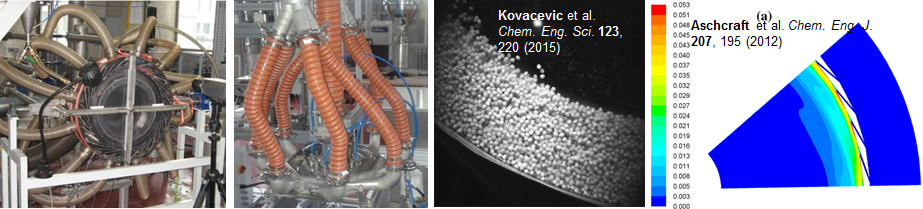
OCM is initiated at the catalyst surface by the generation of methyl radicals. Methyl radicals recombine in the gas phase to yield ethane, which then dehydrogenates to ethene. The C2 products as well as the methyl radicals are, however, exposed to further oxidation, leading to the undesirable COx formation. The strong exothermicity of OCM furthermore implies that efficient heat removal is critical to prevent combustion of the reaction products. In order to prevent the unwanted propagation of the gas-phase reactions and efficiently address the large amount of heat released, reactors with short gas-phase residence time and efficient heat transfer are preferred for OCM. Hence the GSVR−SG, developed at the Laboratory for Chemical Technology (Ghent University), emerges as an excellent reactor choice for demonstrating the OCM process. LCT has a cold flow, hot flow and reactive setup which provide new insights in different effects occurring at every stage of the OCM process. In combination with modeling, valuable experimental studies can be carried out for different operating conditions. Nevertheless, these time intensive experimental studies can be drastically reduced by focusing on high level computational fluid dynamics (CFD) simulations. These simulations will allow to optimize the reactor geometry and operating conditions specifically for OCM and to easily investigate alternative processes benefitting from this technology such as biomass fast pyrolysis and gasification.
In this project, both reactive and non-reactive CFD simulations of the GSVR-SG are performed using the open-source CFD package OpenFOAM. The developed reactive CFD model takes into account a detailed OCM microkinetic model consisting of both homogeneous and heterogeneous reactions. The simulations are validated against the results obtained on the three experimental setups available at the LCT.
See more of this Group/Topical: Topical 4: The 29th Ethylene Producers