
 Google
 Yelp
 Facebook
 Twitter
 ChEnected
481453 A Systematic Approach to Alarm Design with Application to the Tennessee Eastman Problem
Abstract for 2017 AIChE Spring Conference
A systematic approach to alarm design with application to The Tennessee Eastman Problem
JOSHIBA ARIAMUTHU VENKIDASALAPATHY*, COSTAS KRAVARIS and M. SAM MANNAN
Artie McFerrin Department of Chemical Engineering
Texas A&M University
College Station, Texas 77843-3122, USA
*+1(979)402-9823, joshvenkat03@tamu.edu
When a process plant faces an abnormal situation, the alarm management system that is meant to assist process operators, may hinder effective remedial measures by simultaneously displaying several alarms, making it nearly impossible for the operator to identify the critical variable that needs immediate attention. This condition is known as 'alarm flooding'. This study focuses on efficient alarm identification which is the first critical step in designing the alarm system of a process plant.
We formulate a systematic approach to alarm identification wherein a subset of measured variables is chosen for configuration in the alarm system. The approach may be outlined as (i) Identification of potential hazardous scenarios, (ii) Simulation of these scenarios in order to quantify process measurement response time, (iii) Formulation of a mixed integer linear programming problem (MILP) that is solved using MATLAB. The solution to this problem gives a set of process variables that minimizes the time taken for abnormality detection while taking into account all potential hazards. Additionally, this optimal set ensures that the number of alarms activated for any fault is not more than a threshold number.
The formulation is as follows:
|
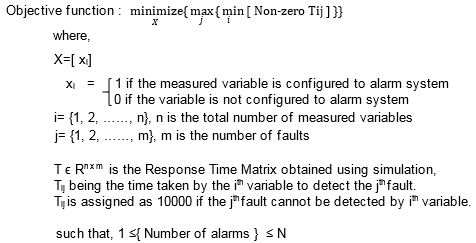
For this particular study, the MILP routine ‘intlinprog’ has been used which is based on the branch and bound algorithm.
The proposed approach is then applied to a benchmark industrial plant control problem, the Tennessee Eastman Process Control Problem [1], a well-defined simulator of a chemical process plant which is extensively used in process control research. It consists of a reactor, separator, condenser, stripper and a recycle compressor. The exothermic reactions involved and its operation under pressurized conditions make it a safety-critical plant, and hence a potential application for the proposed algorithm.
A number of major hazards were identified for this plant including control valve 'stiction’ and sensor faults. The abnormal scenarios were simulated using the closed loop simulator [2], [3] in a MATLAB environment. The simulations were carried out, one scenario at a time. An important observation based on the results obtained is that the number of alarms for any scenario should be not less than 4, in order to detect any abnormal situation soon enough to provide the operator with adequate response time. The optimal set of process variables identified to be configured in the alarm system are ‘Reactor pressure’, ‘Separator liquid Level’, ‘Stripper Liquid Level’ and ‘Purge gas composition- G component’.
References
[1] Downs, James J., and Ernest F. Vogel. "A plant-wide industrial process control problem." Computers & chemical engineering 17, no. 3 (1993): 245-255.
[2] Ricker, N. Lawrence. "Decentralized control of the Tennessee Eastman challenge process." Journal of Process Control 6, no. 4 (1996): 205-221.
[3] Ricker, N. Lawrence. "Tennessee Eastman challenge archive." [Simulink Model], Retrieved from http://depts.washington.edu/control/LARRY/TE/download.html (accessed November 21, 2016).
See more of this Group/Topical: Computing and Systems Technology Division