
Graphical Abstract:
Zeolites are an intellectually fascinating and technologically important class of materials used in the chemical conversion and separation of small molecules. Their ability to achieve these unit operations is a result of the crystalline microporous structures enabling highly size-selective separations.[1] Coupling that with the ability to impart acidity to the zeolites through the introduction of trivalent elements such as aluminum and boron into the framework has led to zeolites finding a wide range of applications in the chemical and petrochemical industry.[2] Over the last 20-30 years beyond aluminum and boron, it has been shown that other elements including titanium[3], tin[4] and germanium[5] can be introduced into the zeolite lattice with varying levels of success. This expansion of the zeolite framework composition space has led to new uses for zeolites in a range of catalytic chemistries.
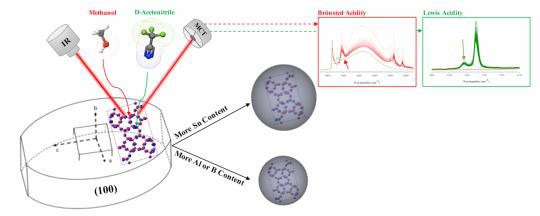
The synthesis and characterization of tin, tin/aluminum, and tin/boron containing MFI zeolites will be presented. It is shown that tin uptake is high (near 100%) and decreases with the introduction of a second heteroatom. Also, the boron uptake was found to be low for tin-boron-MFI samples, consistent with our prior work on germanium-boron-MFI[6]. XRD and FE-SEM show that higher tin contents and higher aluminum and boron contents in the synthesis gel lead to smaller and less faceted crystals. Diffuse reflectance UV-Vis spectroscopy confirms the tetrahedral framework coordination of tin within the zeolite and no polymeric SnO2 can be detected, given the absence of a strong signal at 280 nm. XPS, in consistent with UV-Vis, indicates the absence of an additional phase in the surface of these particles. In-Situ IR spectroscopy, using methanol as a probe molecule, shows that the nature of number of acid sites in these materials changes in going from pure tin-MFI (very weakly acidic) to tin-aluminum-MFI (mildly acidic). The Lewis acid nature of the tin centers was confirmed using IR of d-acetonitrile treated samples.
Keywords: Tin-MFI, synthesis, probe molecule binding, mixed heteroatom zeolites
Reference:
(1) R.M. Barrer, Hydrothermal Chemistry of Zeolites, Academic Press Inc., London, 1982.
(2) G.T. Kokotailo, S.L. Lawton, D.H. Olson, W.M. Meier, Structure of Synthetic Zeolite ZSM- 5, Nature, 272
(1978) 437-438.
(3) M. Taramasso, U.S., 1983.
(4) A. Corma, L.T. Nemeth, M. Renz, S. Valencia, Sn-zeolite beta as a heterogeneous chemoselective catalyst for Baeyer-Villiger oxidations, Nature, 412 (2001) 423-425.
(5) Z. Gabelica, J.L. Guth, A Silicogermanate with a Si/Ge Ratio Greater Than or Equal to 2. Ann MFI Zeolite of Novel Composition, Angewandte Chemie-International Edition in English, 28 (1989) 81-83.
(6) Vargas, Nataly Garcia, Scott Stevenson, and Daniel F. Shantz. "Simultaneous isomorphous incorporation of boron and germanium in MFI zeolites." Microporous and Mesoporous Materials 170 (2013): 131-140.
See more of this Group/Topical: Southwest Process Technology Conference