

Introduction: Cyclone separator is one of the most widely applied equipments for separating particles from the air. However, it is difficult to separate particles with diameters smaller than 2.5 micron using the cyclone separator. In light of the particle-vapor interaction, it is possible to increase the particle diameter via forced condensation, especially when the particle contains soluble component. This study has examined the possibility of using a cyclone separator to collect the soluble particle, i.e., sodium chloride (NaCl) as test example, numerically. Specifically, a steam of saturated water vapor with elevated pressure (0.7 MPa) is introduced vertical to the air-particle inlet to increase the particle size by hygroscopic growth, i.e., forming a NaCl-water droplet due to absorbing water vapor. Comparisons of trajectories between the particles with and without hygroscopic growth are presented.
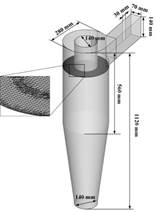
Methods: A cyclone separator model and its mesh, i.e., tetrahedral mesh with prism layers, were created (see Fig 1.). The velocities of the air and the water vapor were 10 m/s and 1 m/s, respectively. The NaCl particle density was 2165 kg/m3. The Euler-Lagrange method was applied to predict the airflow and particle transport. If The NaCl-water droplet collided with the cyclone surface, deposition was assumed to occur when considering the particle-vapor interaction. For comparison, the particle separation without hygroscopic growth was also simulated to examine the separation efficiency. Simulations were carried out by ANSYS Fluent with user-defined functions based on validated particle-vapor interaction model (J. Aerosol Sci. 2017, 105: 108-127).
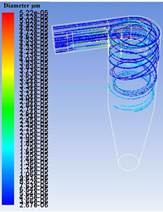
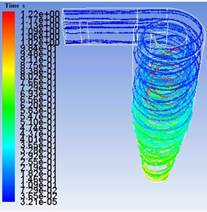
Results and Discussion: The trajectories of the 2.5 micron NaCl particles are shown in Fig. 2 when including the effect of particle-vapor interaction. The particle / droplet size increases rapidly when traveling through the air with high relative humidity. Thus, these large droplets would deposit on the cyclone surface due to inertial impaction, which leads to a high separation efficiency. The solution could be collected at the bottom of the cyclone separator with extra water trickled from the top of the cyclone, if the deposited droplets and condensed water cannot form a liquid film on the cyclone surface. Fig. 3 illustrates the trajectories of the 2.5 micron NaCl particles without hygroscopic growth.
|
|
|
Fig.1 Geometry and mesh for the cyclone separator | Fig. 2 2.5 micron particle trajectories with hygroscopic growth | Fig. 3 2.5 micron particle trajectories without hygroscopic growth |
Conclusions: The numerical study validated the feasibility of separating small soluble particle (<2.5 micron) using cyclone separator by introducing the saturated water vapor with elevated pressure. This method could be useful for the design of the fine particle removal device with simple structure and easy-maintenance.
Acknowledgements: The authors gratefully acknowledge the financial support of the National Natural Science Foundation of China (grant No. 51606041), National Natural Science Foundation of Jiangsu Prov. (grant No. BK20160688). The Fundamental Research Funds for the Central Universities are also acknowledged.
See more of this Group/Topical: Particle Classification