

It is essential to offer a universally accepted way to systematically evaluate agglomerate breakage propensity and mechanisms. Discrete Element Method (DEM) simulation is a commonly used tool but is limited by the lack of identical, controlled agglomerates to test and validate simple models, let alone replicate the complex structure of real industrial agglomerates.
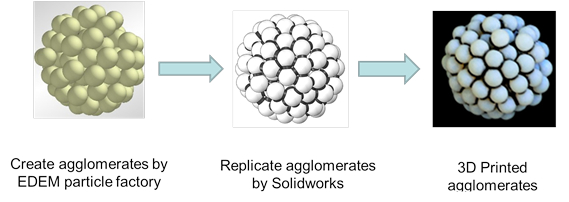
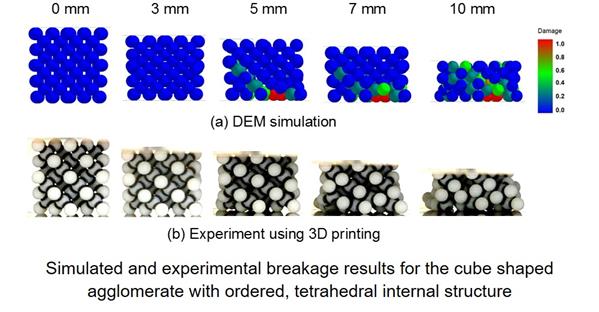
Our research presents a systematic approach to produce 3D printed agglomerates with tuneable properties. Agglomerates with different mechanical properties and structures were designed and printed by an Objet500 Connex 3D printer. The tensile and shear strength of inter-particle bonds was characterized using Instron tester. Breakage results of agglomerates with simple cubic structures and the design of agglomerates with irregular structures were presented. This 3D printing method will allow more rigorous testing of agglomerate breakage models. Discrete Element Method (DEM) has been used to simulate the agglomerate crushing using the Timoshenko Beam Bond Model (TBBM) with bond properties matching the 3D printed agglomerates. For both two agglomerate structures used in this research, the simulation and experiment showed similar breakage patterns. However, the simulation results significantly underestimated the compressive loads of spherical random structured agglomerates. In order to improve the simulations of compressive granule breakage, the influences of bond geometry definitions and non-linear behaviour of the bond contacts need to be explored.
|
|
See more of this Group/Topical: Poster Sessions