

Detailed numerical simulation of a full-loop circulating fluidized bed under different operating conditions
Yupeng Xu1,*, Jordan Musser1, Tingwen Li1,2, William A. Rogers1
1 National Energy Technology Laboratory, Morgantown, WV 26505, USA
2 AECOM, Morgantown, WV 26505, USA
Abstract
Circulating fluidized beds (CFB) are widely employed in industry for a wide variety of gas-solid contacting operations. Over the past few decades, CFB hydrodynamics have been studied using various experimental techniques and by numerical simulations. Recently, several efforts have modeled full-loop CFBs using the two-fluid model (TFM) whereby gas and solids are treated as interpenetrating continua. However, this technique only resolves solid motion at the computational cell level. With the advancement of high-performance computing, higher fidelity models, like Computational Fluid Dynamics-Discrete Element Method (CFD-DEM) which tracks the trajectory of individual particles, have become increasingly popular as research tools. This is because particle-scale information including residence time, collision forces, and dispersion intensities are readily available for detailed analysis of complex flow phenomena.
In this first of its kind work, both experimental and computational studies of a benchtop, full-loop circulating fluidized bed are conducted. Experimental data include pressure drops across different components, solids circulation rate measured using Particle Image Velocimetry (PIV), and standpipe inventory height. Numerical simulations were performed with MFIX-DEM, a coupled Computational Fluid Dynamics-Discrete Element Method (CFD-DEM) solver. Comparison of experimental and simulation data shows good agreement with respect to system component pressure drops and standpipe inventory height. Additionally, the effects of drag model selection and particle representation (mono-sized particles versus a particle size distribution) are also reported.
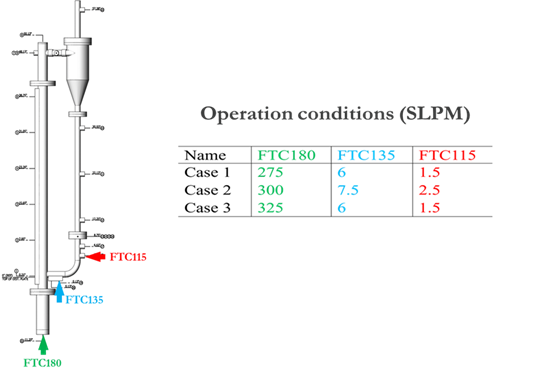
Figure 1. Experimental setup and operation conditions (SLPM)
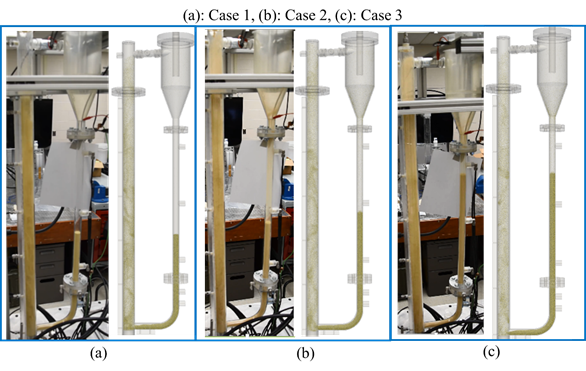
Figure 2. Direct comparison between experiments and simulations under different operating conditions (Left: experiments, right: simulation)
See more of this Group/Topical: Fluidization & Multiphase Flow