

Fluidization of non-spherical particles of cylindrical or close to cylindrical shape is part of many industrial processes, especially in relation to biomass fuel production, fluidized bed gasifiers and pharmaceutical tablet coating processes. In these applications accurately accounting for the details of particle shape is important for safe and efficient design of industrial equipment. In this work the numerical model based on the Discrete Element Method (DEM) fully coupled with CFD is used to predict the effect of particle aspect ratio and presence of sharp edges in the particle’s shape on the fluidized bed hydrodynamics. The model is implemented within commercial software STAR-CCM+ version 12.06 developed by Siemens PLM. The model assumes particles are cylinders or spherocylinders (capsules). It accurately resolves the collisions between cylindrical particles or between capsules without employing conventional method of “spheres glued together” for non-spherical particles.
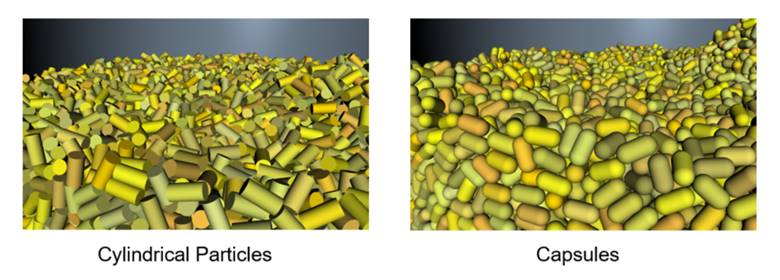
The model is then used to simulate cylindrical particles or capsules of the same volume, mass, aspect ratio, and frictional properties in a cylindrical container with air inlet at the bottom and pressure outlet boundary at the top with the range of inlet velocities both below and above minimum fluidization velocity. The results for pressure drop, particle packing and particle preferred orientation are analyzed for both cylinders and capsules and compared to the correlations reported in the literature. The results for the percentage of particles aligned with fluid flow direction in bubbling flow regime indicate the presence of surprisingly longer timescale for establishing steady state preferred orientation of particles. The effect of the absence of the sharp edges in capsules compared to cylinders on the hydrodynamics of the fluidized bed is discussed in details.
See more of this Group/Topical: Fluidization & Multiphase Flow