

Electrostatic forces cause spontaneous movement in every charged particle. Thus, electrostatic technologies are attracting attention in the actual processes of powder handling, i.e., separation, classification, and collection. When conductive particles come in contact with any one of the inside walls of parallel electrodes, the particles are charged to the same polarity as that of the electrode by induction. If Coulomb forces acting on the charged particles are larger than the adhesion forces between the contact surfaces, the particles will levitate from the electrode. After the particles move and reach the counter electrode, the polarity of the particles inverts, and then the particles levitate again. As a result, the particles oscillate between the parallel electrodes. Replacing the counter electrode with a mesh electrode allows the passage of the charged particles through the mesh openings; then, the particles with the same polarity as the first electrode are dispersed by mutual electrostatic repulsion. However, since the particles are polarized in the external electric field, chain agglomerates can be formed; thereby the particle behavior becomes more complicated. In powder handling processes, dielectric particles are often used. Such particles are accumulated and form multi-layers on the electrodes; this affects the phenomena of particle charging and levitation. The phenomena for single dielectric particles have been reported, but there are few studies focusing on the induction charging and levitation for particle layers.
We present the charging, levitation, and relevant behaviors for dielectric particle layers, which are obtained using parallel electrodes consisting of a lower plate electrode and an upper mesh electrode. First, multi-layers of particles are formed on the lower electrode. Next, DC voltage is applied to the lower electrode and the upper electrode is grounded to vertically form a high-intensity electric field. Then, the particles are charged and levitated in the electric field. The particle motion around the lower electrode is observed via a high-speed microscope camera, showing that agglomerated as well as single particles levitate from the surface of the particle layers, i.e., the particles are polarized in the electric field and form chain agglomerates by mutual electrostatic interactions. When the specific charge, i.e., charge-to-mass ratio of particles is small, single particles cannot levitate because of small Coulomb forces. However, chain agglomerates can levitate because of large Coulomb forces even though the specific charge is small. The Coulomb forces of the chain agglomerates can exceed the adhesion forces and gravitational forces acting on primary particles in the agglomerates.
The specific charge of each levitating particle is estimated by fitting experimentally obtained particle trajectories with calculated ones in simulated electric fields, showing that as the number of primary particles of the chain agglomerate increases, their specific charge decreases. In addition, it is found that as the adhesion force of each primary particle increases, the number of primary particles of the chain agglomerate increases.
Furthermore, a unique phenomenon is observed around the upper electrode. Fig. 1 shows a chain agglomerate that was dispersed. Agglomerates can be rotated in the dispersion process. The charges of the agglomerates during the dispersion process are estimated using a simulated non-uniform electric field around the upper electrode and the effect of the particle charge on the dispersion process is studied.
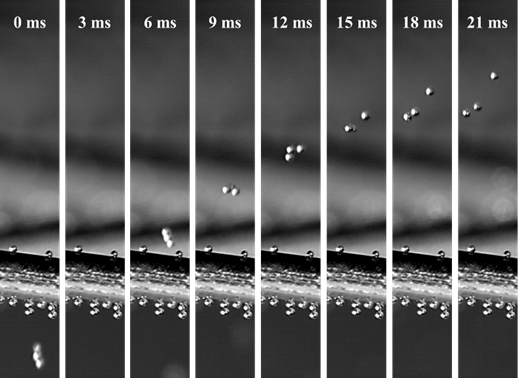
Fig. 1. Dispersion of chain agglomerate by electrostatic repulsion around upper mesh electrode.
See more of this Group/Topical: Particle Interactions