

Experimental Verification of Solid-like and Fluid-like States in Homogeneous Fluidization Regime of Geldart A Particles
Although homogeneous fluidization for Geldart A particles has received considerable attention for a long time, the underlying mechanism has not yet been fully understood.1 Some ascribed the stability to inter-particle forces,2, 3 while others insisted a purely hydrodynamic explanation.4 Valverde et al.5 fluidized fine particles with the average size of 8.53 ¦Ìm (i.e., Geldart C particles) by the addition of fumed silica nanoparticles and found that even during homogeneous fluidization both solid-like and fluid-like behaviors can be distinguished, indicating that the stability of homogeneous fluidization may have two distinct origins: in solid-like state, the particle contact forces dominate; while in fluid-like state, the hydrodynamic factors dominate. However, it is evident that the above conclusions were drawn based on the modified Geldart C particles. To our best knowledge, there is no experimental report on whether both solid-like and fluid-like states exist for true Geldart A particles.
It should be stressed that, however, fluidization behaviors of the modified Geldart C particles and true Geldart A particles should be different from each other: besides some apparent fluidization characteristics such as the expansion ratio, maximum free volume and the ratio of the minimum bubbling velocity to the minimum fluidization velocity, the modified Geldart C particles undergo a dynamical aggregation process,6 while for Geldart A particles, it is still questioned whether or not aggregation presents in homogeneous expansion region.7 Homogeneous fluidization of Geldart A particles is of great relevance: for fundamental research, it is closely associated with the instability and origin of meso-scale structures in fluidized beds;8 for industrial application, the optimal operation for particles circulation in fluidized bed reactor-regenerator systems, such as in fluid catalytic cracking (FCC) and methanol to olefins (MTO) process, is achieved when particles flow downwards a standpipe in a bubble-free condition,9 which is actually homogeneous fluidization. Therefore, it is significant to investigate if both solid-like and fluid-like states exist in homogeneous expansion regime for true Geldart A particles as well.
In this work, incipient fluidization characteristics of FCC catalyst, which is a typical Geldart A powder, were carefully investigated by the use of electrical capacitance tomography (ECT), pressure fluctuation and camera recording. It was found that the dependency of the standard deviation of the overall solid concentration measured by ECT on superficial gas velocity shows three platforms, which were further verified by pressure fluctuation and camera recording to correspond to fixed bed, solid-like homogeneous and fluid-like homogeneous regimes, respectively, and the gas velocity in the terminal point of each platform is the minimum fluidization velocity, the minimum bubbling velocity and the critical velocity between the solid-like and fluid-like homogeneous fluidization states, respectively. Once the existence of both states is verified, it is reasonable to speculate that the mechanism of homogeneous fluidization for Geldart A particles have two distinct factors: one dominated by inter-particle forces in solid-like state and the other dominated by fluid dynamics in fluid-like state.
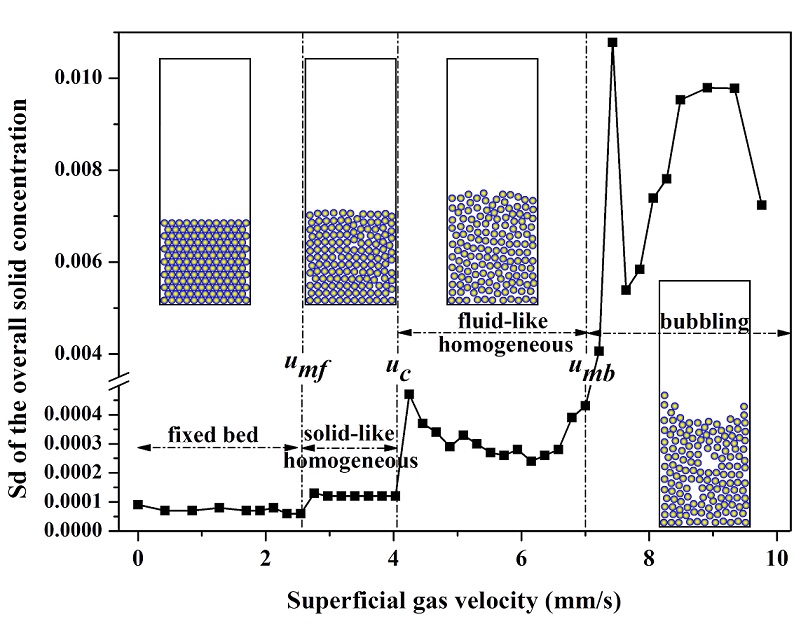
Figure 1. Average and standard deviation of the overall solid concentration against superficial gas velocity.
Literature Cited
1. Oke O, Lettieri P, Mazzei L. An investigation on the mechanics of homogeneous expansion in gas-fluidized beds. Chem Eng Sci. 2015;127:95-105.
2. Rietema K. The effect of interparticle forces on the expansion of a homogeneous gas-fluidised bed. Chem Eng Sci. 1973;28:1493-1497.
3. Menon N, Durian DJ. Particle motions in a gas-fluidized bed of sand. Phys Rev Lett. 1997;79:3407-3410.
4. Cody GD, Goldfarb DJ, Storch GV, Norris AN. Particle granular temperature in gas fluidized beds. Powder Technol. 1996;87:211-232.
5. Valverde JM, Castellanos A, Quintanilla MAS. Self-diffusion in a gas-fluidized bed of fine powder. Phys Rev Lett. 2001;86:3020-3023.
6. Valverde JM, Castellanos A. Effect of vibration on agglomerate particulate fluidization. AlChE J. 2006;52:1705-1714.
7. Sande PC, Ray S. Fine mesh Computational Fluid Dynamics study on gas-fluidization of Geldart A particles: Homogeneous to bubbling bed. Ind Eng Chem Res. 2016;55:2623-2633.
8. Sundaresan S. Instabilities in Fluidized Beds. Annu Rev Fluid Mech. 2003;35:63-88.
9. Xie H-Y, Geldart D. Fluidization of FCC powders in the bubble-free regime: effect of types of gases and temperature. Powder Technol. 1995;82:269-277.
See more of this Group/Topical: Fluidization & Multiphase Flow