

TWIN SCREW GRANULATION: A STEP TOWARDS CONTINUOUS PROCESSING
Rachael Shinebauma, Andrew Ingrama, Hannah Batchelora, Gavin K. Reynoldsb, Ian Gabbottb
a. School of Chemical Engineering, University of Birmingham, Edgbaston, B15 2TT
b. Pharmaceutical Technology & Development, Astra Zeneca, Macclesfield, SK10 2NA
Within the pharmaceutical industry, a shift towards continuous processing to produce granules, away from traditional batch-wise techniques is underway. Twin Screw Granulation (TSG) is a continuous process which, in recent years, has been the subject of much research to increase knowledge in its role within solid oral dosage form manufacturing. TSG reduces plant footprint, reduces process development costs and allows ease of scale-up to full production. Within the TSG process there are a large number of variable process parameters including: screw element configuration, screw speed, liquid feed quantity and powder feed rate. Further work is required to gain a deep understanding of the mechanisms and process factors required to predict the characteristics and quality of the resulting granules required by the FDA regulations, for example Quality by Design (QbD) and Process Analytical Technology (PAT).
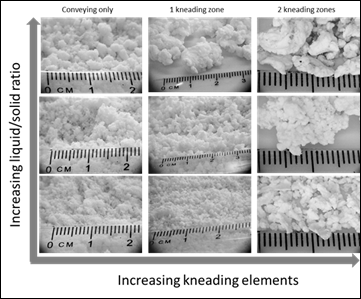
This study investigates the impacts of liquid to solid ratio and screw configuration on the properties of the granules produced by the twin-screw granulator and their subsequent compaction behaviour and tablet properties. A blend of lactose, microcrystalline cellulose (MCC) and hydroxypropyl cellulose (HPC) was granulated using six different liquid to solid ratios and five different screw configurations. The granules were characterised with X-Ray micro tomography to measure porosity and structure, while shape and size analysis was carried out via QICPIC particle size analyser. Granule size increased dramatically with increasing liquid content and kneading zones within the barrel. Tabletability was shown also to be affected by the granule manufacturing conditions and was correlated with the granule.
See more of this Group/Topical: Applications of Particle Technology for Pharmaceuticals