

Granular rheology is complicated by the dependence of the viscosity upon factors such as solid concentration, shear rate, granular temperature, and inter-particle friction. Many different approaches have been developed within the last three decades, including frictional kinetic theory [1, 2], or non-local granular fluidity models [3]. Testing the validity of these models requires measurements of many different quantities, including the solid volume fraction, mean velocity, fluctuating component of velocity (sometimes called the granular temperature), and the angular velocity variance. Magnetic resonance imaging (MRI) has been used to make local measurements of the solid fraction, shear rate and velocity distribution in opaque systems. Here we extend the technique to characterise the rotational motion of the particles as well.
Granular materials exhibit behaviour resembling all of the three main states of matter, such as yielding in solids, gravity flow in liquids and compressibility akin to gases. These features are the result of the contacts between granules at the scale of the particle diameter. In order to understand industrial and natural granular flows, the dynamics of individual granules must be understood. Discrete element method (DEM) simulations of granular flows are useful since the motions of individual particles are tracked, providing detailed information about the flow characteristics [4, 5]. However, DEM simulations are computationally expensive and are limited to simulating laboratory-scale systems. Therefore, a continuum description for granular materials is necessary to assist in the design of industrial processes and to understand natural phenomena.
In order to develop a continuum model, a rheological model is required to determine the stress distribution within the granular material. In liquids and gases, such a model determines the stress from the local shear rate of the material and its viscosity. In granular materials, the relationship is less clear. Models derived from the kinetic theory of granular flow use an effective viscosity, much like in the liquid or gas phase. These models were developed assuming relatively dilute granular flows. By contrast, models derived from dense systems suggest the stress arises primarily from the confining pressure on the flow. Several experimental and theoretical studies now suggest that rotational motion of the granules should also be considered. In comparison to other variables, particle rotation has not been widely studied, in part due to the scarcity of suitable measurement techniques.
In MRI, pulsed field gradient (PFG) measurements encode for spin position during the acquisition time. From the PFG signal, the local mean velocity and the variance of the velocity fluctuations (i.e. the granular temperature) may be retrieved [6, 7]. Changes in spin position may be caused by translational motion resulting from external forcing of a system and by inelastic collisions between granules. Conventional analysis of the signal assumes that the granules behave as point sources and that there is no contribution to the signal from their rotation. However, spins move along the encoding axis as the particle rotates. Thus, it is expected that the measured velocity fluctuations will be greater than that arising from the translational motion alone.
In this work, we propose a
framework by which the angular velocity distribution of a granular material may
be measured using MRI. A model is developed to describe the PFG signal in terms
of the translational and rotational motion of the granules. The apparent
granular temperature measured by MRI, Tapp is related to the
true granular temperature,  and the angular
velocity variance,
 by:
|
| (1) |
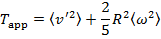
where R is the granule radius. The model was validated against discrete element method simulations of PFG experiments in granular couette flow. The PFG signal acquisition is simulated by modelling each particle as a cluster of points. A simulated MRI signal was then found by numerically integrating the point positions with respect to time. This method offers the advantage of being able to include or exclude the effect of particle rotation upon the signal. Hence, the true granular temperature may be separated from the apparent granular temperature. These simulated measurements were then analysed as in a conventional MRI experiment to determine the mean velocity and fluctuating component of the velocity.
The mean velocity profile was in excellent agreement with physical PFG measurements for the same system. Granular rotation was found to have no effect upon the imaginary component of the signal and hence the mean velocity. Each spin has a counterpart positioned on the other side of the granule with an equal and opposite phase. Thus the net phase for a granule is equal to the phase arising from translational motion only.
Measurements of the fluctuating component of the particle velocity were found to exceed the value obtained from the simulations of the fluctuations of the translational component of motion. Increasing the inter-particle friction coefficient and coefficient of restitution caused the rotational and translational components of the granular temperature to increase, respectively. However, for all contact parameters tested, the simulated granular temperature arising from translational motion was lower than the apparent granular temperature of the PFG experiments. The deviation between the simulation and experimental results could only be removed by including the effects of particle rotation in the calculation of the simulated granular temperature.
Rotational motion increases signal attenuation when measured by MRI, and hence the apparent fluctuating component of the particle velocity is overestimated. A detailed study of the influence of rotation on the signal revealed that the contribution from rotational motion increased with increasing particle radius, as given in the equation above. The simulation results also confirmed the additive relationship between the translational and rotational contributions to the apparent granular temperature. This result provides a means to quantitatively measure the rotational and translational components of the velocity fluctuations.
The decomposition of the measured apparent granular temperature into separate translational and rotational components is not possible using PFG experiments alone. Instead, the true granular temperature must be measured by another experimental method. In this paper we consider using modulated gradient spin echo and dynamic magnetic resonance scattering as possible means of separating both translational and rotational components of the motion. These experiments will provide completely non-invasive measurements of particle dynamics in opaque, particulate flows. Thus, we will show that MRI may be used to fully quantify the granular dynamics and hence probe rheological models of granular flow experimentally.
References:
1. Jenkins, J.T. and C. Zhang, Kinetic theory for identical, frictional, nearly elastic spheres. Physics of Fluids, 2002. 14(3): p. 1228-1235.
2. Lun, C.K.K., Kinetic theory for granular flow of dense, slightly inelastic, slightly rough spheres. Journal of Fluid Mechanics, 1991. 233: p. 539-559.
3. Kamrin, K. and G. Koval, Nonlocal constitutive relation for steady granular flow. Physical Review Letters, 2012. 108(17).
4. Cundall, P.A. and O.D.L. Strack, A discrete numerical model for granular assemblies. Geotechnique, 1979. 29(1): p. 47-65.
5. Kloss, C., et al., Models, algorithms and validation for opensource DEM and CFD-DEM. Progress in Computational Fluid Dynamics, 2012. 12(2-3): p. 140-152.
6. Callaghan, P.T., Principles of nuclear magnetic resonance microscopy. 1991.
7. Holland, D.J., et al., Spatially resolved measurement of anisotropic granular temperature in gas-fluidized beds. Powder Technology, 2008. 182(2): p. 171-181.
See more of this Group/Topical: Special Topics in Particle Technology