Z Lift Facelift
Goals/Purpose: To describe a safe, effective rejuvenation technique to improve nasolabial folds, jowls and neckline in the aging patient. A retrospective review of 218 patients who had rhytidectomy with SMAS by a single surgeon. Average age 55 over an 18 year period with a range of 43 to 83. In earlier years of practice from 1992 to 2004 the average age was 49, In 2017 however the average age was 62.
Methods/Technique: 60 % of patients a]were done under local with conscious sedation, 40 % under general anesthesia. Patients take Valium 10mg, Emend a long acting antinausea medication and an antibiotic orally with a sip of water 1 hour prior to procedure. All patients have 0.5% lidocaine with epi injected in
incision lines and fatty areas. 10 minutes elapses while a TCA peel, filler and/or Botox are administered. The skin is painted with Betadine, the hair is soaked with Betadine, the ear canals have Betadine applied, towels are placed and the hair is slicked back with Bacitracin ointment. Any excess neck or cheek adipose tissue is syringe liposuctioned. Fat grafts are used sparingly after settling and separating at the end of the surgical procedure.
Preauricular and posterior auricular incisions are extended around side burns anteriorly and along the posterior hairline PRN. The angle of the head rest is raised to an acute angle to flex the neck as much as possible. No submental incisions or anterior platysma plications have been performed the last 15 years. The orbicularis oris muscle fascia is grasped with a forceps and a 3-0 Ethibond is placed as a suspension suture to the anterior SMAS. The platysma muscle is dissected laterally and suspended to the mastoid fascia with a 3-0 Ethibond suture. A 2-0 PDO Quill is placed over the 3-0 Ethibonds and SMAS to bury the Ethibond permanent suture and to smooth out the SMAS and subcutaneous adipose tissue. Any bulging adipose tissue or irregularities are trimmed. The skin vector is checked for best angle placement, dart incisions are made, 5-0 Vicryl sutures are placed at the superior anterior auricular border and at the superior posterior auricular border. The skin is trimmed from beneath the earlobe and set under no tension around the earlobe. 3-0 Monocryl subcuticular is used for closure of the skin. Interrupted Prolene sutures are placed as needed for tight closure of the skin. Bacitracin is applied to the wounds, 4"X 4" gauze and 4" Kerlex Barton's dressing.
Results/Complications: All patients are discharged home the same day as the procedure. There was no postoperative nausea or vomiting. Most patients only took Tylenol postoperatively. Some patients had Tylenol PM at night and 5 mg Valium for anxiety or feeling of tightness. There were two small hematomas evacuated with a syringe during a postoperative visit. One patient had a seroma over the parotid gland that required multiple syringe aspirations till resolved. One patient developed a swimmer's ear infection under the concha 8 days after surgery, resolved with oral antibiotics. One other patient acquired an MRSA 6 days after surgery from reused home towels. 3 pixie ears were noted with long term follow up. All patients with conscious sedation reported an excellent operative experience on a post-procedure questionnaire.
Conclusion: Emend may help prevent postoperative nausea and vomiting. The 2-0 PDO quill may help long-term SMAS elevation and prevent exposure of permanent Ethibond suture. Elevating the head rest can help elevate the SMAS and skin under no tension intraoperatively and give superior results. Patient satisfaction was excellent in 63 %, good in 27%, fair in 8% and unsatisfactory in 1%.
Methods/Technique: 60 % of patients a]were done under local with conscious sedation, 40 % under general anesthesia. Patients take Valium 10mg, Emend a long acting antinausea medication and an antibiotic orally with a sip of water 1 hour prior to procedure. All patients have 0.5% lidocaine with epi injected in
incision lines and fatty areas. 10 minutes elapses while a TCA peel, filler and/or Botox are administered. The skin is painted with Betadine, the hair is soaked with Betadine, the ear canals have Betadine applied, towels are placed and the hair is slicked back with Bacitracin ointment. Any excess neck or cheek adipose tissue is syringe liposuctioned. Fat grafts are used sparingly after settling and separating at the end of the surgical procedure.
Preauricular and posterior auricular incisions are extended around side burns anteriorly and along the posterior hairline PRN. The angle of the head rest is raised to an acute angle to flex the neck as much as possible. No submental incisions or anterior platysma plications have been performed the last 15 years. The orbicularis oris muscle fascia is grasped with a forceps and a 3-0 Ethibond is placed as a suspension suture to the anterior SMAS. The platysma muscle is dissected laterally and suspended to the mastoid fascia with a 3-0 Ethibond suture. A 2-0 PDO Quill is placed over the 3-0 Ethibonds and SMAS to bury the Ethibond permanent suture and to smooth out the SMAS and subcutaneous adipose tissue. Any bulging adipose tissue or irregularities are trimmed. The skin vector is checked for best angle placement, dart incisions are made, 5-0 Vicryl sutures are placed at the superior anterior auricular border and at the superior posterior auricular border. The skin is trimmed from beneath the earlobe and set under no tension around the earlobe. 3-0 Monocryl subcuticular is used for closure of the skin. Interrupted Prolene sutures are placed as needed for tight closure of the skin. Bacitracin is applied to the wounds, 4"X 4" gauze and 4" Kerlex Barton's dressing.
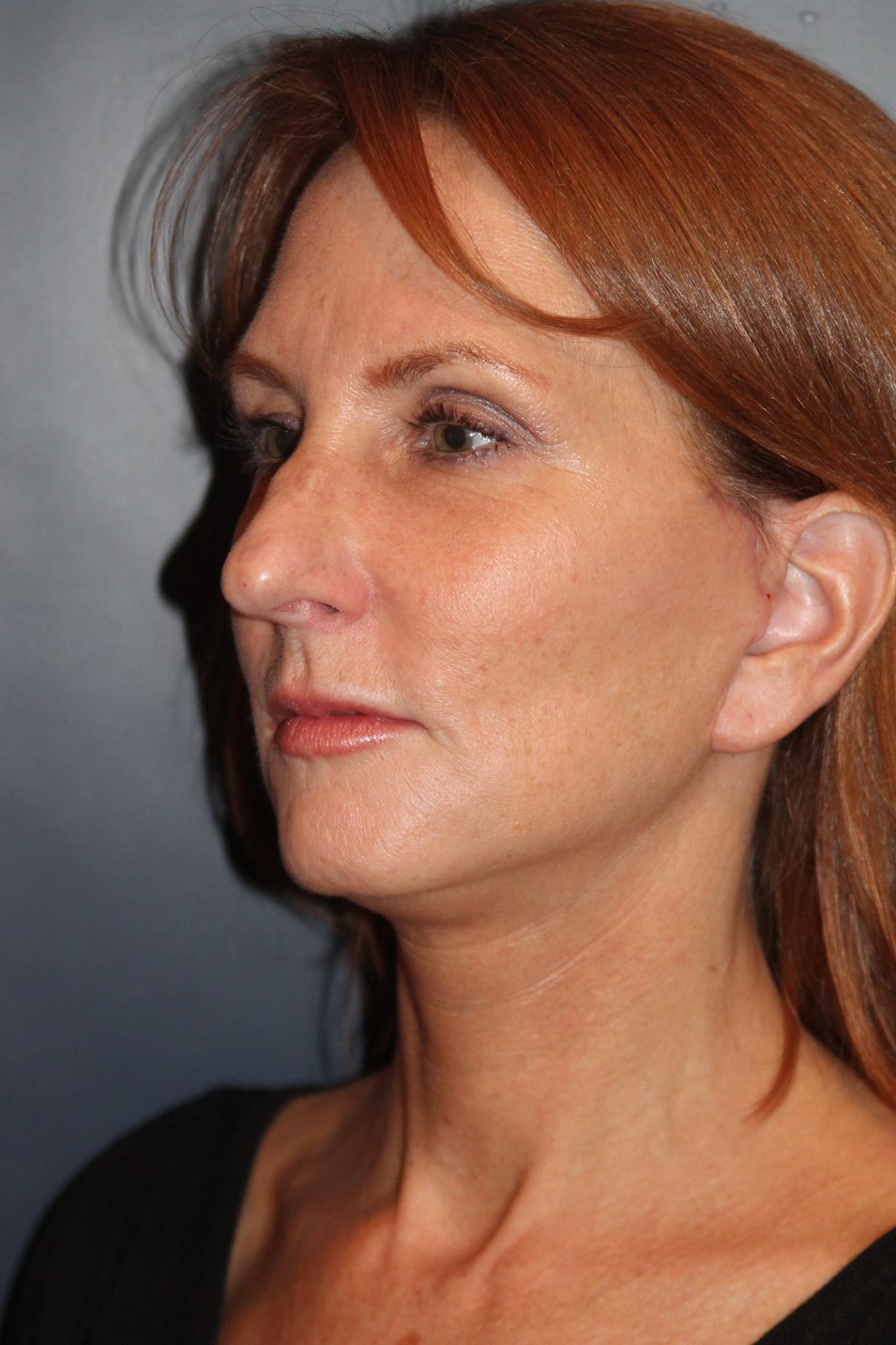
Results/Complications: All patients are discharged home the same day as the procedure. There was no postoperative nausea or vomiting. Most patients only took Tylenol postoperatively. Some patients had Tylenol PM at night and 5 mg Valium for anxiety or feeling of tightness. There were two small hematomas evacuated with a syringe during a postoperative visit. One patient had a seroma over the parotid gland that required multiple syringe aspirations till resolved. One patient developed a swimmer's ear infection under the concha 8 days after surgery, resolved with oral antibiotics. One other patient acquired an MRSA 6 days after surgery from reused home towels. 3 pixie ears were noted with long term follow up. All patients with conscious sedation reported an excellent operative experience on a post-procedure questionnaire.
Conclusion: Emend may help prevent postoperative nausea and vomiting. The 2-0 PDO quill may help long-term SMAS elevation and prevent exposure of permanent Ethibond suture. Elevating the head rest can help elevate the SMAS and skin under no tension intraoperatively and give superior results. Patient satisfaction was excellent in 63 %, good in 27%, fair in 8% and unsatisfactory in 1%.