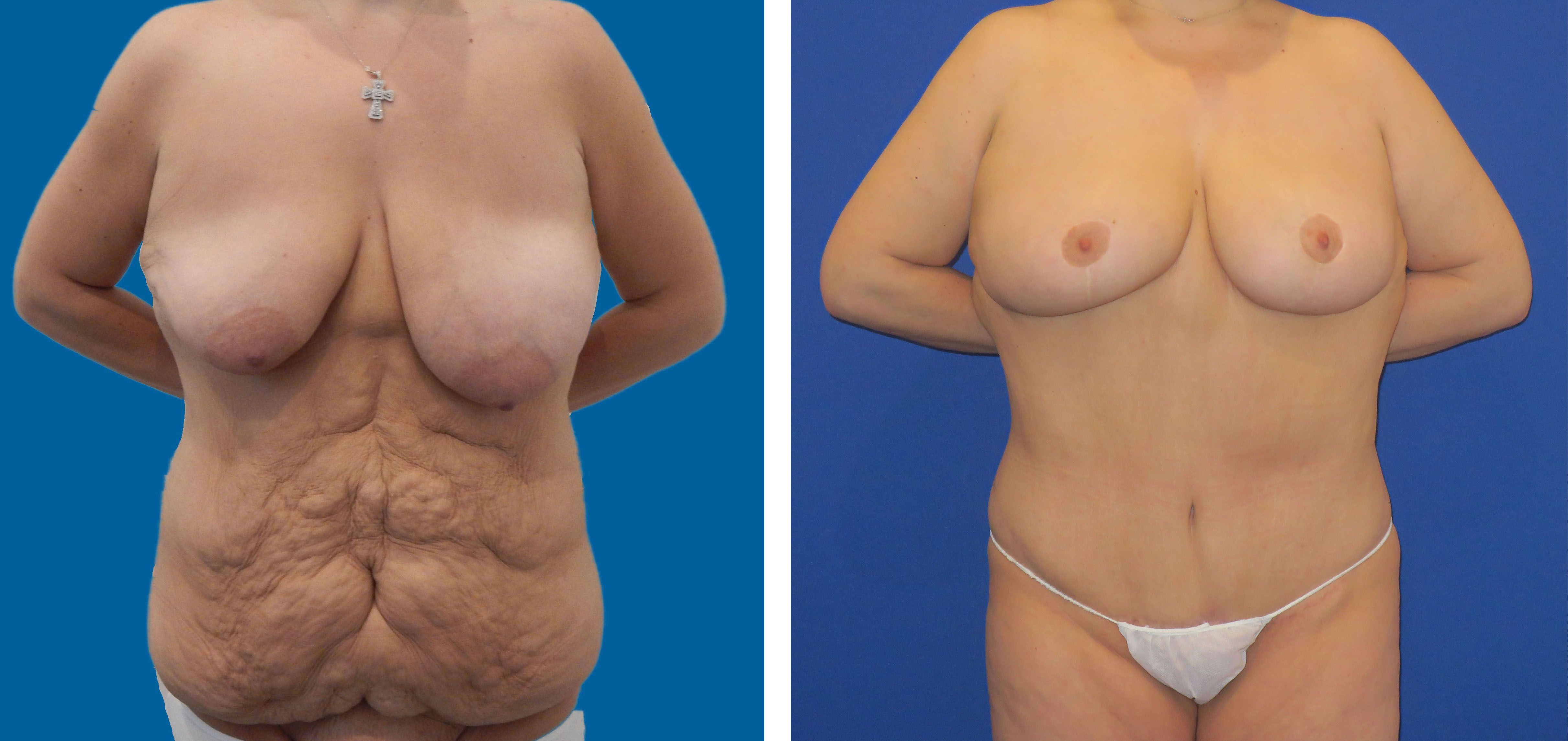
Abdominoplasty in the Massive Weight Loss Patient: Should a Different Aesthetic Standard Apply?
Methods/Technique: This is a retrospective study examining a single surgeon experience over a twelve-year period. 910 women were available for study and consisted of three groups: postpartum (n=718, mean BMI 26.74), dietary MWL (n=65, mean weight loss 85.49 pounds, mean BMI 28.28) and bariatric MWL (n=127, mean weight loss 107.74 pounds, mean BMI 30.12). All patients were approached with a well-defined set of aesthetic goals which were pursued as needed and as feasible. Complications were assessed by univariate/multivariate analysis and propensity score case-control matching.
Results/Complications: The utilization of aesthetic abdominoplasty components and simultaneous aesthetic procedures was similar in the postpartum and MWL groups, supporting the assertion that the groups were subjected to a similar aesthetic emphasis. Univariate analysis showed that bariatric MWL patients had a higher rate of total complications than postpartum patients (31.49% vs. 22.70%, p= 0.030), and multivariate analysis (logistic regression) showed that a history of bariatric MWL was an independent risk factor for multiple complications (OR 2.738, p=0.014). Multivariate analysis also showed that elevated BMI at abdominoplasty was an independent risk factor for major flap loss, fat necrosis, seroma, any complication, aggregate ischemic complications and multiple complications, a history of smoking was an independent risk factor for major and minor flap necrosis and aggregate ischemic complications, diabetes was an independent risk factor for minor flap necrosis and aggregate ischemic complications, and age was an independent risk factor for venous thromboembolism, infection, and multiple complications. The dietary MWL group had only a higher risk of seroma formation on univariate analysis. A direct comparison of the dietary and bariatric MWL groups with propensity score matching matching showed a statistically significant higher rate of multiple complications in the bariatric MWL group (9.52% vs. 0%, p = 0.031).
Conclusion: In this study the MWL abdominoplasty patient was approached like any other abdominoplasty candidate, with consideration given to more complete aesthetic refinement with such aesthetic components as fascial plication, flank liposuction, sub-Scarpa’s lipectomies, and simultaneous aesthetic procedures. Bariatric MWL patients seem to be at somewhat higher risk for complications although dietary MWL patients seem not to be. Other comorbidities (elevated BMI, smoking, diabetes, age) seem to be more important predictors of complications than MWL status. Surgical risk must be assessed for all patients but select MWL patients (lower BMI, nonsmoking, nondiabetic, dietary MWL) can likely be approached with an emphasis on aesthetic goals, without increasing risks as compared to the postpartum population.