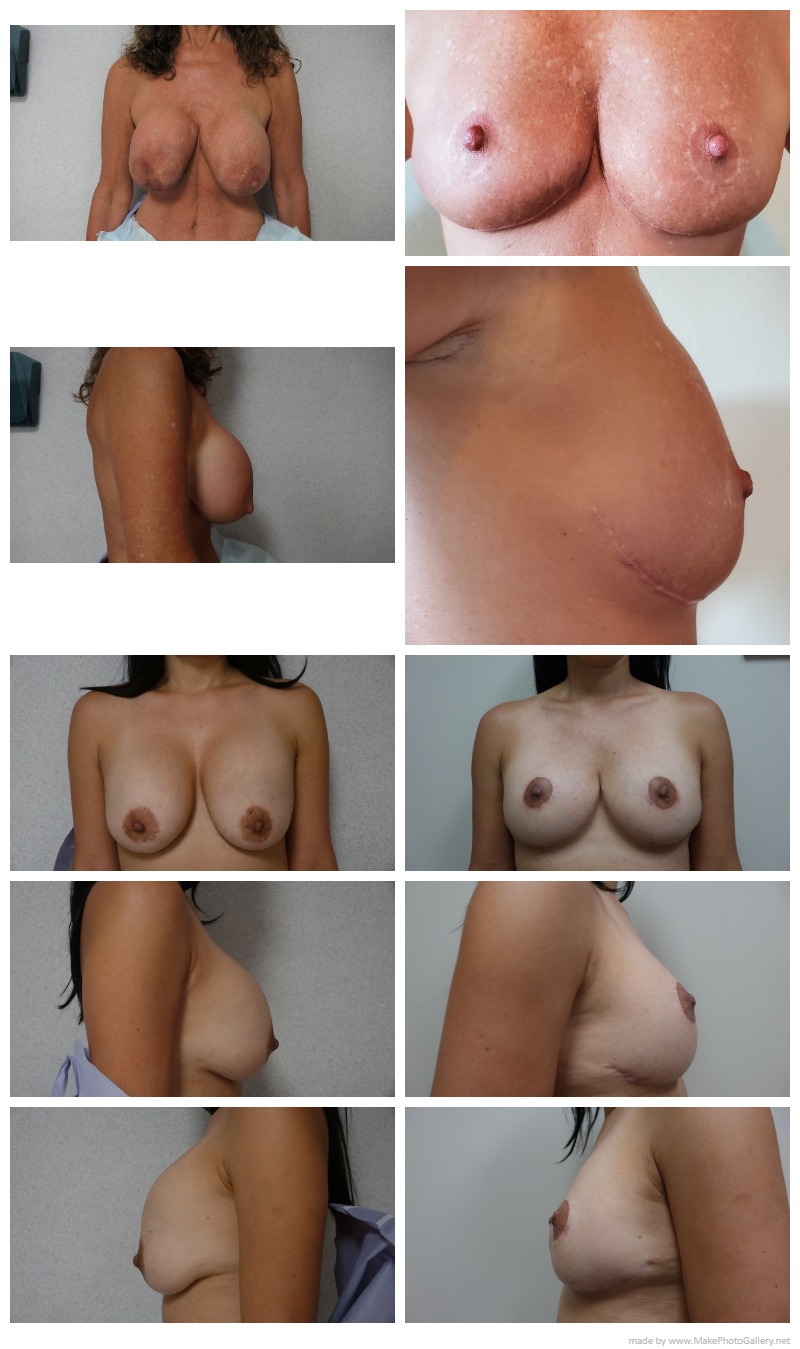
Explantation and No Vertical Scar Auto-Projection Mastopexy
The goal of breast augmentation is to create beautiful, functional breasts. In 2019 The Aesthetic Society reported 280,692 beast augmentations, but 66,982 breast implant removals, a 34% increase from 2018. Failed augmentation necessitates a surgical alternative to achieve the aesthetic and functional desires without implants. Explantation alone results in the loss of projection and a lax skin envelope. Circumareola mastopexy has limited skin resection and results in additional loss of projection. The circumvertical and anchor pattern mastopexies frequently result in inadequate upper breast projection and unacceptable vertical scars. No vertical scar mastopexy techniques have evolved with the goal of improving shape and upper breast projection. Unfortunately, breast implants expand the skin envelope vertically and increase the breasts descent. However, these changes are ideal for the horizontal incisions required for no vertical scar mastopexies.
Methods/Technique:
Thirteen consecutive women who underwent explantation and mastopexy by one surgeon from January 1, 2017 to December 31, 2017 are included in this study. Digital video imaging and software analysis of chest images are obtained to measure breast volume and surface dimensions of the breast and chest wall. These parameters are combined with the implants volume and the woman’s desires to generate a surgical blueprint. The blueprint determines an almond shaped skin pattern, the flap’s origins, insertions and thickness. The breast is divided horizontally at the cephalad border of the areola, into two components, preserving the neurovascular supply and the major lactiferous ducts. A skin flap cephalad to the areola is elevated and provides external coverage. The areola remains attached to a de-epithelized central mound which is rotated into an oblique cone. Dermal straps originating from the base of the cone are passed through breast tissue outside the cone then looped through the pectoralis major muscle and cone repeatedly. The force generated by the muscle is transmitted through the tendon like straps, which entrains breast tissue. Myointegration of the cone maintains rotation, cephalad medial transposition, inclination and breast projection. The cephalad flap is advanced over the cone and closed creating a new inframammary fold. If fat grafting is performed simultaneously, it is injected within the pectoralis major muscle or within the cephalad flap. Fat grafting performed at a second procedure was directed within the de-epithelized cone, which functions similar to an adjustable implant.
Results/Complications:
A retrospective review from 12 of 13 women (92%) was obtained. The mean age at explantation was 48 years (27 to 64 years), mean volume of implants was 360 cm3 (222 to 502 cm3) and the mean follow up was 26 months (22 to 36 months). The reason for implantation was desire for larger breasts in 89% or treatment of tubular breast in 11%. Explantation was chosen by women’s desires in 50%, implant failure in 38% or surgical failure in 62%. Capsulectomy was performed in 16% for calcification or silicone contamination.
Complications requiring return to surgery occurred in two women, a 10 cm3 hematoma or retained keratin cysts. Minor complications were dog ears in five women but only one chose revision with local anesthesia. Other minor complications were suture erosion, hard spots that resolved and left breast numbness. Five women thought their breasts were too small after explantation. Of these, two had undergone simultaneous fat grafting of approximately 100 cm3 to each breast. One of these underwent 300 cm3 fat grafting to each breast two years later and was satisfied with her final results.
Satisfactory results were obtained in 75% of women. The cause of dissatisfaction was reoperation in two women and left breast numbness in one woman. 73% of women chose this mastopexy procedure to avoid vertical scars. 70% of women regretted initial breast augmentation. 36% of women initially desired mastopexies but were redirected to breast augmentation to avoid vertical scars. This raises the question, could the frequency of explantation be significantly reduced by offering a mastopexy that eliminates vertical scarring? If 36% of augmentations were converted to mastopexies, then breast augmentations would drop to 179,643 and the 146,711 mastopexies in 2019 would increase to 247,760. Elimination of the vertical scar may result in mastopexies exceeding breast augmentations.
Conclusion:
Explantation and auto-projection mastopexy has a high satisfaction rate and is an alternative for women who want to avoid vertical scarring. Major complications requiring return to the operating room occurred in 17% and minor complications requiring in office surgery in 8%. Simultaneous fat grafting was limited and unsatisfactory. Secondary fat grafting allowed greater volume by placement within the autogenous cone, which resulted in increased projection and patient satisfaction. Increased public and FDA concerns about complications from breast implants, particularly BIA-ALCL and breast implant illness, may lead to greater demand for explantation. No vertical scar auto-projection mastopexy with possible secondary fat grafting may satisfy increasing future demands.