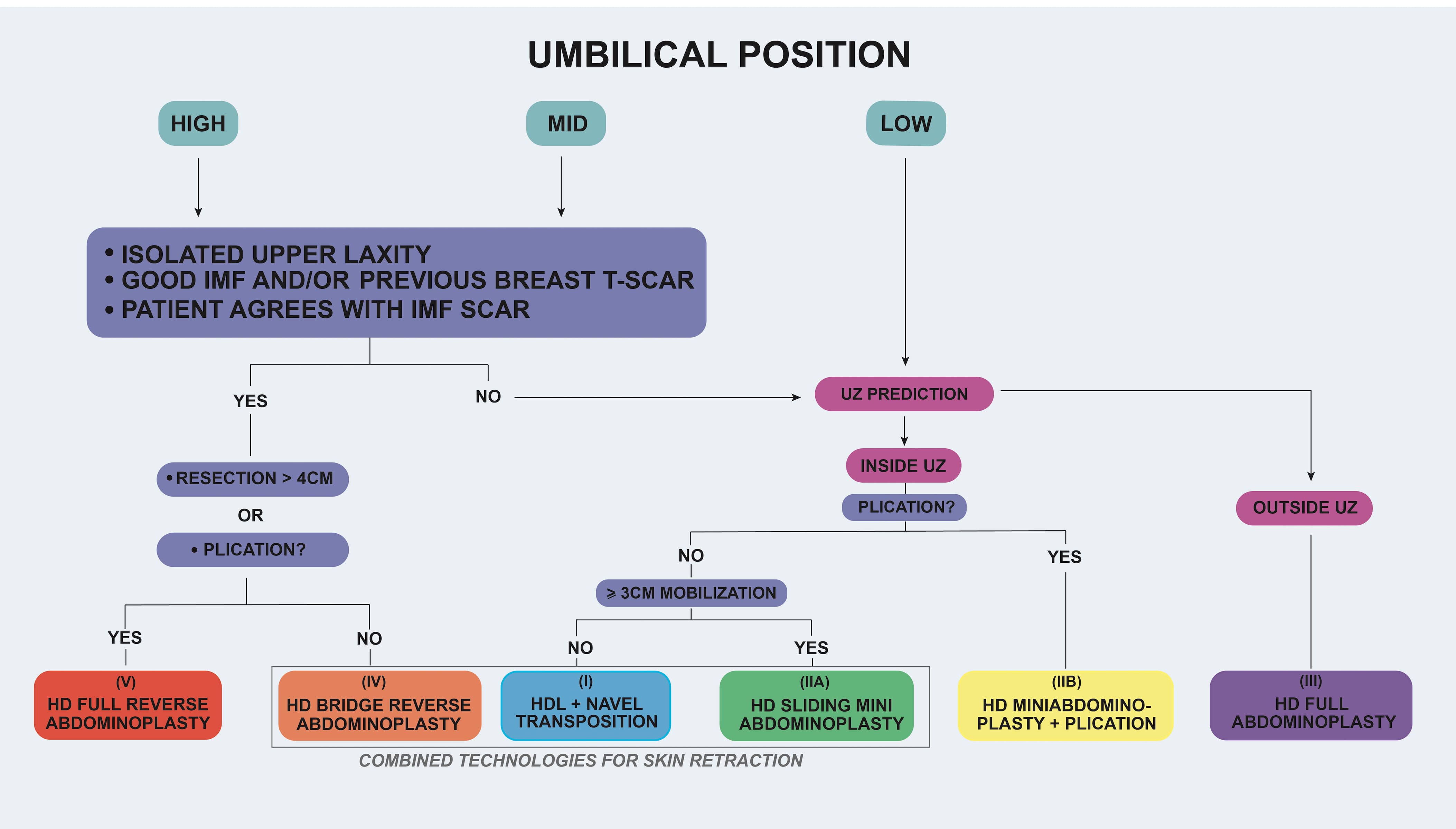
How to Choose the Best Excisional Dynamic Def Procedure: Decision-Making Algorithm.
Plastic Surgeons usually face not only many anatomic variations but also aftermath of previous abdominal procedures at their office, that actually makes it difficult to choose an exact procedure for a certain patient, which ends up in a troublesome decision. So, why not to create a diagram that addresses these concerns and encompasses the most common surgeries, so as to ease our choice? Well, we have figured out a preoperative patient classification based on their current navel position added to the result of the abdominal skin examination. These features would accurately predict what the most adequate body contour surgery should be, of course in addition to High Definition Liposculpture (HDL)[i],[ii]. The latter is based on a 360-degree approach involving most muscular groups and segments of the body; the lights and shadows plus the motion effect that muscles leave over skin while contracting, have been the cornerstone of Dynamic Definition (HD2) Liposculpture which is the uppermost upgrade from HDL[iii]. Besides, the advent of new technologies for skin retraction (Radiofrequency = RF, Helium Plasma = JP) improved even more the aesthetic results by offering more conservative treatments, and so reducing tissue resections. Consequently, we now use these technologies as HDL and HD2 adjuvants for skin retraction in patients who were previously considered candidates for mini tummy tuck procedures.
Methods/Technique:
The Algorithm follows the interaction of 3 components: 1. the degree of skin laxity; 2. the navel preoperative position and its predictive location after excision, and 3. the need of muscular plication.
Patient classification
- Navel preoperative location is classified in reference to the ideal umbilical zone (IUZ) in High, Mid or Low navel.
- Degree of diastasis and its correction: Patient with satisfied parity could undergo a muscular plication when its width is >2 cm.
Procedures
- (I) Umbilical mobilization + mixed technologies.
- (IIA) Sliding mini abdominoplasty + mixed technologies.
- (IIB) Dynamic Definition Mini abdominoplasty.
- (III) Dynamic Definition Full Abdominoplasty[iv].
- (IV) Dynamic Definition Bridge Reverse Abdominoplasty.
- (V) Reverse Full abdominoplasty.
The patient classification and the result of his/her physical exam will guide us to choose the procedure that best fits their anatomic features, and expectations.
Results/Complications
:Pinch test estimates how far the flap should be mobilized and resected. Then, depending on whether the umbilical predictive position (UPP) falls inside or outside the Umbilical Zone (UZ), we will pick the main procedure (Figure 1).
- High navel:
- Go high: Bridge (£4 cm and no muscle plication) Total (³ 4 cm or muscle plication needed); depending on certain conditions:
- Isolated upper skin laxity.
- Good inframammary fold and/or previous inverted T scar.
- Patient agrees with an inframammary fold
- Go low: If UPP drops inside the UZ and no plication is needed, then Procedure I (≤ 3 cm descent) or IIA (> 3 cm) will be the best choices. If the navel descends into the UZ but plication is mandatory, then procedure IIB is the ideal one. If UPP falls below the UZ, then Procedure III would be the best option.
- Mid navel: If no plication is needed and the UPP is inside UZ (≤ 3 cm of descent) then Procedure I should be done. When plication or > 3 cm mobilization are required, and umbilicus is inside UZ, then procedure IIB would be ideal. If the UPP falls below the UZ, Procedure III is the best choice.
- Low navel: These patients are the perfect case for Procedure III, due to the typical location of the navel outside the UZ.
Conclusion:
Our experience encouraged us to design a new decision-making algorithm for excisional body contour surgery will help you to achieve better outcomes in your future patients, since we have discussed 3 critical concepts: 1. the new adjuvant therapy for skin retraction with RF or JP, which enabled us to move into more conservative procedures; 2. the decisive role of the umbilical position on the abdominal contour and aesthetics; and 3. the addition of HD2 premises to a greater spectrum of excisional body contour procedures with a new perspective that aids in the surgeon’s choice when considering the best procedure for any patient.
[i] Hoyos AE, Perez ME, Castillo L. Dynamic definition mini-lipoabdominoplasty combining multilayer liposculpture, fat grafting, and muscular plication. Aesthetic Surg J. 2013;33(4):545-560. doi:10.1177/1090820X13484493
[ii] Hoyos A, Perez ME, Guarin DE, Montenegro A. A report of 736 high-definition lipoabdominoplasties performed in conjunction with circumferential VASER liposuction. Plast Reconstr Surg. 2018;142(3):662-675. doi:10.1097/PRS.0000000000004705
[iii] Hoyos AE, Perez ME, Domínguez-Millán R. Variable Sculpting in Dynamic Definition Body Contouring: Procedure Selection and Management Algorithm. Aesthetic Surgery Journal. May 2020. doi:10.1093/asj/sjaa133
[iv] Hoyos A. Omphaloplasty: X-Shaped Flap Technique. In: Omphaloplasty. Springer International Publishing; 2018:215-223. doi:10.1007/978-3-319-64313-7_16