Gynecomastia Surgery at a Pediatric Burn Center: Aesthetic Outcomes and Complications
Methods/Technique: From 2014 to 2019, one hundred thirty-three patients (n=133) were treated by 11 surgeons. The surgical approaches utilized were direct excision or subcutaneous mastectomy alone, liposuction alone, a combination of both, and with or without simultaneous nipple-areola complex (NAC) reduction or free nipple grafting. Descriptive statistics on the 133 patients in the study included means, medians and measures of variability. Comparisons between gynecomastia patients who had complications and those who did not were made by Student’s t-tests and c2 tests. Statistical significance was set at p < 0.05. All patients were assigned a gynecomastia grade based on the ASPS Gynecomastia Scale adapted from the McKinney and Simon, Hoffman and Kohn scales. Four independent raters completed a 5-point Likert scale (1-least desirable to 5-most desirable) to subjectively assess aesthetic outcomes (i.e. chest shape, scar severity, symmetry, nipple/NAC position and appearance, and overall appearance). We used univariate analyses to determine which variables significantly influenced the outcome score.
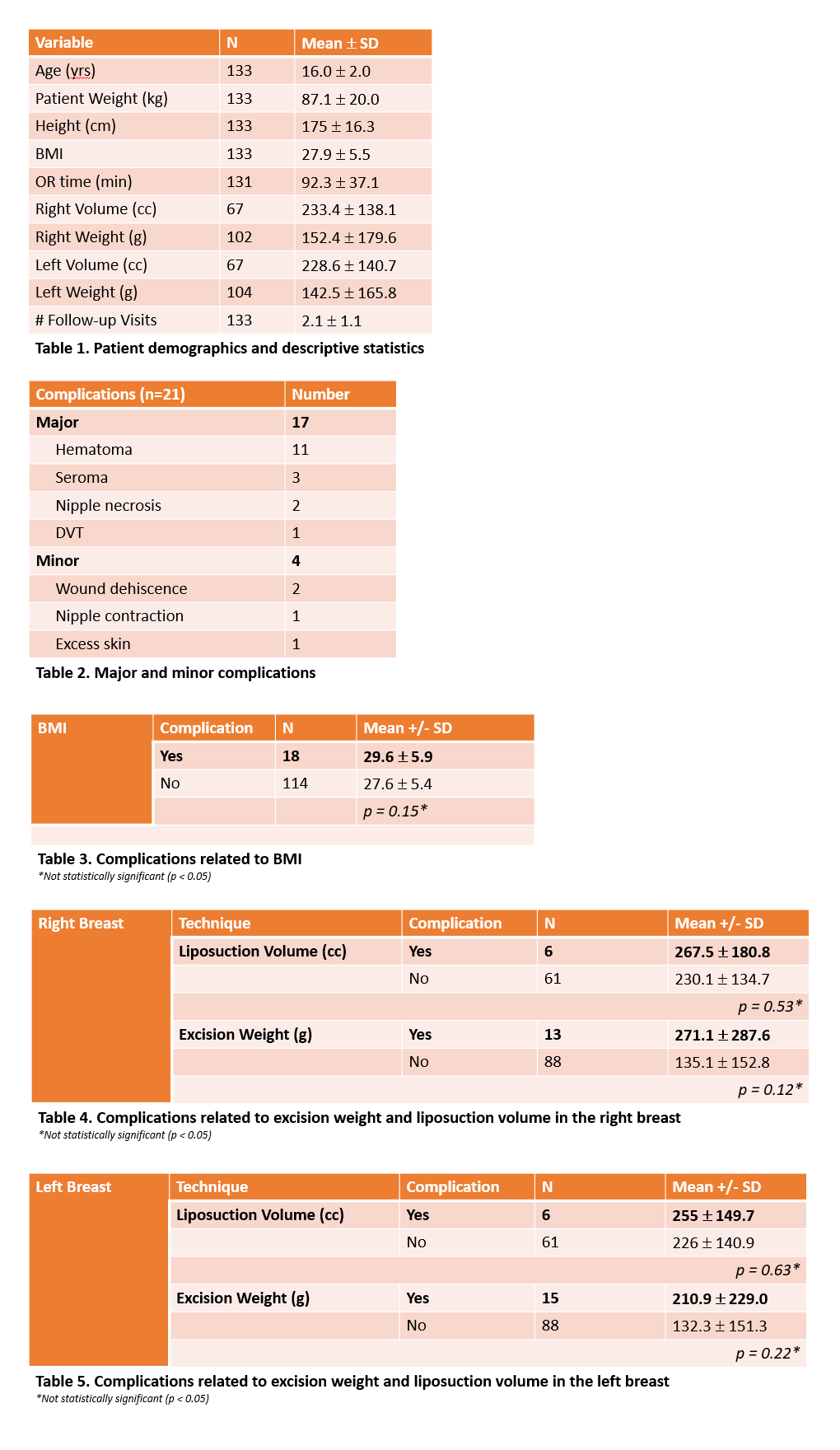
Results/Complications: The average age and weight at the time of intervention was 16 ± 2 kg and 87.1 ± 2 kg, respectively (Table 1). Among our patients, 13.6% (n=18) had a complication that is categorized as either major or minor (Table 2). Overall there were a total of 21 major and minor complications (15.7%). There were 17 major complications, defined as a hematoma, seroma, nipple necrosis, and DVT, and 4 minor complications, defined as wound dehiscence, nipple contraction, and excess skin requiring re-excision. BMI was not found to be a statistically significant predictor of complications (p=0.15) (Table 3). Patients with greater liposuction volumes and excision weights lead to higher observed complications although these results were not statistically significant (Tables 4 and 5). Placement of a drain and type of drain did not lead to significant differences on outcomes (p=0.16 & p=0.49, respectively). A group of independent physician reviewers rated aesthetic outcomes based on standardized postoperative photographs.
Conclusion: Reported complication rates after gynecomastia surgery historically have been significantly high.1-3 We report our reduced complication rate of 13.6% in a large cohort of patients at a major pediatric burn center. BMI, age at intervention, excision weight, placement of a drain, and surgical technique did not lead to significantly higher adverse events. Contributing factors to our lower rates observed may in part be due to our aggressive immediate post-operative use of anti-emetics, a 6-week course of compression wrapping, and a reduced physical activity regiment. Based on our results from independent reviewers, we have developed a treatment algorithm to optimize aesthetic outcomes based on gynecomastia grade. Proper counseling of patients is necessary to ensure adequate understanding of gynecomastia surgery, postoperative course, and outcomes. Ultimately, results from this analysis has led our institution to reconsider timing and intervention on patients previously excluded, which may correlate to earlier improvements in mental health.
1 Fagerland A, Lewin R, Rufolo G, Elander A, Pompeo FS, Selvaggi G. Gynecomastia: A systematic review. J Plast Surg Hand Surg. 2015;49(6):311-8.
2 Lanitis S, Starren E, Read J, et al. Surgical management of gynaecomastia: outcomes from our experience. Breast. 2008;17:596-603.
3 Wiesman IM, Lehman JA, Parker MG, et al. Gynecomastia: an outcome analysis. Ann Plast Surg. 2004;53:97-101.