A Geometric Approach to the Aesthetics of Eyes in Young Asian Women
The objective of this study was to understand which anthropometric measurements and angles determine attractiveness in young Asian eyes. The goal of this study was to discover the most important features of attractiveness in Asian eyes to help guide surgical techniques.
Methods/Technique
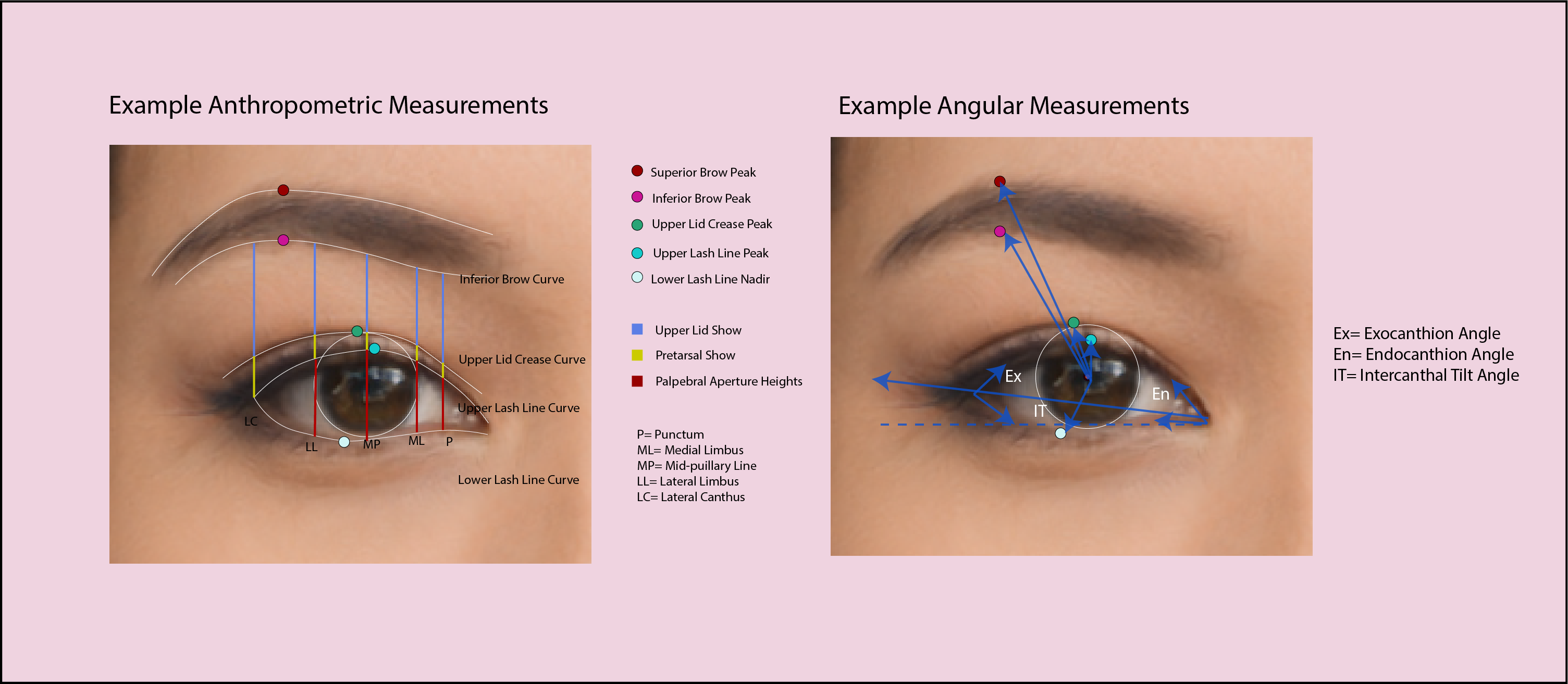
:Frontal facial photos of young Asian women (approximately mid-twenties) were collected from publicly available sources online from August to October 2020. Photos with excessive makeup distorting anatomy, non-neutral expressions, ptosis, a monolid crease, or a negative intercanthal tilt were excluded. The periorbital region of each eye was cropped and all left eyes were reflected across a vertical axis to gather a collection of only right eyed images. These images were evaluated by 10 people of varying ethnicities, age, and occupation on a likert scale of 1-5 determining attractiveness. Images were subsequently standardized by iris diameter and analyzed using ImageJ software. Thirty-eight measurements relating various eye anatomy were collected from each attractive and unattractive eye. Finally, peak points from the brow, upper lid crease, upper lash line, and lower lash lines were imposed on a golden spiral to determine goodness of fit for the attractive and unattractive eye cohorts.
Results/Complications
:A set of 322 young Asian eye photographs were evaluated for attractiveness. Eyes that received a majority rating of ³ 4 from 10 evaluators were designated as attractive, while those that received a majority rating £ 2 were deemed unattractive. These thresholds were set to find only the most significant differences between the attractive and unattractive cohorts. A total of 66 attractive eyes and 43 unattractive eyes were compared using 38 unique measurements.
Peak Points
The distance from the superior brow peak to the lateral canthus was significantly smaller in attractive eyes, 23.02 ± (2.7) mm compared to unattractive eyes 26.18 ± (3.09) mm, (p=<0.001). The angle of the superior brow peak was lower than that of the upper lid crease peak and upper lash line peak from the pupil center in attractive eyes 65.38 ± (7.76), compared to unattractive eyes, 72.08 ± (9.98), (p<0.001). The upper lid crease and upper lash line peaks were approximately 8-9 degrees medial to the superior brow peak in attractive eyes compared to ~6 degrees lateral in unattractive eyes, (p=0.01).
Upper Lid Show and Pretarsal Show
The upper lid show at the punctum, medial limbus, mid-pupillary line, lateral limbus, and lateral canthus were all significantly smaller in attractive eyes. The ratio of the upper lid show to pretarsal show in attractive eyes was less than in unattractive eyes at the lateral canthus (2.74 ± (1.16) vs 3.48 ± (1.82), p=0.04). and medial limbus (3.8 ± (1.9) vs 6.01 ± (4.45), p=0.01).
Palpebral Aperture to Upper Lid Show Ratios
The maximum palpebral aperture height was not significantly different across groups (10.94 ± (1.24) vs 10.8 ± (1.33), p=0.70). However, when comparing ratios of the aperture heights to upper lid show along the punctum, medial limbus, mid-pupillary line, and lateral limbus, attractive eyes had greater ratios than unattractive eyes. For example, at the mid-pupillary line the palpebral height to upper lid show ratio was ~2:1 for attractive eyes compared to ~3:2 for unattractive eyes, p=<0.001.
Miscellaneous Measurements
Intercanthal height, tilt, and medial canthal angle were not significantly different across groups. However, the angle of the lower lash line as it bends at the punctum was greater in attractive compared to unattractive eyes. This angle measures the smoothness of curvature of the lower lash line. The distance from pupil center to the lateral canthus was lower in attractive eyes, 12.75 ± (1.69) vs 13.68 ± (1.21), p=<0.001.
Conclusion
:The features determining attractiveness in Asian eyes may be different than in Caucasian eyes. While in Caucasian eyes a greater positive canthal tilt, higher ratio of upper lid show to pretarsal show, and lateralized peak points deem attractiveness, in attractive Asian eyes these relationships do not hold true.
In attractive young Asian eyes the superior brow peak position is far more important and its relation to the peak points of the upper lid and upper lash line. In fact, these peak points may be medialized in the Asian eye and still be attractive so long as the superior brow peak is more lateral. Furthermore, in Asian eyes, the ratio of palpebral heights to upper lid show seem to be more important than pretarsal show. An understanding of these proportions can help guide double-eyelid surgery, brow lifts, and filler injections. Finally, too great of a distance from the center of the pupil to the lateral canthus may lead to an unattractive eye, which has important implications for the planning of a lateral canthoplasty or canthopexy.
While the golden spiral has been purported to have significance in attractive eyelid topography in Caucasian eyes, we found that it does not have much relevance in determining attractiveness in Asian eyes.