Sliding Osseous Genioplasty: A Viable Alternative to Implant Exchange in Patients with Previous Chin Implantation
Surgical chin implantation is performed to improve overall facial harmony. Over time, implant complications, significant bony erosion, or worsening aesthetic appearance may necessitate re-operation, classically with re-implantation. Here, we examine the morphologic outcomes of patients receiving implant removal and sliding osseous genioplasty instead of re-implantation.
Methods/Technique
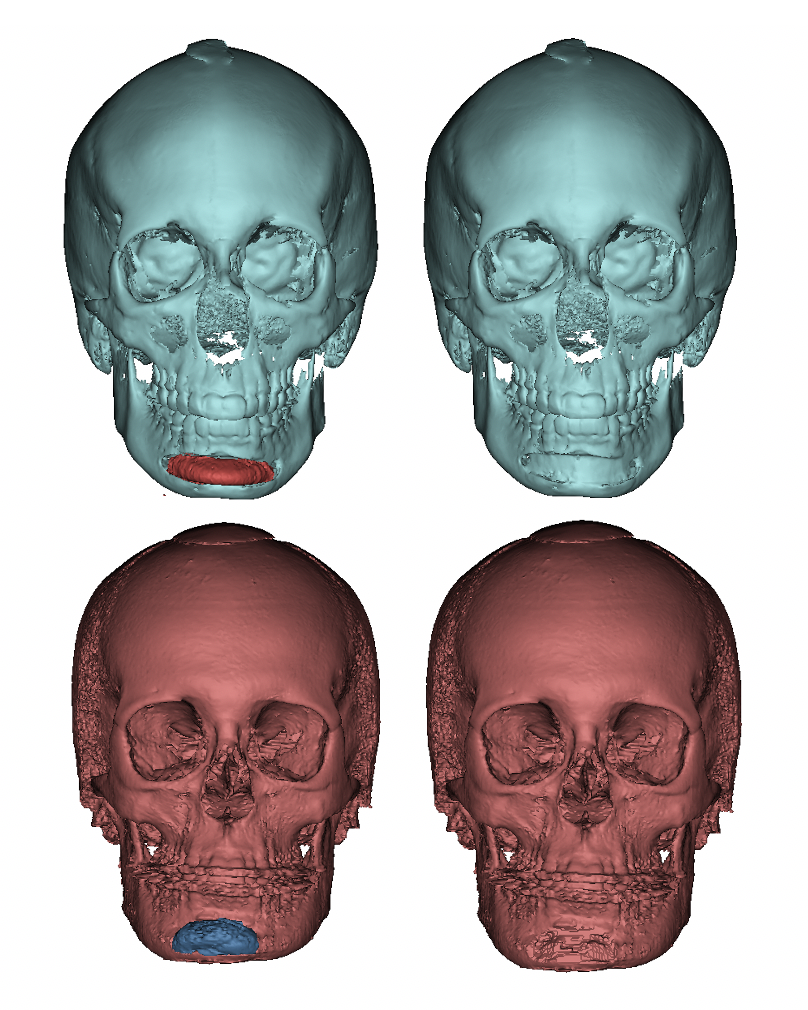
:Pre- and post-operative CT scans from patients receiving implant removal and sliding osseous genioplasty from two surgical centers were assessed using Mimics 3D software. Volumetric analyses were performed to estimate the size of the chin implant and the amount of bony erosion. Cephalometric measurements of chin morphology were utilized to assess bony and soft tissue chin movement and projection following surgery. Anatomic ratios were calculated and compared to age-matched controls.
Results/Complications
:8 preoperative and 4 postoperative CT scans were analyzed from 9 patients receiving implant removal and sliding osseous genioplasty. Significant bony erosion was seen beneath the implant in all preoperative images, with as much as 75% of the implant volume eroding through bone in some cases. Following implant removal and genioplasty, patients had increased tissue chin projection as evidenced by both soft tissue and bony linear and angular measurements: increased gonion-pogonion length bilaterally (p<0.05), increased condylion-pogonion length bilaterally (p<0.05), increased nasion-sella-gnathion angle (p=0.01), and increased sella-nasion-pogonion angle (p<0.001). Post-operative chin anatomic ratios more closely approximated that of normal age-matched controls.
Conclusion
:Chin implants were associated with significant bony erosion and abnormal morphologic characteristics in our study patients. Implant removal with subsequent osseous genioplasty improved chin projection and facilitated a more normal chin appearance.