The Readability, Quality, and Technical Aspects of Cosmetic Injectable Websites
Patients access online cosmetic health information to help with decision making. This information is unregulated, variable in quality, and may be biased. The purpose of this study was to compare the most popular cosmetic injectables websites and to assess their readability, quality, and technical performance.
Methods/Technique
:A Google search for “Botox” and “Fillers” was performed in July 2020, identifying the most popular health information websites. Sites were analyzed for their readability using eight established tests used commonly by school teachers to determine reading difficulty. Health information quality was assessed using the validated DISCERN criteria and the Health on the Net principles (HONCode). Technical qualities were evaluated using two website evaluation algorithms, WooRank and WebsiteGrader which assessed a site’s performance, security, search engine optimization (SEO), social media integration, mobile friendliness, and ease of use.
Results/Complications
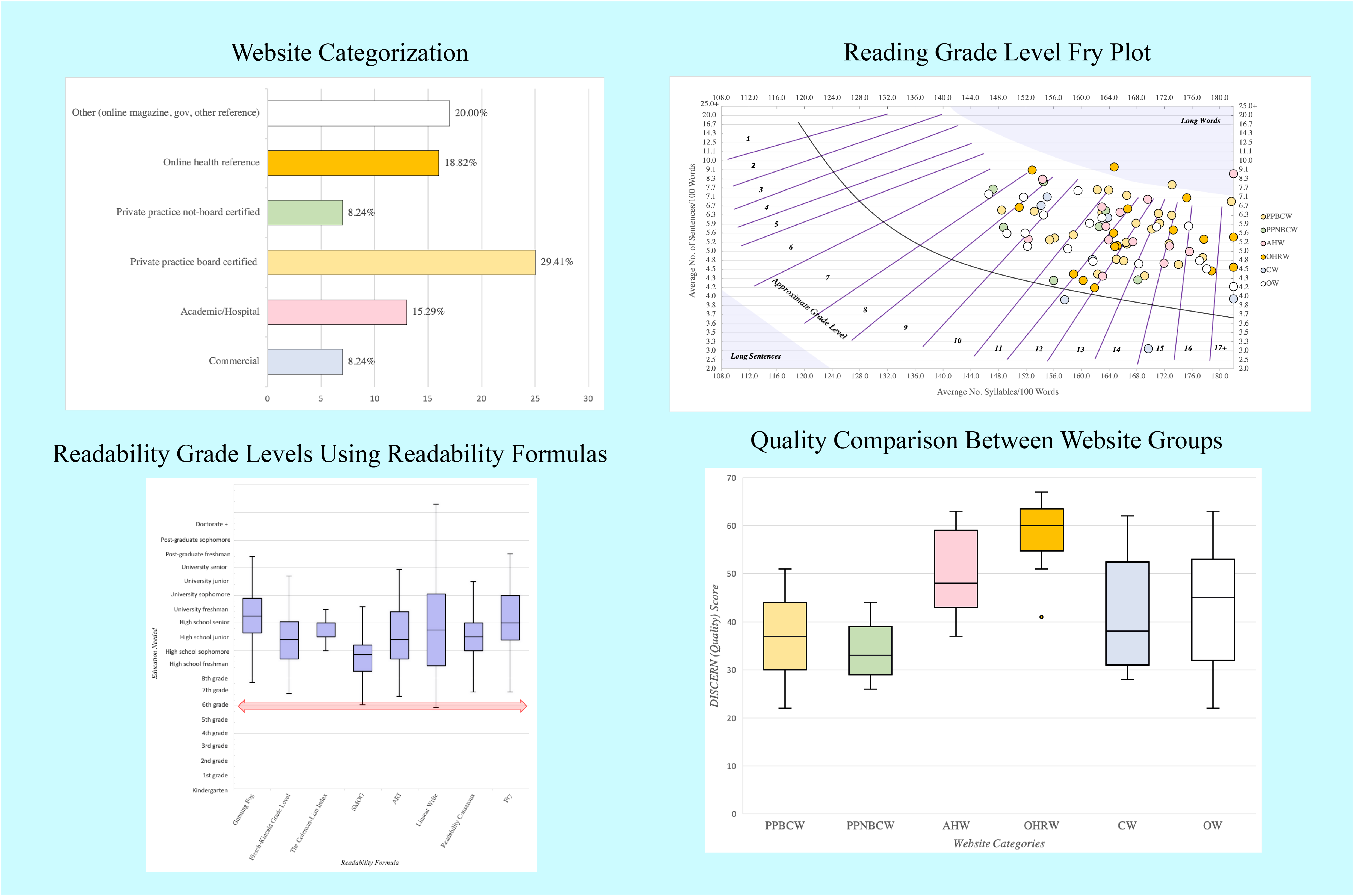
:Eighty-five websites were analyzed (13 academic/hospital websites (AHW), seven commercial websites (CW), 25 private practice board-certified websites (PPBCW), seven private practice not board-certified websites (PPNBCW), 16 online health reference websites (OHRW), and 17 other websites (OW). The mean readability consensus score was 11 (eleventh-grade reading level). The mean DISCERN quality scores were higher for OHRW (58.4) compared to AHW (49.8, p=0.045), CW (42.1,p=0.045), PPBCW (36.8, p<0.001), and PPNBCW (34.1, p=0.002). No correlation between a website’s rank and its DISCERN score was found, r= -0.07 (p=0.49). WooRank and WebsiteGrader scores were lower for CW (63.3, 60.1) compared to OHRW (77.8, 73.3, p=0.03).
Conclusion
:Cosmetic injectable websites are too difficult to read by the 6th grade standard recommended by the National Institutes of Health (NIH) and the American Medical Association (AMA).This has implications for the ability of many patients to be fully informed consumers. When compared across categories there was no difference in readability among websites, suggesting that all website author contributor groups need to simplify language, use fewer complex words, eliminate technical jargon, and shorten sentences to deliver more readable information.
OHRW sites are superior in quality compared to all other groups, including physicians regardless of board-certification status. Physician based websites should look to OHRW as a resource when designing the content of a site. Furthermore they should include aspects related to treatment side effects, alternative treatment options, and the effect of a treatment on a patient’s quality of life while citing references to evidence these claims.
Physicians may benefit from the use of online technical software to evaluate and improve their websites. These technical software programs generate reports highlighting strengths and weaknesses of a website. They may suggest adding key words, social media integration, or image use for better SEO. Furthermore they may provide insight into a website’s security, mobile friendliness, ease of access, and navigation. Enhancing these technical aspects may lead to more accessible information, allowing patients to become more informed.
Since patients heavily rely on online health information to guide their medical decisions, increasing the readability, quality, and technical aspects of a website may lead to more productive in-office conversations and greater satisfaction with treatment results. Online information has the ability to set expectations, inform patients, help guide patients to correct treatment options, and keep them safe. These intended effects can only be realized with readable, high quality, and technically accessible health content.