15-Year Outcome Data Evaluating the Utilization of High-Resolution Ultrasound in Breast Implant Revision Patients and Tips on Integrating Ultrasound into Your Practices
High Resolution Ultrasound (HRUS) is rapidly becoming an extension of our physical exam and finally emerging into the forefront of plastic surgery in the evaluation and follow-up of patients with breast implants. Improving breast implant technology with stronger more uniform shells, higher fill volumes and increased gel cohesivity is merging with continued improvements in HRUS coming together resulting in much more accurate way to evaluate implants. The FDA has reversed it’s prior decision for MRI screening and just released new recommendations (October 2019) for HRUS screening for silent rupture of breast implants beginning 5 years following implantation and every 2-3 years thereafter. The goal of this presentation is to report Level II outcomes of an exploratory cohort in our first 680 confirmed surgical patients undergoing HRUS, review the state of the art of this technology and to present pearls and benefits of incorporating this new technology into our practices.
Methods/Technique:
Over the past 15 years, more than 2500 breast implant patients have undergone HRUS imaging in our practice. We performed 680 surgical revisions in sequential patients during this time who also had preoperative HRUS performed with their implant diagnosis confirmed at surgery. The first 100 patients were examined with HRUS performed both by me and a board-certified radiologist independently. Determination of whether the implant was intact or not was documented and also if any fluid was present around the implant. True positive, false positives and predictive values were then determined. A Terason Ultrasound system was used to obtain images in these patients with a variable 12-15 MHz transducer. A specific imaging pattern was developed, and images recorded.
Ultrasound now has become an extension of my physical exam and I am ultrasounding, on average 12 patients a day, 20-30 patient a week as part of their routine breast implant follow-up. HRUS is easily incorporated into a plastic surgery practice, and patients are excited and assured knowing the status of their implants. Shell surfaces differences, smooth verse textured and detectable fluid around an implant is definable and increasingly important to follow in breast implant patients. HRUS has also transformed seroma management in the breast and body and is easily learned and transferable to other surgeons.
Results/Complications:
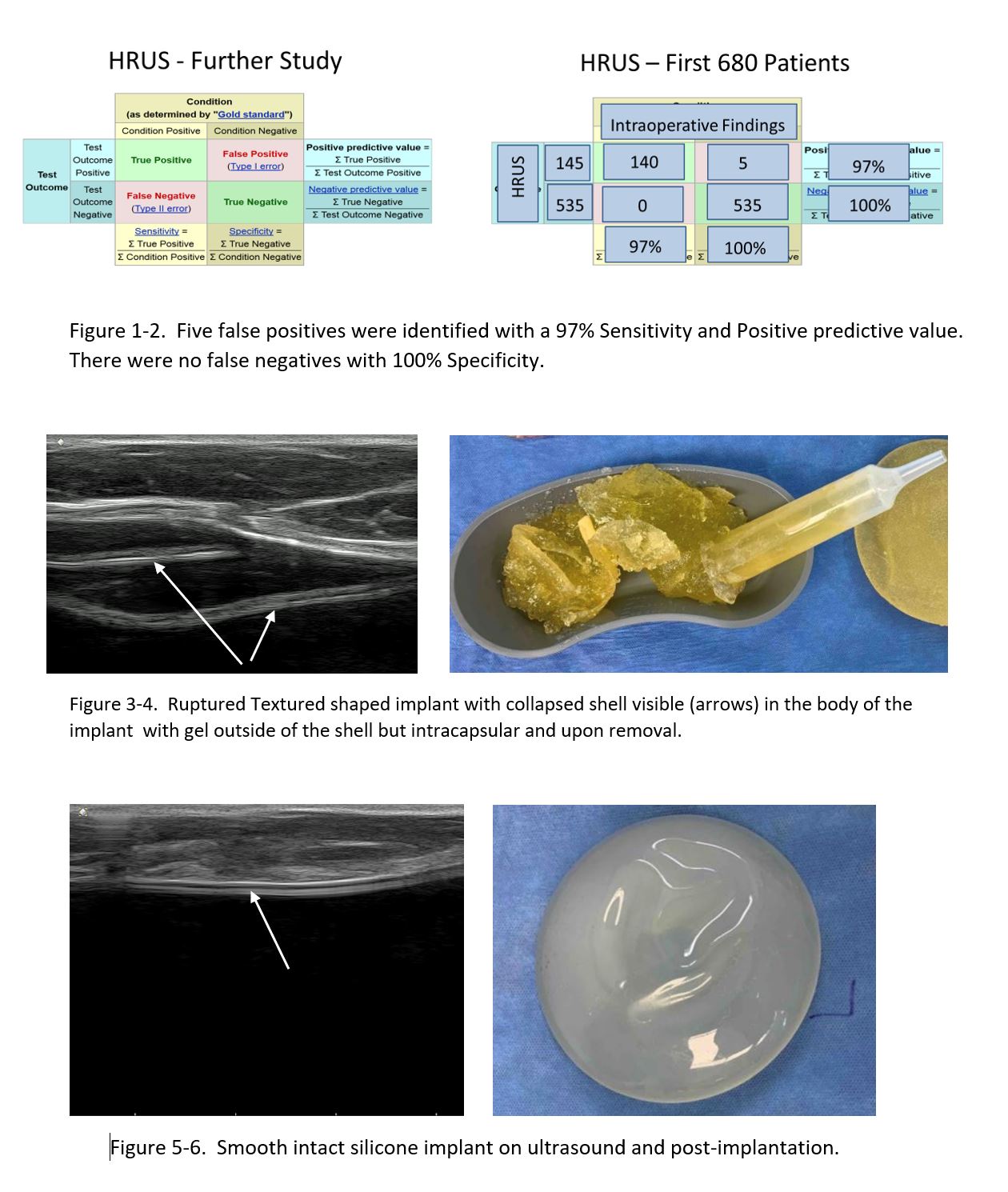
Over 2500 breast implant patients have been scanned with HRUS over the past 15 years at our center with 680 sequential breast revision patients having their preoperative ultrasound findings confirmed at surgery. We had 5 false positives in our first 300 patients with a Sensitivity rate of 97% (True Positive/Condition Positive), and Zero false negatives 100% Specificity (Fig 1-2). When an implant was identified as intact, it was indeed found intact in surgery (Fig.3-6). Although not specifically the focus of this study, fluid collections throughout the body are easily identified and treated under ultrasound guidance with differences between true fluid and tissue edema easily differentiated. his technology takes an average 7 minutes to complete per patient and is easily incorporated into a surgeons practice during their patient follow-up and we are showing it is teachable and transferrable to other surgeons and providers.
Conclusion:
Everyone needs a better imaging and screening tool for breast implant evaluation. The FDA, implant companies, plastic surgeons and particularly our patients all require a safe, fast, portable, reliable and accurate new diagnostic tool. The FDA has just released (October, 2019) their recommendation for HRUS to be used as a screening tool beginning 5 years following implantation and every 2-3 years following. Historically, ultrasound has been utilized to evaluate breast implants particularly in the 1990’s but has given way to MRI. Our study shows that one center dedicated to the implementation of HRUS can be extremely accurate in the diagnosis of shell failure with a 97% Sensitivity and Positive Predictive value and a 100% Specificity recognizing when implants are intact. Similar outcomes of growing plastic surgeon experiences (Adams, Salzman, Jewell, Edwards...) are reporting similar highly accurate results in identifying shell failure. We recommend early users refer questionable HRUS scans for additional screening with HRUS or MRI. However, most patients have multiple factors for implant exchange. We have also shown this technology is easy to learn and is transferrable to other board- certified plastic surgeons. We are developing a broad network of plastic surgeons and introducing ultrasound and helping them integrate HRUS into their practices. In addition, we are initiating additional multicenter studies and working with our societies to develop HRUS educational platforms and eventually credentialing courses.