Orthognathic Considerations in the Rhinoplasty Patient: A Treatment Algorithm for Optimizing “Profileplasty” Outcomes
Rhinoplasty has a powerful impact on the facial profile. Classic rhinoplasty, however, often underemphasizes the chin and facial support. The purpose of this study was to review the facial profiles of rhinoplasty patients at our institution in order to describe common facial and nasal profile patterns, and to develop a diagnostic algorithm for a more holistic “profileplasty” correction.
Methods/Technique
:All rhinoplasty patients treated by the senior author from 2011-2018 were reviewed.
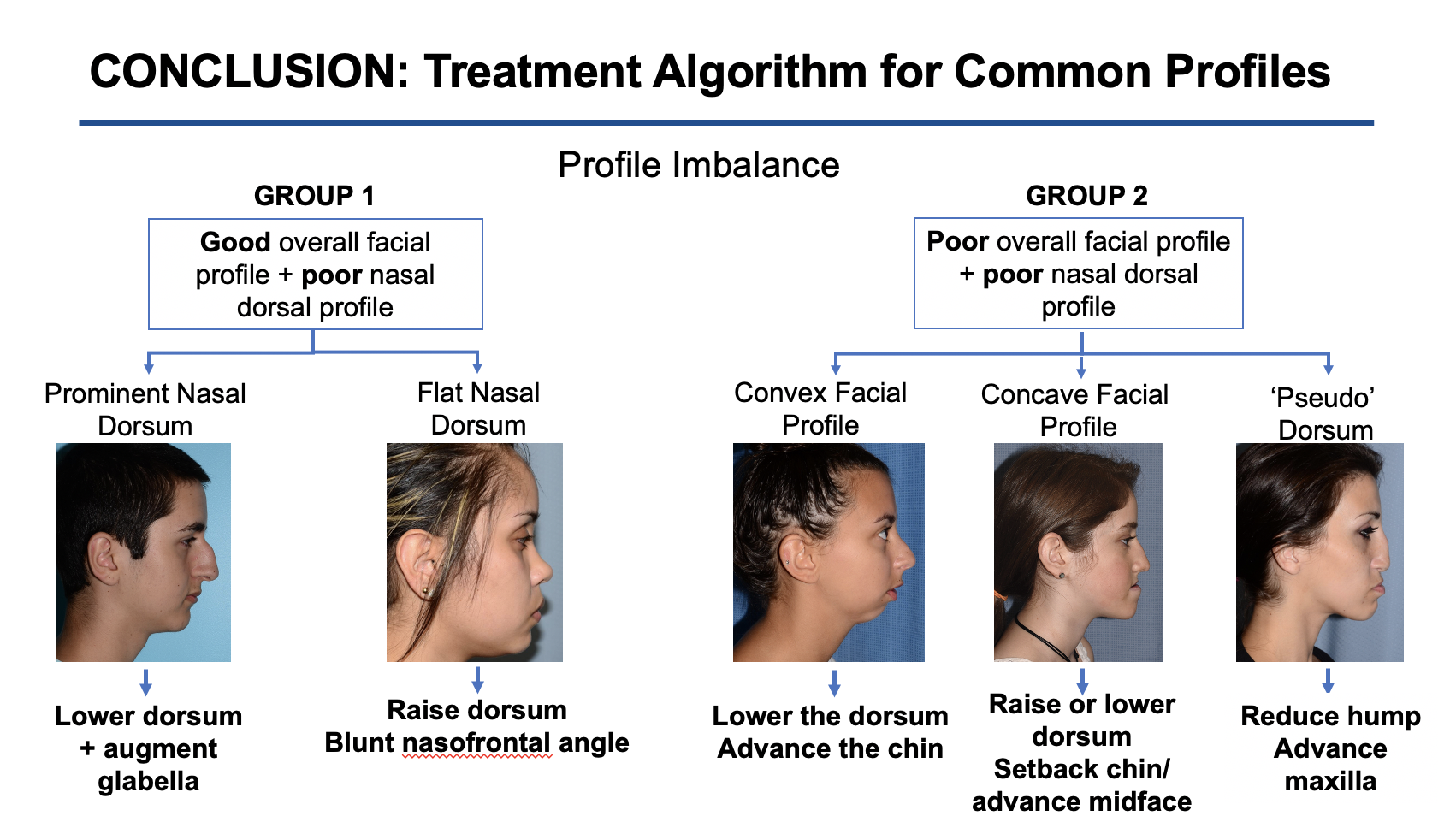
Patients were categorized into two primary and six secondary subgroups according to the type of facial imbalance observed. Treatment plans and outcomes were reviewed across patient subgroups in order to enumerate recommended treatments for each patient type.
Results/Complications
:A total of 715 rhinoplasty cases were reviewed. There were two general categories of patient profiles identified among patients: Group 1 (those with good overall facial profile but poor nasal profile) and Group 2 (those with poor overall facial profile and poor nasal profile). Analysis of Group 1 patients resulted in 2 subtypes: 1a) those with a prominent or 1b) flat nasal dorsum. Treatment in both of these subtypes focused on balancing the dorsal height and nasofrontal angle. Analysis of Group 2 patients resulted in 3 subtypes: 2a) those with a convex profile (nasal prominence with microgenia), 2b) those with a concave profile (prominent chin), and 2c) those with a “pseudo-dorsum” occurring secondary to retroposition of the lower third of the nose. Treatment plans in Group 2 centered around reducing the nasal dorsum and repositioning of the maxilla and/or chin.
Conclusion
:Characterizing and correcting the facial and nasal profile can be complex. We describe a series of common facial and nasal profile patterns and an algorithm that allows for systematic identification of the deformity found and its appropriate treatment. Case examples are reviewed to highlight outcomes of the proposed “profileplasty” algorithm.