Data Driven Insights on the Effects of COVID-19 on the Aesthetics Market
The COVID-19 pandemic has caused significant changes for aesthetic plastic surgeons. Understanding patient interests in various parts of medical aesthetics will be important as plastic surgeons prioritize aspects on their reopening to maximize efforts and allocation of resources. This study aims to passively and actively query public interest in aesthetics.
Methods/Technique
:In Part I, Google Trends was used to see relative search volumes over the course of 4 years for a variety of aesthetic related categories: surgery or surgeons, patient chief complaints, injectable procedures, breast procedures, face procedures, and body procedures. Data were deseasonalized and represented graphically. Significance of each time-point differing from the expected values was determined using least squares regression. In Part II, Amazon’s Mechanical Turk platform was used to crowdsourced public opinions regarding aesthetic interventions from April 30-May 3, 2020. The survey discussed prior experience with and interest in six aesthetic interventions before and during the pandemic, and reasons for changing interest.
Results/Complications
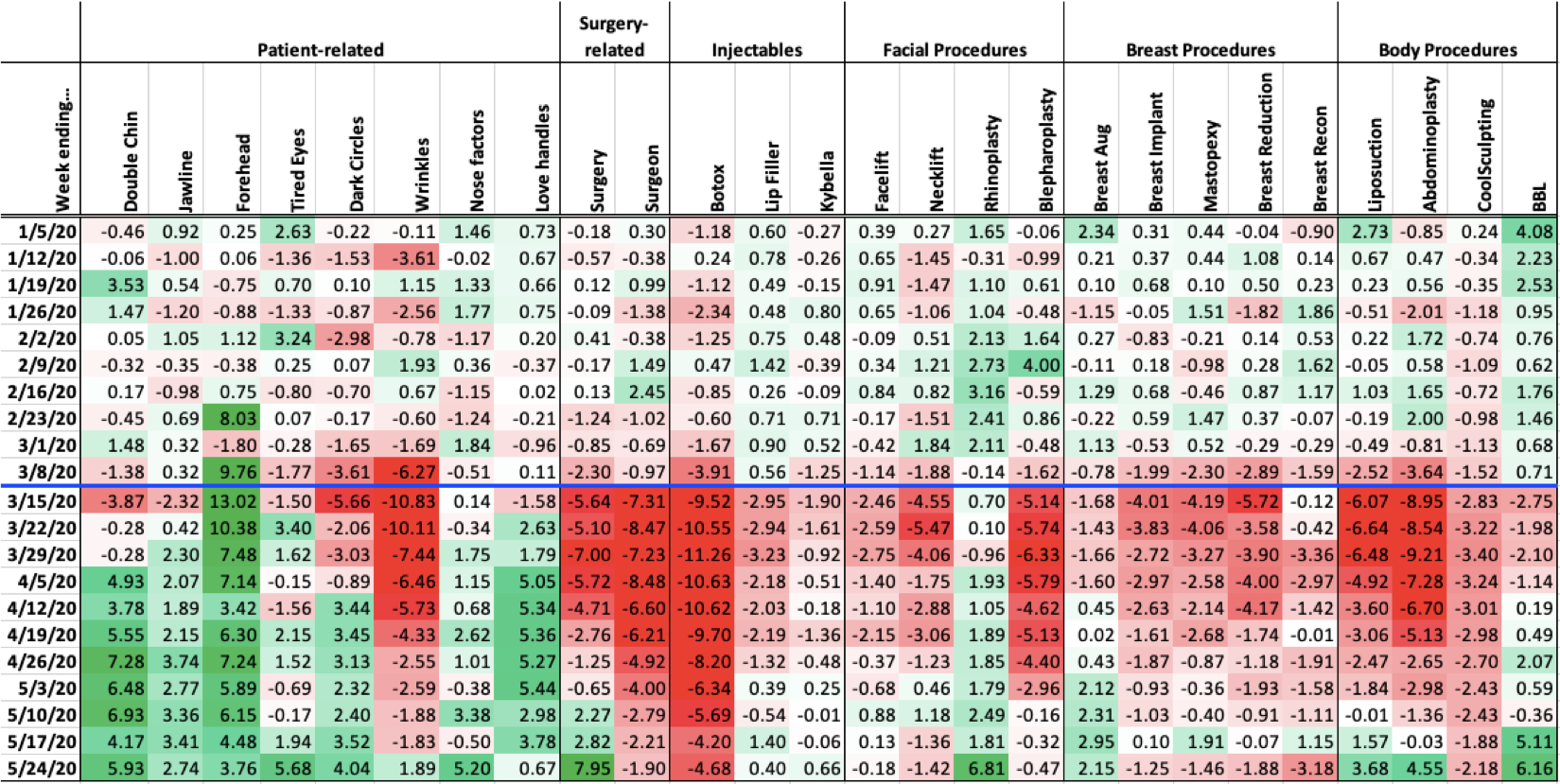
:In Part I, of the 156 significantly anomalous search term data points in 2020, 126 (80.8%) occurred after week 11 (national emergency declaration) (Fig 1). 61% of searches in all all time-points after week 11 were significantly different, and 21/26 (80.8%) of search terms experienced significant changes after week 11. Eighteen terms saw decreased interest with variable recovery. Onset of declining interest varied between weeks 10-12 (with the exception of “bbl” OR “brazilian butt lift” in week 9). Six of these terms recovered to normal or increased search volumes between weeks 15-18; another sixare approaching full recovery, while five show slow or stalled recovery. Procedural nadirs (lowest search volume) for search volume troughs occurred between weeks 12-14. Four patient-related chief complaints saw increased search interest, with onset during weeks 10-14, peak interest between weeks 12-15, and no return to expected levels. In Part II, 704 out of 838 responses were included. Half of respondents were female; median age group was 25-34 years. During the pandemic, 21% of respondents had increased and 33% decreased interest in at least one intervention. Non-invasive procedures (7.3%), facial aesthetic surgery (6.6%) and medical-grade skincare (5.9%) elicited the greatest interest increase. Seeing themselves in the mirror more often (43.2%), desire to look better after the crisis (41.8%), and increased time on social media (40.4%) were the top reasons for increased interest. The most common reasons for decreased interest were changing spending priorities (58%), focusing on other health aspects (49.8%) and worrying about infection in medical facilities (46.3%). Almost half of respondents considered virtual consultations for interventions of increased interest.
Conclusion
:Conclusions: This is the first study to assess real-time, national data about the impact of COVID-19 on public interest in aesthetics. Google search data serves as an interest proxy and demonstrates an almost universal change in public interest from expected norms and varied rates of normalization. Amazon Mechanical Turk survey analysis enabled a segmentation of the public into groups of patients and how and why their interest has changed. Offering telemedicine, establishing detailed COVID-19 infection control policies, and discussing these with patients will be critical to address patient needs and concerns. Understanding the public’s dynamic interest in aesthetic offerings can facilitate resource allocation and procedure prioritization as practices reopen.