Data-Driven Assessment of Instagram Use By Plastic Surgeons
As 49% of all plastic surgery patients and the majority of patients undergoing cosmetic procedures are between 40 and 54 years old (according to the American Society of Plastic Surgeons [ASPS]), the rise of social media represents an opportunity for plastic surgeons to diversify their offering and educate/ communicate directly with a new patient demographic. While current guidelines exist to establish social media best practices and ensure the ethical use of these tools, there is no evidence- based consensus on how plastic surgeons can maximize the reach of their social media presence. The aim of this study is to provide the plastic surgery community with a comprehensive account of Instagram use and to leverage the large amount of publicly available data for optimal use by operators of active and future accounts.
Methods/Technique
:A list of US- listed plastic surgeons, current as of December 1st, 2019, was generated from the ASAPS webpage. Instagram accounts (and all posts associated to all accounts) associated to individual surgeons were identified manually. Engagement rates were calculated as the quotient of mean likes on ten most recent posts and number of followers. Engagement rates were categorized as: very low (less than 1%), low (1 to 6%), average (6 to 12%), high (12 to 20%), and very high (greater than 20%). Accounts were ranked by engagement rate, number of followers, and date of first post.
Results/Complications
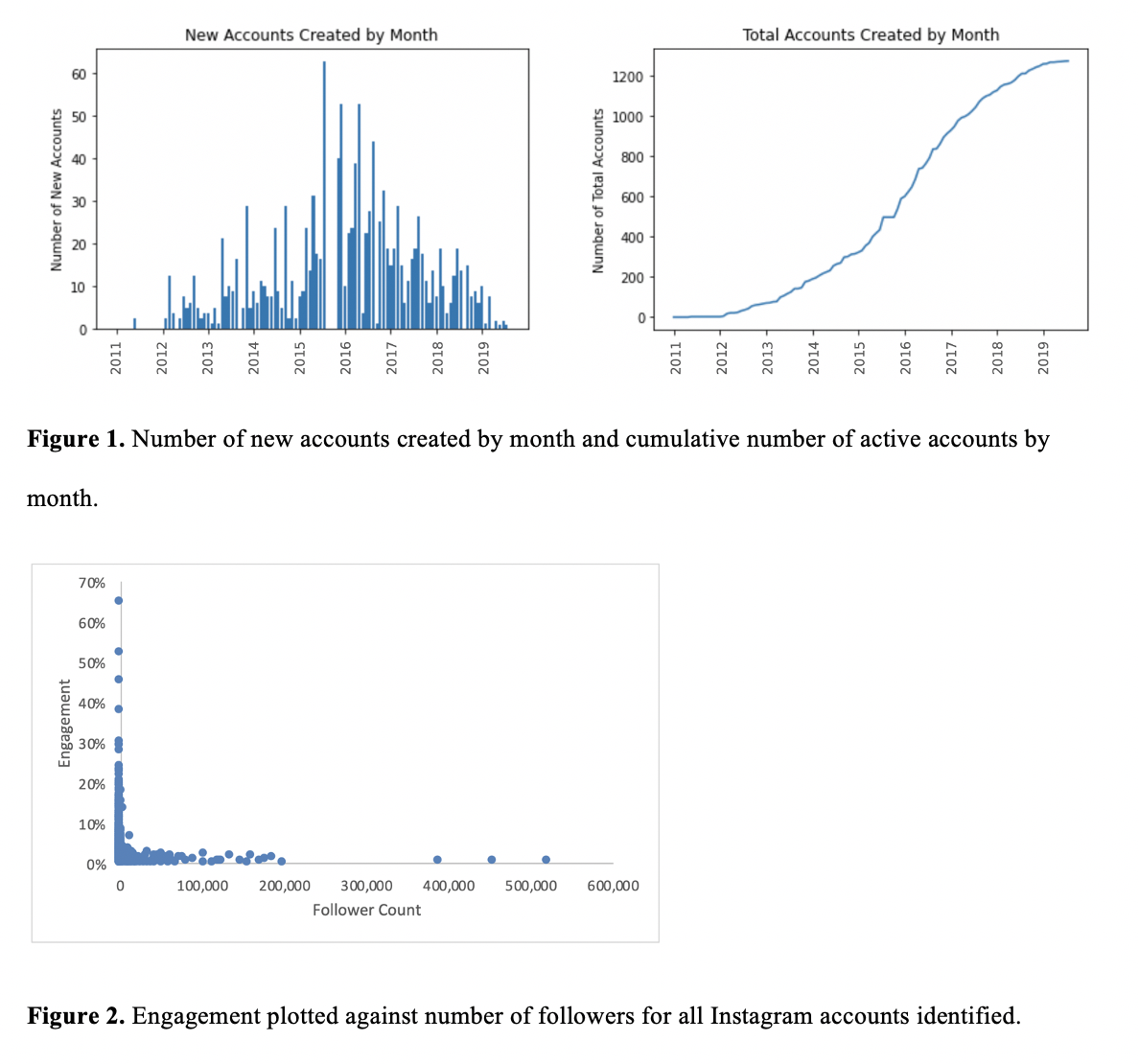
:Across 2,183 US- based ASAPS members, we identified accounts associated to 58.2% (n= 1,272) of plastic surgeons. The mean number of followers was 5,894 (range 0- 521,896), while the mean number of accounts following was 805 (range 0- 7,507). The mean number of posts per account was 311 (range 0- 4,909). The first account was created in July 2011 (Figure 1). Mean engagement was 7.5% (range 0- 660%) (Figure 2). Across all accounts, we identified 395,537 posts. The mean number of likes was 133 (range 0- 45,588). The mean caption length was 46 words (range 0- 441) and 354 characters (range 0- 2,283 characters). The most common hashtags used were #plasticsurgery (28.1%, n= 111,023), #plasticsurgeon (13.9%, n= 54,787), and #cosmeticsurgery (9.3%, n= 36,840). The most common discrete words used were “patient(s)” (23.2%, n= 91,775), “skin” (18.1%, n= 71,646), and “call” (15.9%, n= 62,952).
Conclusion
:Previous studies have summarized use of social media, specifically Instagram, by plastic surgeons. Others have described ethical best practices for sound adoption. This is the first study to 1) exhaustively quantify adoption of Instagram by members of a professional society of plastic surgeons and 2) plot adoption over time and elucidate the period of exponential adoption between January 2013 and December 2016 (r2= 0.98 over that range). This is consistent with worldwide adoption of social media, and with a previous finding published by Chartier et al. that a few cautious early adopters in the field of plastic surgery pave the way for rapid adoption by the critical mass. With nearly 60% of ASAPS- affiliated plastic surgeons having an Instagram account, our data supports the claim that members of the plastic surgery community have made it a priority to establish themselves on social media. It is also worth noting we identified seventeen plastic surgeons with “influencer” accounts (> 100,000 followers) and 102 with micro- influencer accounts (between 10,000 and 100,000 followers). Further study of “influencer” plastic surgeons is necessary to gain a more granular understanding of their outsized popularity.