Evaluating National Trends for Autologous Graft Use in Primary and Revision Rhinoplasties
Rhinoplasty is one of the most common and complex procedures performed by plastic surgeons yearly. The evolution of this intricate technique has led surgeons to utilize a wide range of cartilaginous grafts for functional and aesthetic purposes. To visualize the evolution of cartilaginous graft use, we decided to evaluate the trends over the course of 15 years and evaluate to track adverse events.
Methods/Technique:
This is a retrospective cohort review from 2003 to 2018 using the Tracking Operations and Outcomes for Plastic Surgeons (TOPS) database. The dataset was queried using Current Procedural Terminology (CPT) codes for primary and secondary rhinoplasties with grafts and indication codes (20910, 20912, 30400, 30410, 30420, 30430, 30435, 30450, 30460, 30462, 30465, 30520, 21230, 21235). These codes correspond to costochondral cartilage, nasal septum grafts, primary rhinoplasty (lateral and alar cartilages and/or elevation of nasal tip), complete primary rhinoplasty (external parts including bony pyramid), primary rhinoplasty including major septal repair, secondary rhinoplasty minor revision, secondary rhinoplasty intermediate revision, secondary major revision, osteotomies with repair of vestibular stenosis, repair of nasal vestibular stenosis, septoplasty or submucous resection, rib cartilage and auricular cartilage, respectively. Of note, nasal septal graft code is counted as separate if used for sites other than septum. Septal graft is inherently attached to the rhinoplasty codes. We paired every consecutive year for interpretability of results and graphs. The frequency of auricular, costochondral, rib and septal grafts were analyzed by year groups. Categorical variables are described as frequencies and compared with Fisher’s exact or Pearson’s Chi-squared test. Continuous variables, based on normality, are described as means (SD) or medians (IQR) and compared with Wilcoxon Rank-sum or Student’s T-test.
Results/Complications:
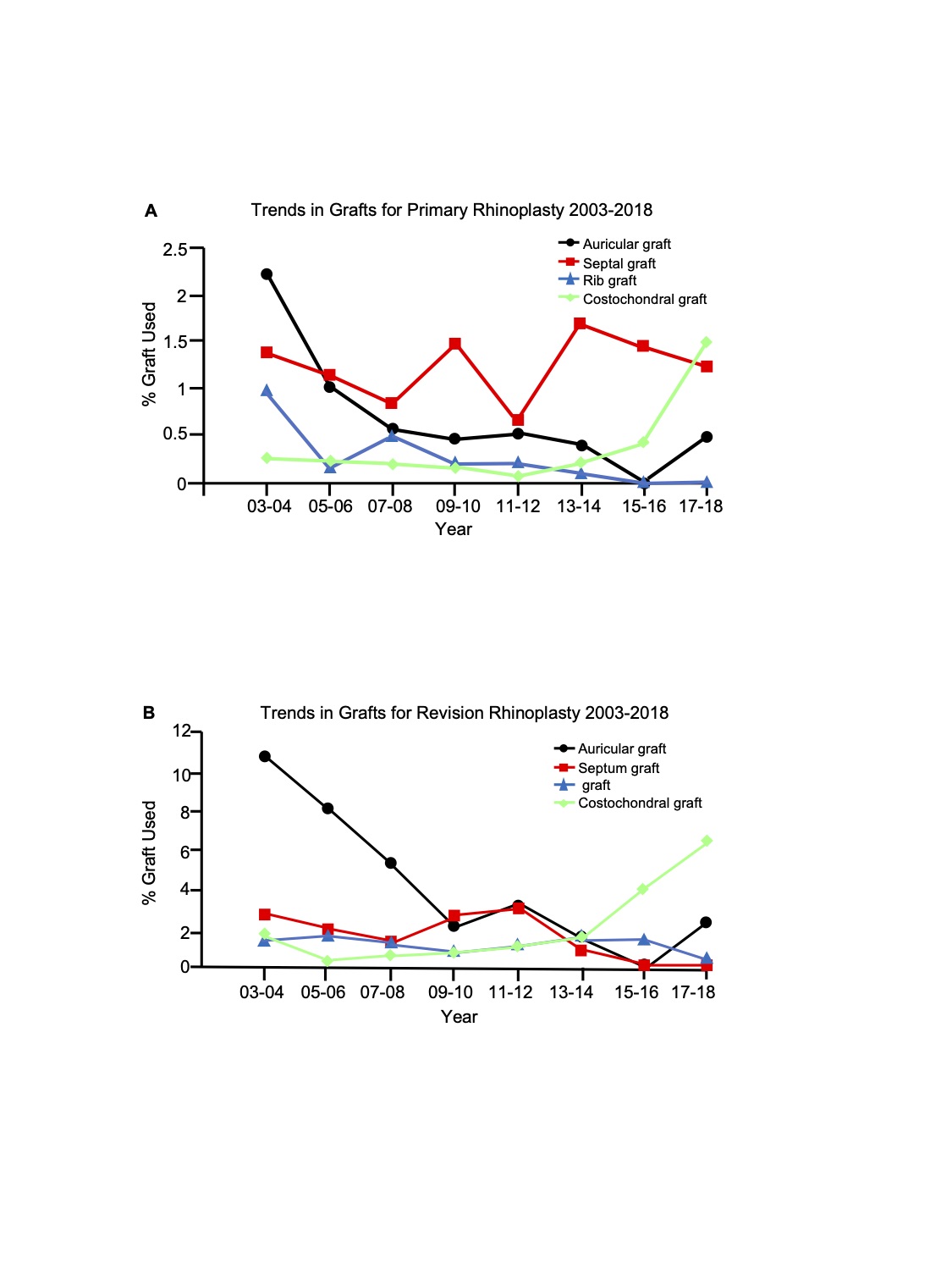
A total of 11,800 rhinoplasties were included (median age 30y [21-43]) and 75.61% female). We analyzed 10,050 (85.2%) primary and 1,750 (14.83%) secondary or revision rhinoplasties. We found a statistically significant change in frequency of rib (p:0.01), costal (p:<0.001) and auricular graft (p:<0.001) with auricular graft showing the most significant decrease (3.99% in 2003-04 to 0.67% in 2017-18) and costochondral with an increase (0.52% to 2.01%). For primary rhinoplasties a similar statistically significant trend for grafts was seen, with the highest change in auricular (2.62% in 2003-04 vs. 0.5% in 2017-18; p: <0.001) and costal with a trend towards increase (0.25% in 2003-04 vs. 1.5% in 2017-18; p: <0.001) (Figure 1A). Interestingly, in the secondary rhinoplasty group there was only a statistically significant difference for auricular graft with a noticeable decrease from 10.73% in 2003-04 to 2.13% in 2017-18 (p: 0.001) and costochondral having an increase from 1.58% in 2003-04 to 6.38% in 2017-18 ( p:0.004) (Figure 1B). Septal graft remained stable in all groups; however, as stated above, the “septal graft” group on the reported data is strictly used as a separate code when used on a separate site other than septum. In addition, there was no statistically significant difference in adverse event rate throughout the years for overall (p:0.38), primary (p:0.48) and secondary rhinoplasties (p:0.52). We found the highest rate of adverse events in the 2009-10 group in overall (1.97%) and primary rhinoplasties (1.85%). This group had septal graft used most frequently. While for secondary rhinoplasties, the highest frequency of 3.22% was seen in 2007-08 when rib and additional septal graft were used with the same frequency.
Conclusion:
The results from this study show that there is a recent preference in the use of costal grafting predominantly in revision rhinoplasties, while the use of auricular grafts have decreased over time. Nevertheless, this does not seem to have an impact on adverse events and may correlate with potential benefits in functional and aesthetic outcomes.