Early Experience with the Use of the Interi System to Facilitate Internal Wound Control after Abdominoplasty
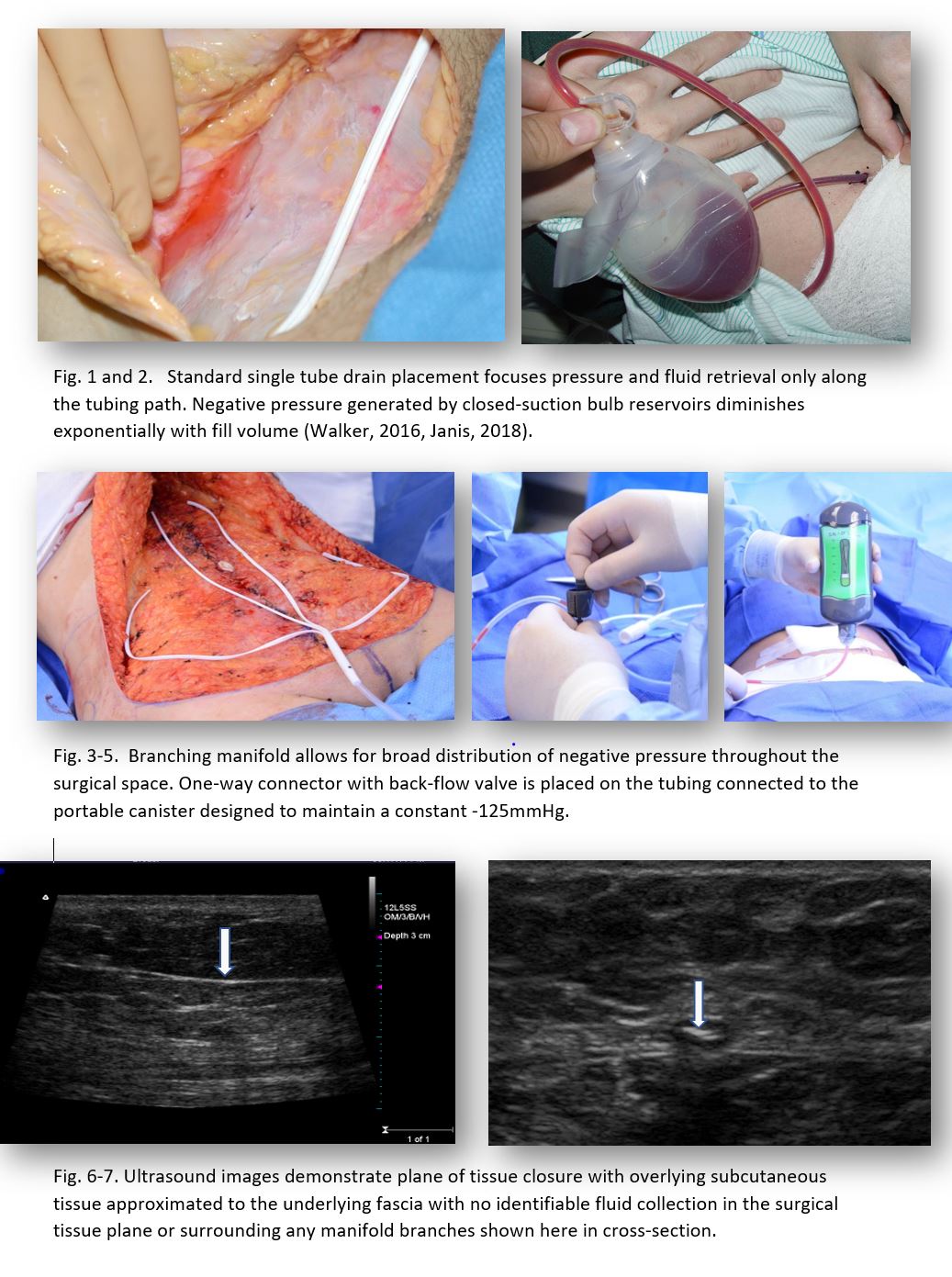
Seroma formation and poor wound healing following major surgical procedures are the most common complications in plastic surgery Strategies have been reported to reduce complications related to seroma formation, but none have proven superior. Current technology and surgical approaches are often inadequate in closing surgical dead space, and largely fail at reducing post-operative fluid collections. Surgical drains are the most common device used to manage this problem; however their suction effect diminishes exponentially as fluid accumulates. Drains only manage fluid directly around them leading to potential fluid collections and seromas at distant sites within the surgical plane (Fig.1-2).
We describe a novel system including a branching 4-channel internal manifold attached to a one-way connector and portable, enclosed pump canister system designed to deliver a constant -125mmHg throughout the entire surgical space without electrical power. A First-in-Man pilot clinical study was undertaken to evaluate the clinical safety and functionality of the system in 24 full abdominoplasty patients. Clinical assessments and ultrasound were performed during the 30-day post-operative period to assess wound healing, presence of seroma, and adverse events. Surgeon and patient assessment of system performance were also evaluated.
Methods/Technique
:A WIRB pilot clinical study (#20162287) was performed at 3 separate practice locations by 3 board-certified plastic surgeons in 24 patients. Full abdominoplasty was performed in female patients, average age 40.6 years [Range 25-63] and average BMI of 25.1 [Range 20-29]. All four branches of the manifold were opened completely and evenly distributed throughout the surgical field following flap elevation (Fig.3). The connector was attached to the tubing and secured to the pump/canister (Fig. 4-5). Patients were evaluated on POD 1,3,7 and POD 30 for final assessment.
Per protocol, all manifolds were removed on POD 7 (fluid drainage was <20 ml in preceding 24 hours). High resolution ultrasound was performed in 8 patients at each follow-up visit at Site #1. Wound and exit site assessments for seroma, erythema, swelling, adverse events were documented at each follow-up visit. Surgeons and patients provided a subjective assessment of their personal experience with the system as well as the ease of removal.
Results:
The average volume of drainage recorded a mean of 551mL [Range 240mL - 2205mL]. One outlier patient was identified who experienced 2205mL of postoperative drainage following 5L of lipoaspirate without developing a postoperative seroma.
The average tissue flap resected measured 764 cm2 [Range 288 cm2-1350cm2]. Erythema of the surgical site at POD’s 7 and 30 was essentially zero. Swelling at the operative site POD 7 was 0.3 (0-4.0 scale) and essentially zero at day 30. No adverse events were reported including no skin edge necrosis, no wound dehiscence and no wound infections. Importantly, there were no clinical seromas reported on physical exam in any patient at any Site (n=24) and no fluid collection detectable on ultrasound in any patient at Site #1 (n=8) at any postop visit and including POD 30 (Fig 6-7).
Subjectively, 100% patients were very satisfied with the system function and pain reported was 0.5 (Pain scale 0-5.0). Independent testing, reported separately, of the pump/canister demonstrates maintenance of constant negative pressure from no fill to maximal fill.
Results/Complications
:See "Conclusion: "
Conclusion
Multiple strategies have been described for closing surgical dead space and minimizing postoperative fluid collections reducing associated surgical complications. Suturing techniques, drains and glues are perhaps the most common approaches employed to address this challenge; however, drain technology has not significantly changed in decades. Recent studies have reported the mechanism of action and benefits of constant negative pressure wound therapy (Orgill, 2009). Likewise, two independent studies (Walker, 2016 and Janis, 2018) have demonstrated that standard closed suction drains do not maintain suction or negative pressure as canisters fill with fluid.
We describe the use of a novel 4-prong, branching manifold capable of delivering constant negative pressure (-125mmHg) in 24 abdominoplasty patients with no clinically identified (n=24) or ultrasound-detected (n=8) fluid collections at 30 days postoperatively or other significant complications. The system was well-tolerated by all subjects demonstrating an effective method of closing tissue planes and removing fluid in abdominoplasty patients and confirming the findings of previous reports comparing devices delivering constant vs diminishing internal negative pressure in the management of postoperative fluid collections.
Fig. 1 and 2. Standard single tube drain placement focuses pressure and fluid retrieval only along the tubing path. Negative pressure generated by closed-suction bulb reservoirs diminishes exponentially with fill volume (Walker, 2016, Janis, 2018).
Fig. 3-5. Branching manifold allows for broad distribution of negative pressure throughout the surgical space. One-way connector with back-flow valve is placed on the tubing connected to the portable canister designed to maintain a constant -125mmHg.
Fig. 6-7. Ultrasound images demonstrate plane of tissue closure with overlying subcutaneous tissue approximated to the underlying fascia with no identifiable fluid collection in the surgical tissue plane or surrounding any manifold branches shown here in cross-section.