Utility of Fresh Frozen Rib Cartilage Grafts in Revision Rhinoplasty – an 8 Year Review
Revision rhinoplasty is undoubtedly one of the most challenging procedures in facial plastic surgery. The complexity is compounded when there is a paucity of native septal cartilage to perform the required framework reconstruction. The traditionally reliable and robust cartilage source is autologous costal cartilage, but this can result in trepidation by the patient to pursue intervention due to the additional surgical site, and associated potential morbidity. Harvest of autologous costal cartilage also results in increased operative times, and possible secondary site complications like contour irregularity, poor scarring, and even pneumothorax. Irradiated rib graft has been criticized for its tendency to resorb in the long term, resulting in poor outcomes with external nasal distortion or loss of structure. Over the past 8 years, the senior author has utilized fresh frozen rib cartilage grafts ( FFRG) from MTF Biologics which is only treated with gamma radiation, similar to all food products over the past 60 years. The availability of FFRG provides the surgeon with various selections of age and contour of specific rib cartilage, while avoiding the morbidity associated with harvesting autologous rib graft, and the disadvantages of irradiated rib graft. Our study investigates the outcomes and rate of revision surgery associated with FFRG cartilage in comparison to autologous and irradiated costal cartilage in revision rhinoplasty.
Methods/Technique:
A retrospective review was conducted of the senior author’s (R.J.R.) patients from 2011 to 2020 who underwent primary or revision rhinoplasty. Long term outcomes were assessed for patients who had MTF FFRG used and any complications encountered in long term follow-up. Inclusion criteria included patients with fresh frozen ‘off the shelf’ cartilage used in revision rhinoplasty only with a minimum of 1-year follow-up. A total of 400 patients were reviewed and 220 met the inclusion criteria. Outcomes for evaluation were warping, resorption, displacement, and infection. Our data was compared to the reported complication rates in published plastic surgery literature utilizing autologous, and irradiated rib grafts.
Results/Complications:
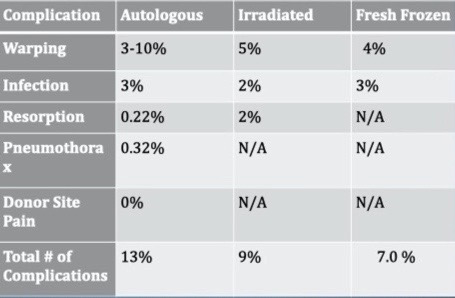
In our retrospective cohort, there was a 4% warping rate (two required operative revision which were dorsal onlay grafts), a 3% infection rate but only one required operative dorsal graft removal and all others were successfully treated with antibiotics. Four patients experienced nasal tip erythema in the early post-operative period without additional findings for infection, which resolved within 2-3 weeks without surgical intervention.
Our results compare very favorably to reported rates of complication in autologous and irradiated rib graft ( see table 1) . Previously reported complication rates of autologous grafts included 3-10% for warping, 0.22% for resorption, 3% for infection, 0.39% for displacement, 5.45% for hypertrophic chest scarring, and 0%-0.32% (95% CI) for pneumothorax.1 Previously reported complication rates with irradiated rib included 5% for warping, 2% for resorption, 1% for contour irregularity and infection rates up to 2%.2
Table 1: Complications for Autologous, Irradiated and Fresh Frozen Rib Grafts
Conclusion:
The results in revision rhinoplasty are significantly enhanced with the creation of stable nasal framework using off the shelf, easily accessible, specifically tailored fresh frozen cadaveric rib grafts. The long-term outcomes and complication rate in our 8 year retrospective study demonstrates the safety of fresh frozen rib graft in comparison to autologous or irradiated rib graft.
References:
- Wee JH, Park MH, Oh S, Jin HR. Complications associated with autologous rib cartilage use in rhinoplasty: a meta-analysis. JAMA Facial Plast Surg. 2015 Jan-Feb;17(1):49-55. doi: 10.1001/jamafacial.2014.914. PMID: 25429595.
- Vila PM, Jeanpierre LM, Rizzi CJ, Yaeger LH, Chi JJ. Comparison of Autologous vs Homologous Costal Cartilage Grafts in Dorsal Augmentation Rhinoplasty: A Systematic Review and Meta-analysis. JAMA Otolaryngol Head Neck Surg. 2020 Apr 1;146(4):347-354. doi: 10.1001/jamaoto.2019.4787. PMID: 32077916; PMCID: PMC7042943.