AI in the Face of Aesthetic Surgery: Assessing Demographic Bias in Visual Representations
This study investigates the representation of plastic surgeons in artificial intelligence (AI)-generated images, aiming to identify potential demographic biases and their implications. Given the increasing use of AI in medicine and the existing disparities in the surgical field, this research seeks to assess whether AI visuals accurately reflect the diversity of plastic surgeons or perpetuate—or even exaggerate—existing inequalities. By examining the outputs of prominent AI text-to-image generators, this study aims to shed light on the potential for AI to either reinforce or challenge stereotypes, with consequences for both the medical profession and public perceptions of plastic surgery.
Methods/Technique
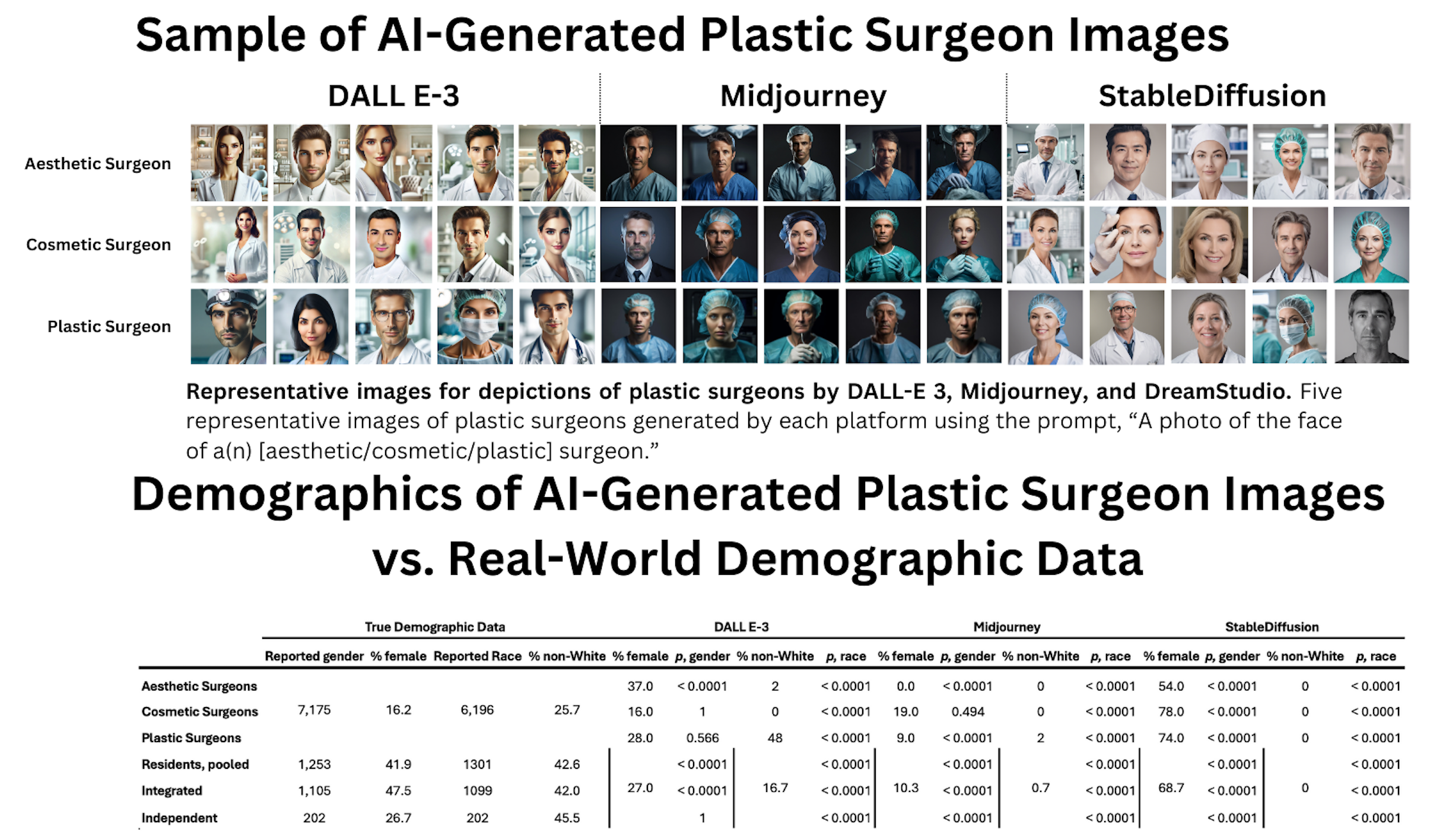
:Three popular text-to-image generators were used to assess potential demographic biases in AI-generated images: DALL-E 3, Midjourney, and StableDiffusion. Each model was prompted with the phrase "a photo of the face of a [surgeon type] surgeon," using the terms "aesthetic," "cosmetic," and "plastic" to generate 100 images per term per platform, resulting in a total of 900 images. Three blinded independent reviewers categorized each image by gender (i.e., male/female) and race (i.e., White/non-White), using Fitzpatrick skin types 1 & 2 as a guideline for "White" and types 3-6 for "non-White." We compared the proportion of female and non-White surgeons in the AI-generated images to the demographic data of practicing plastic surgeons in the United States, based on the 2018 American Medical Association Physician Masterfile. Likewise, we drew these comparisons to demographic data regarding plastic surgery residents based on the 2022-2023 ACGME Data Resource Book. Fisher's exact tests were used to assess the significance of these analyses, with α = 0.05.
Results/Complications
:Analysis of over 900 AI-generated images from DALL-E 3, Midjourney, and StableDiffusion revealed significant discrepancies in demographic representation compared to real-world data. DALL-E 3 overrepresented women when prompted with "aesthetic surgeon" (p < 0.0001) but underrepresented them relative to resident demographics when data from all terms’ images (i.e., "aesthetic,” "plastic," "cosmetic") were pooled (p < 0.0001). Midjourney underrepresented women for images using the terms "aesthetic" (p < 0.0001) and "plastic" (p < 0.0001) surgeons, while StableDiffusion overrepresented them across all prompts. Racial disparities through these platforms were considerably more pronounced. DALL-E 3 underrepresented non-White individuals as "aesthetic" (p < 0.0001) and "cosmetic" (p < 0.0001) surgeons but had more diverse representation for "plastic" surgeons (p < 0.0001), mirroring resident demographics more than those of practicing plastic surgeons. Midjourney and DreamStudio severely underrepresented non-White individuals across all prompts (p < 0.0001). Notably, DALL-E 3 often depicted “cosmetic surgeons” as males wearing makeup (i.e., quite literally, cosmetics), and some images occasionally portrayed surgeons as patients, highlighting the occasional inaccuracies of these platforms.
Conclusion
:This study highlights the concerning potential for AI to amplify existing gender and racial disparities within plastic surgery. While increasing diversity amongst trainees offers promise, the significant biases observed in AI-generated images, particularly the underrepresentation of women and non-White surgeons, can negatively impact self-perception, career aspirations, and patient perceptions of the field. This is particularly troubling given the already existing real-world gender disparity between patients and providers in aesthetic surgery, where female patients, who comprise 93.4% of aesthetic patients per The Aesthetic Society in collaboration with CosmetAssure, may particularly benefit from the perspectives of other female surgeons who can better empathize with their patients’ experiences. The relative accuracy and diversity of DALL-E 3, potentially due to its user-feedback driven design inherited from its predecessor DALL-E 2, suggests that incorporating such mechanisms can mitigate bias in AI models. We urge other platforms to adopt similar strategies to promote inclusivity and avoid the dissemination of harmful stereotypes. Furthermore, it is crucial to educate trainees and practicing surgeons on the potential for AI-generated images to misrepresent the field, thereby shaping public perception and influencing career decisions. By acknowledging and addressing these biases, we can strive towards a more equitable and inclusive future for plastic surgery.