A Minimally Invasive Midface and Neck Lift Utilizing a Novel Suturing Device
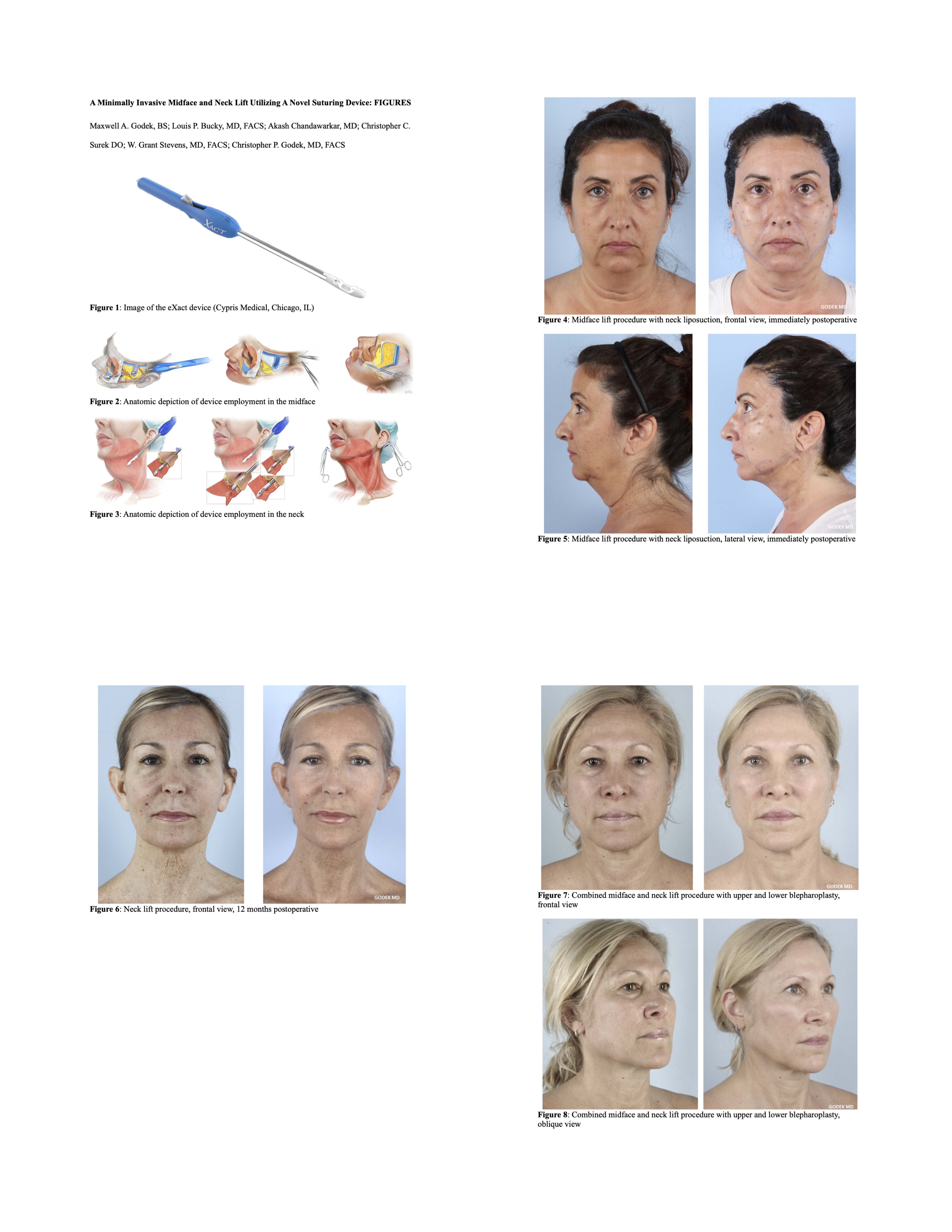
The direct suture suspension approach to midfacial and neck rejuvenation is a reliable procedure. However, this can be technically difficult to achieve through a small remote incision without the use of an endoscope. Therefore, we have developed a surgical suturing device using a novel 'needle and hook' mechanism (Figure 1) to purchase and pass sutures through targeted tissue for a minimally invasive, modified face and neck lift procedure without the need for an endoscope. Through direct suture suspension, the midface lift is achieved from a temporal incision whereas the neck lift is achieved from a posterior auricular incision. We aim to describe this minimally invasive surgical procedure utilizing this novel suturing device for midfacial and neck lifting and present our initial, multi-surgeon and institution, clinical experience.
Methods/Technique:
Our midface lift was developed based upon previously described endoscopic, midface procedures. Access to the cheek fat pad is made through a temporal incision. A temporal tunnel is then created at the level of the deep temporal fascia and proceeds over the zygomatic arch in a pre-periosteal plane. (Figure 2) The pre-zygomatic space is then entered in a blunt fashion where the cheek fat pad can be captured with our suturing device. The cheek fat pad is then suspended from the deep temporal fascia for optimal correction of midface descent. (Figure 2)
Our neck lift was developed based upon previously described small incision, pre-plastsymal procedures. Access to the platysma is made through a posterior auricular incision. A tunnel is then created at the level of the mastoid fascia and proceeds antero-inferiorly in a pre-superficial musculoaponeurotic system (SMAS) plane. (Figure 3) The pre-plastysmal space is entered through continuation of blunt dissection such that the platysma can be captured with our suturing device. The platysma is then suspended from the mastoid fascia for optimal correction of neck laxity. (Figure 3)
Our multi-center, multi-surgeon initial clinical experience included 267 patients. A bilateral direct suture suspension midface lift and neck lift without the use of an endoscope facilitated by use of the eXact Device (Cypris Medical, Chicago, IL) was performed in 97 and 104 patients, respectively, between 2016-2023. A total of 66 patients underwent a combined bilateral midface and neck lift procedure with the use of the eXact Device during this same time period. All patients were followed for at least 6 months to assess for complications and qualitative improvement using two-dimensional standard photography. (Figures 4-8) A subset of these patients (n=9) were followed in an IRB approved study up to 3 years post procedure to assess for patient reported outcomes, patient satisfaction, clinical visual assessment, and surgeon usability. Where available, three-dimensional imaging with marker-less tracking technology was used to assess for magnitude and vector of midfacial and neck movement and volume recruitment.
Results/Complications:
Our initial experience involves 97 midface, 104 neck, and 66 combination lift procedures utilizing this device. Before and after images are provided in Figures 4-8 to demonstrate the aesthetic results achieved through these procedures. There were no device failures or device-related complications. Excellent tissue purchase was achieved in every case. Patients are typically socially acceptable at 5 to 7 days post procedure. Postoperative complications were limited to dimples in 2.2% of cases (6 patients), most of which resolved within 2 weeks with gentle massage. In 2 cases, in-office subcision under local anesthesia was required to release small dimples in the cheek which did not resolve with massage therapy. There were no instances of neurapraxia, hematoma, infection, or extrusion. Patients required limited narcotics and pain management. Average follow-up is 42 months. Results have been durable out to 3 years with high patient satisfaction.
Conclusion:
The midface, neck, and combination lift utilizing a novel suturing device described in this report provides an additional option for patients wishing to undergo minimally invasive facial rejuvenation. Our initial experience with over 250 patients in both the midface and neck demonstrates the safety of the device and the effectiveness of this procedure.