Public Engagement with Plastic Surgery Education: Analyzing Tiktok Plastic Surgeon Influencer Content
Methods/Technique: We used Google and TikTok searches to identify the top 10 most followed English-speaking plastic surgeon influencers on TikTok, whose 50 most recent videos all had at least 1,000 views. For each surgeon, we reviewed their latest 50 videos, along with the top 3 pinned videos (as of October 14, 2024), focusing on those related to educational content in surgery, medicine, general health, healthcare, health policies, or medical training. Two independent reviewers then analyzed each video for popularity metrics, including views, likes, comments, saves, and shares. They also assessed the target audience, content, format, tone, and engagement methods, with defined inclusion criteria for each category. We defined popularity as videos receiving at least 500,000 views, 50,000 likes, or 1,000 comments. Analysis for each category was not mutually exclusive.
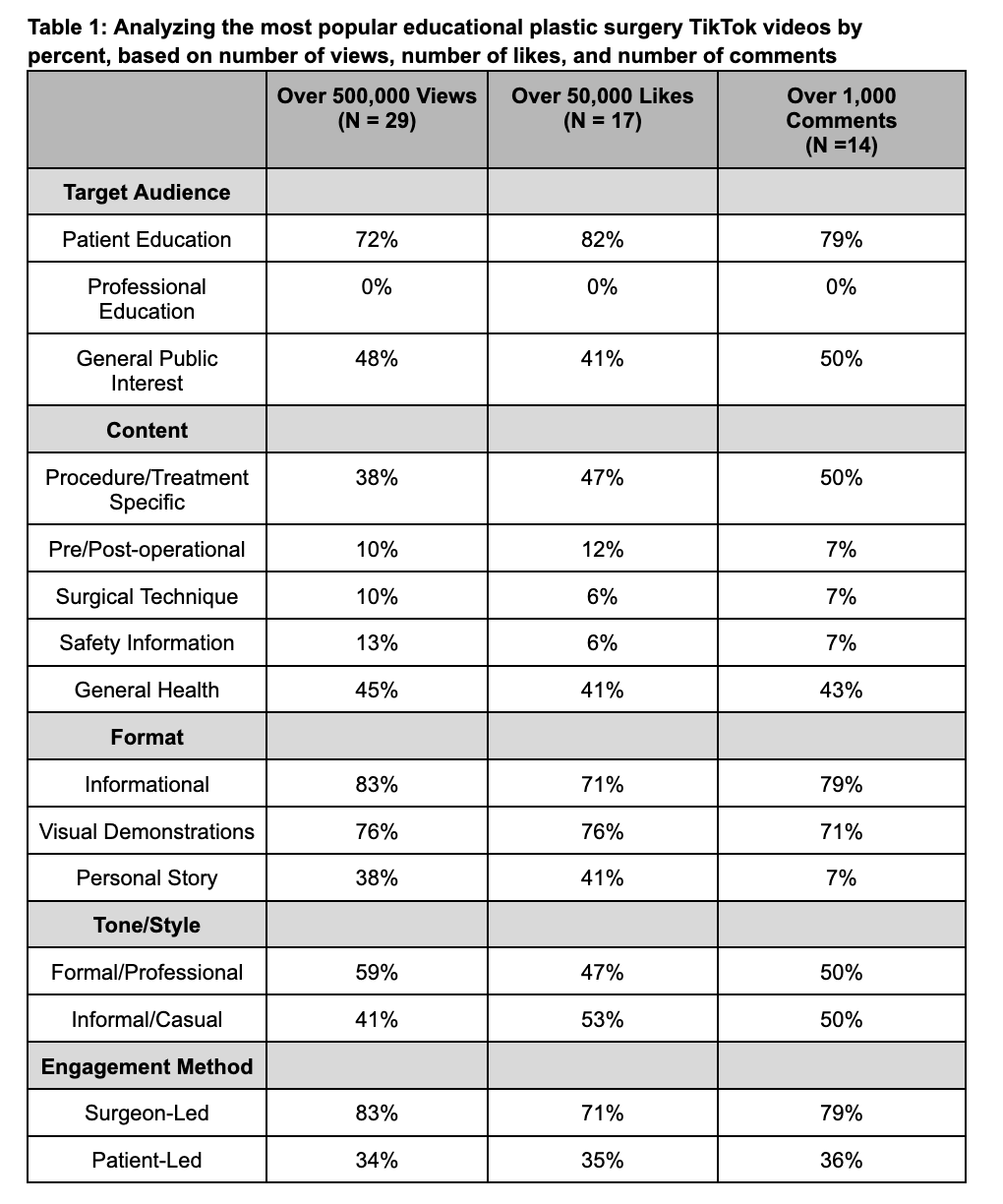
Results/Complications: Out of 530 potential TikTok videos, we found 241 videos to fit within our inclusion criteria for educational content (45%). Majority of the videos centered on educating patients (76%). In addition, 36% of the videos targeted general public interest, while only 1.2% focused on educating other healthcare professionals. Regarding content, 60% of the videos provided procedure- or treatment-specific information, outlining indications, risks, and benefits. Pre-operative and post-operative education appeared in 32% of the videos, covering topics such as before-and-after care and visual comparisons. Additionally, 8% of the videos discussed specific surgical techniques used during procedures. Plastic surgeon influencers also shared general health education in 27% of videos, addressing topics like nutrition, exercise, skincare, aging, and healthcare policies. Most videos followed an informational format (79%), typically featuring the surgeon speaking directly to the camera. Visual demonstrations, including images, diagrams, models, or related videos, were used in 70% of the videos. Surgeons maintained a formal or professional tone in 68% of the videos, though 30% included educational content with an informal or humorous approach. Most videos (84%) featured narration by the surgeon, while 34% included patient-led stories or examples. Of the 241 videos, 29 (12%) had over 500,000 views, 17 (7%) had over 50,000 likes, and 14 (6%) had over 1,000 comments (Table 1). Half of the influencers had more than 50% educational content. Dr. Anthony Youn, the most followed plastic surgeon influencer, had 47% educational content, while Dr. Prem Tripathi led with 92% educational content.
Conclusion: Our study demonstrates that a significant portion of content produced by plastic surgeons on TikTok is educational, with high engagement rates, particularly for videos focused on patient education, specific procedures, and general health. These findings highlight the potential for TikTok to serve as a valuable platform for disseminating medical knowledge, reaching a wide audience, and shaping public perceptions of plastic surgery. This study may be limited by selection bias, since only English-speaking influencers were analyzed, and subjective video categorization. Future research could broaden the range of influencers studied, including non-English-speaking and less-followed accounts. Additionally, use of surveys could explore the impact of these educational videos on patient decision-making and outcomes, as well as the effectiveness of different content styles in enhancing public understanding of plastic surgery.