Opioid Prescription Disparities in Non-English Speaking Patients Following Most Common U.S. Aesthetic Surgeries
control leads to quicker ambulation and return to work, and decreased rates of DVT/PE, chronic pain, and
opioid dependence. Non-English-speaking patients frequently encounter difficulties communicating with
the medical system, and previous studies in other surgical fields suggest discrepancies in post-operative
pain management between English-speaking and non-English-speaking patients. In this study, we aimed
to evaluate whether primary spoken language affects postoperative pain management prescriptions
following aesthetic surgery.
Methods/Technique: This study utilized TriNetX, a global health research platform that compiles data from electronic medical
records in real-time. Ninety-seven healthcare organizations and 134,328,422 patients were queried for
patients with a lifetime history of at least one of the United States’s top five aesthetic surgeries
(liposuction, breast augmentation, abdominoplasty, mastopexy, or blepharoplasty), documented as
SNOMED or CPT codes. TriNetX demographic codes for spoken language differentiated patients into
two cohorts: English (En) and non-English (nonEn) speakers. Sub-cohorts were also broken down into (1)
English, non-Spanish (En/nonSp); (2) Spanish, non-English (Sp/nonEn); and (3) non-English, non-
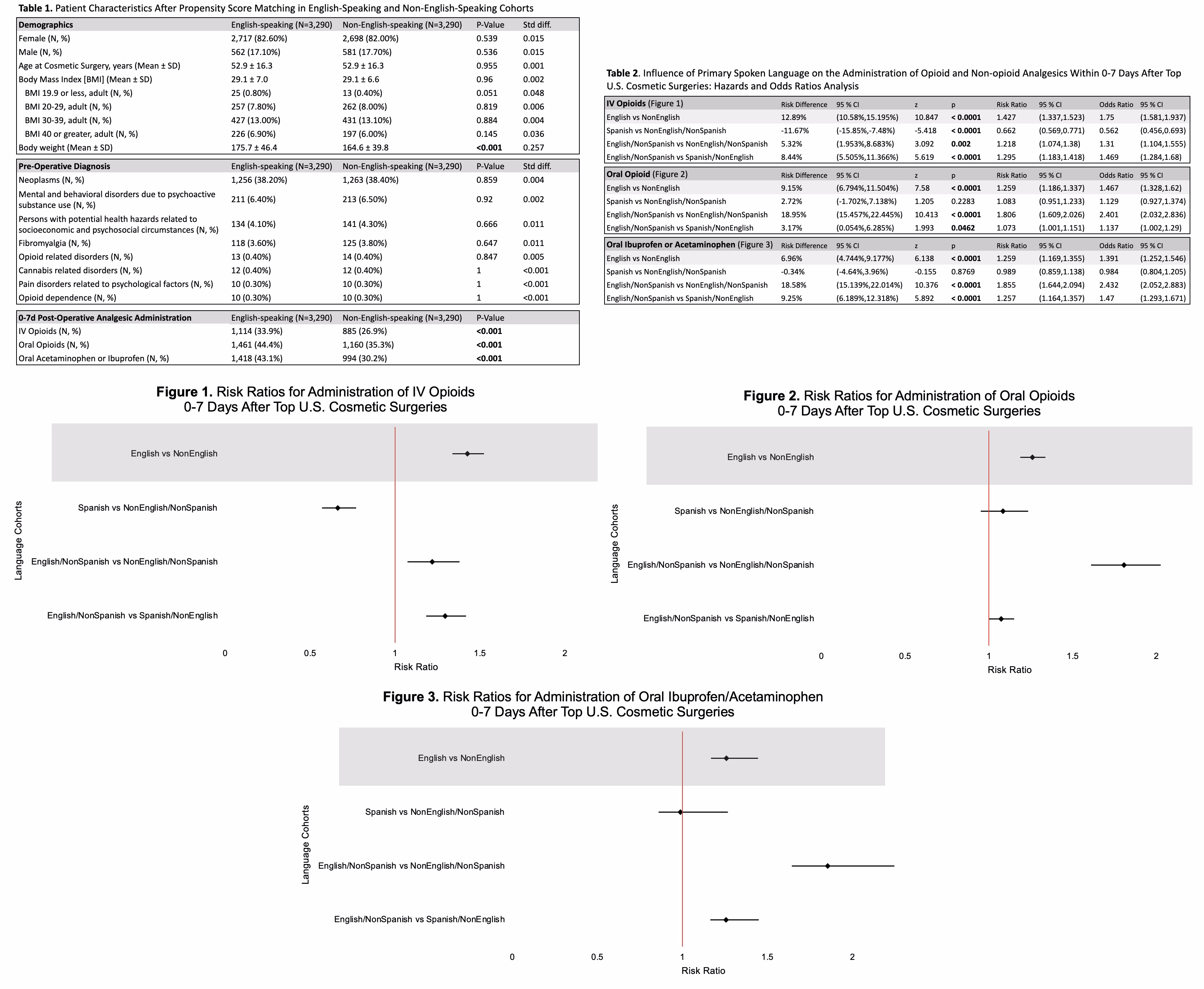
Spanish (nonEn/nonSp) speakers. Propensity score matching was performed on thirteen characteristics
that included patient age at first aesthetic surgery, sex, BMI, body weight, substance use, pain disorders,
neoplasms, and socioeconomic and psychosocial circumstances. Risk analysis compared the proportions
of patients prescribed intravenous opioids, oral opioids, and oral acetaminophen or ibuprofen 0-to-7 days
after surgery across groups. Risk difference, risk ratio, and odds ratio were calculated for each pair of
cohorts.
Results/Complications: This study utilized TriNetX, a global health research platform that compiles data from electronic medical
records in real-time. Ninety-seven healthcare organizations and 134,328,422 patients were queried for
patients with a lifetime history of at least one of the United States’s top five aesthetic surgeries
(liposuction, breast augmentation, abdominoplasty, mastopexy, or blepharoplasty), documented as
SNOMED or CPT codes. TriNetX demographic codes for spoken language differentiated patients into
two cohorts: English (En) and non-English (nonEn) speakers. Sub-cohorts were also broken down into (1)
English, non-Spanish (En/nonSp); (2) Spanish, non-English (Sp/nonEn); and (3) non-English, non-
Spanish (nonEn/nonSp) speakers. Propensity score matching was performed on thirteen characteristics
that included patient age at first aesthetic surgery, sex, BMI, body weight, substance use, pain disorders,
neoplasms, and socioeconomic and psychosocial circumstances. Risk analysis compared the proportions
of patients prescribed intravenous opioids, oral opioids, and oral acetaminophen or ibuprofen 0-to-7 days
after surgery across groups. Risk difference, risk ratio, and odds ratio were calculated for each pair of
cohorts.
Conclusion: English-speaking patients were significantly more likely than non-English speaking patients to receive
opioid prescriptions following aesthetic surgery. Additionally, English-speaking patients were more likely
to receive prescriptions for multimodal pain control regimens. Our data suggests there may be broad-scale language-based disparities and potential under-treatment of pain in non-English speaking aesthetic surgery patients. Plastic surgeons may aim to establish standardized postoperative pain-control protocols to reduce language-based discrepancies in postoperative pain management.