Alloplastic Midface Augmentation and Concomitant Soft Tissue Maneuvers Optimize Aesthetic Results and Longevity in Patients with Negative Vector Morphology
Methods/Technique: During the period January 2020 - July 2022 a retrospective review was conducted of 143 patients with neutral or negative vector midface morphology treated with soft tissue modification alone (referred to as "non-alloplastic group") or with soft tissue modification and porous polyethylene midface implants (referred to as "alloplastic group"). Soft tissue maneuvers in both groups included microfat grafting, deep plane or subperiosteal midface lift, transconjunctival or subciliary lower blepharoplasty with fat transposition, and lateral brow/lateral retinacular suspension. Patient data were extracted from records and retrospective analysis performed in compliance with the Declaration of Helskinki. Linear and volume measurements of inferior orbital and midface aesthetics were made, and qualitative evaluations included vector analysis (malar eminence to anterior globe point), scleral show (inferior limbus to lash line distance), infratarsal fullness (5 point Likert scale), tear trough deformity effacement (5 point Likert scale), and lid-cheek junction to lash line distance (mm). Correlation with pre-operative vector analysis was made, and pre- vs post-operative differences were computed with statistical analysis performed for significance.
Three routes of dissection (trans-oral, trans-temporal and trans-conjunctival) gave full access to the midfacial skeleton to facilitate implant placement. A novel trans-temporal technique was used in patients who required simultaneous lateral brow and canthal suspension with or without midface lift, whereas trans-oral access facilitated vertical subperiosteal midface lift. Trans-conjunctival access facilitated implant positioning, mini screw implant fixation and lower blepharoplasty fat transposition.
Results/Complications: Follow-up period ranged 7-48 months with a mean and standard deviation of 16.3 +/- 6.1 months. In the alloplastic plus soft tissue group, inferior orbital rim and midface (IOR/MF) projection increased by a mean of 3.7 mm +/- 0.2, whereas in the soft tissue only group projection was increased 2.3 +/- 0.2 mm and the difference was statistically significant to p value < 0.05. Qualitative change from negative to positive vector occurred in all patients of the alloplastic group and 16% of the non-alloplastic group and partial correction the remainder. A visible reduction of scleral show, elevation of lid-cheek junction and increased infra-tarsal fullness were greater by alloplastic augmentation with soft tissue maneuvers as compared with soft tissue maneuvers alone. Failure of aesthetic improvement was not seen in any alloplastic case, however recurrence of deformity was non-zero in the non-alloplastic group. No major complications were observed in any patient. Minor complications were noted in the alloplastic patient cohort with one inflammatory reaction requiring an extended course of antibiotics, one temporary frontal branch neurapraxia, one temporary lagophthalmos, and one patient with mild asymmetry and implant palpability. A novel algorithm for combined alloplastic midfacial skeletal augmentation and periorbital soft tissue shaping is presented. The principles, technique and outcomes of prefabricated implants, their indications, endoscopic and non-endoscopic approaches for placement, and concomitant soft tissue adjuncts for comprehensive treatment of the concave midface are given.
Conclusion: Alloplastic augmentation of the mid facial skeletal with concomitant soft tissue maneuvers offer superior and durable aesthetic results. As porous polyethylene implants offer reliable augmentation of the midfacial skeleton, ease of use and an excellent safety profile, they should be considered for the treatment of patients with neutral and negative vector morphology.
Figure:
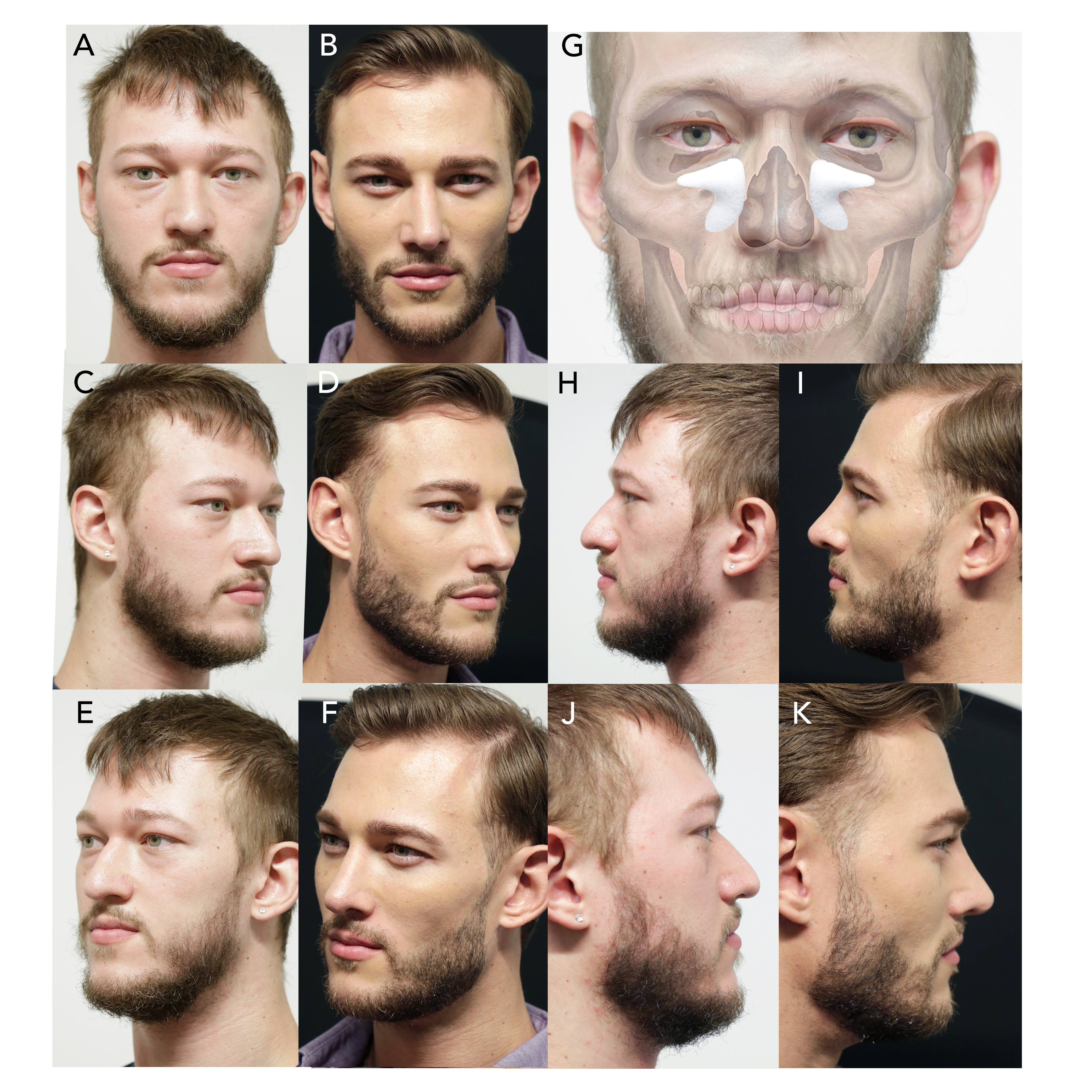
28 year old man treated with porous polyethylene inferomedial orbital rim implants via trans-conjunctival approach, midface fat grafting, lower blepharoplasty with fat transposition, neck lift, buccal fat reduction and closed rhinoplasty in two surgical stages. A, C, E, H, J: pre-operative appearance; B, D, F, I, K: post-operative results 31 months post-operatively; G: schematic of skeletal implant overlay.