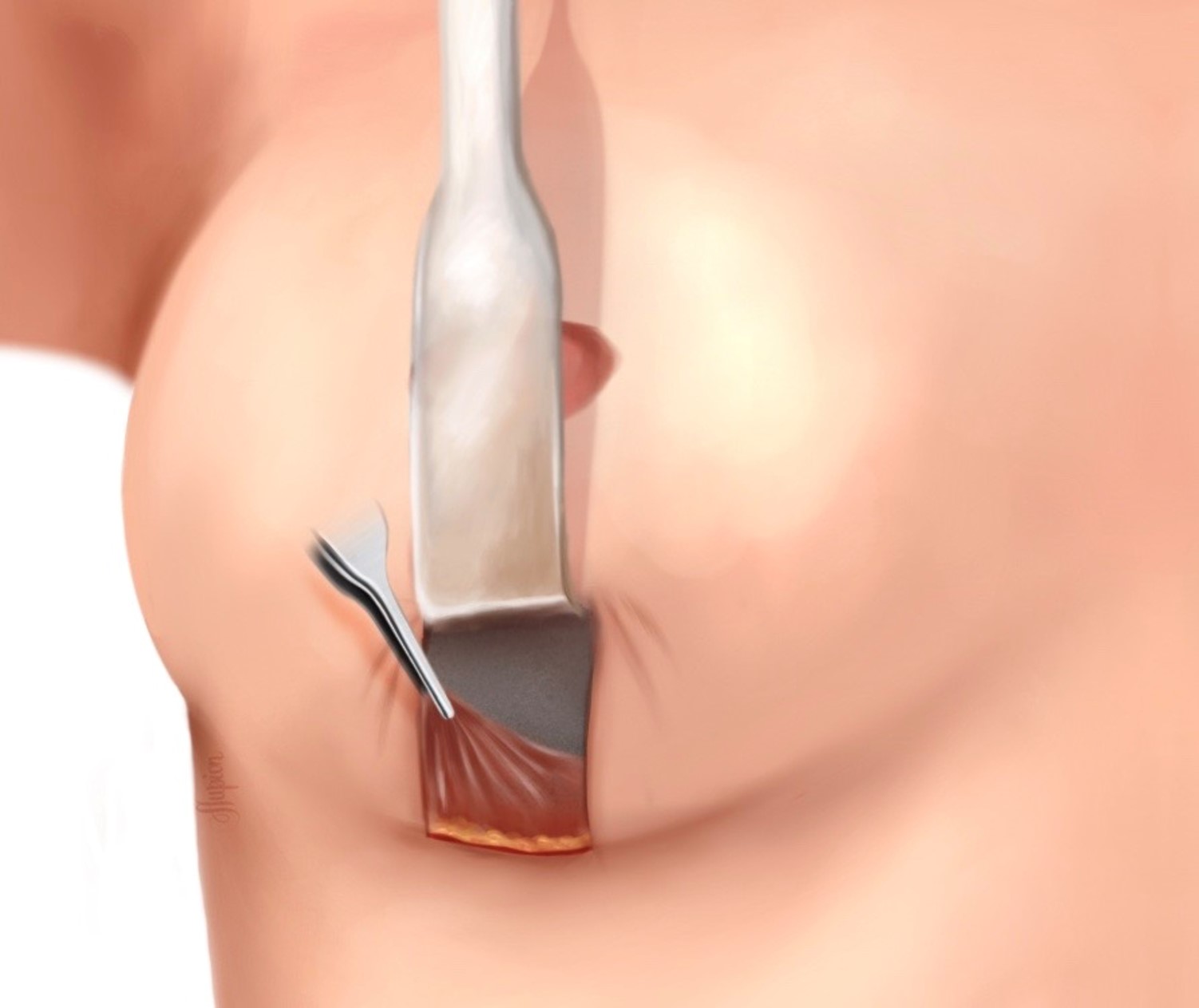
Smooth Implants in Subfascial Pocket - How to Maintain a Stable and Natural Breast Shape?
Methods/Technique: The authors' technique for breast augmentation proposes the following:
- create a precise subfascial pocket for the smoothsilk® implant, avoiding lateral displacement.
- prefer choosing smaller volume of implants.
- elevate some pectoral muscle fibers superomedial, at the upper pole; and
- preserve an inferior fascial or myofascial flap to avoid slide down the implant and to protect exposure
Technique description: The markings were made with the patient in stand position. The midline was marked preserving 1cm at least to medial dissection to avoid synmastia. The anterior axillary line is marked, and the dissection pocket is marked according to the implant dimension. The incision is positioned in the inframammary fold. The muscle fibers that will be dissected superomedial are marked too.
An infiltration was made with adrenaline solution 1:100.000 just in the inframammary fold. The incision is made, three to four centimeters (cm), including skin and subcutaneous tissue. The direction of the incision is oblique until reaches the pectoral fascia, three to four cm above the inframammary fold.
The fascia is opened with electrocautery at this point and the pocket is undermined subfascial superiorly respecting the footprint at the skin performed preoperatively. Avoidance of lateral dissection is fundamental. Inferiorly the pectoralis muscle fibers are undermined together with the fascia until the inframammary fold, creating a myofascial flap. Superior Medially some muscle fibers are spreading with electrocautery to maintain implant protection and to avoid implant visibility.
The implant is placed with keller funnel after hemostasia, and antibiotics solution placed in the pocket. When the implant is inside the pocket, subfascial superiorly and submuscular inferiorly, the myofascial flap is sutured to the fascia superiorly with nylon 3-0 sutures. The subcutaneous tissue is closed and the final suture at the skin is done with absorbable sutures. (Video)
Results/Complications: The myofascial flap in subfascial pocket was performed in 100 patients for breast augmentation from July 2017 from July 2024. In all cases, smooth silicone implants were used. No major adverse health events or infection occurred. Before using the inferior flap, we had two cases of lateral displacement and one rotation, but in mastopexy augmentation. After improving the technique with the myofascial flap, no flips and displacement occurred. We observed more stable results and avoidance of the bottoming out.
Conclusion: The use of smooth implants can be a challenge for the surgeon to avoid malposition and rotation. The importance of creating a precise and super-tight pocket is very important to create stability for the implants. The association of a precise pocket, spreading muscle fibers superomedial, and the inferior myofascial flap can be successfully reproduced by other surgeons, creating more stable results and avoiding displacement, bottoming out and complications.